Tortellini with Tomato Sauce

This is what Eats for One is all about.
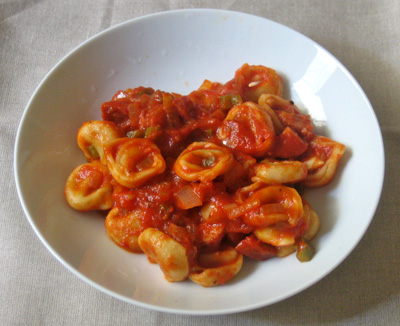
tortellini served

tortellini served

You have noted my harping on the creative use of leftovers; Monday’s lunch presented a perfect example. In order to have leftovers, you have to have meals (duh!), and this is what I had been cooking.

About a week ago, I made a K Paul Meatloaf and had half a green bell pepper left over. I put it in a baggie and stuck it in the crisper.

Last Wednesday I made a pan stew of scallops, peas and pearl onions. The recipe –from the Tra Vigne Cookbook – calls for 1/2 pound fresh pasta in a shape about the size of a pearl onion. I usually use conchiglie (little shells) or gigli (little lily) but this time I used fresh cheese tortellini, which comes in a ten ounce package. So I had some fresh pasta left over.

Thursday, I cooked Swordfish Provencal from a recipe I found on the Beyond Salmon blog. It calls for a 28 ounce can of diced tomatoes, drained. I saved the juice/puree in a POM jar.

Saturday, I made braised chicken thighs with tomato, capers, anchovies & olives from a Janet Fletcher story on chicken thighs in the Chronicle. It calls for a 28 can of whole peeled tomatoes, drained. More drained goodness. In both cases, I used cans of Italian San Marzano tomatoes; they’re more expensive, but well worth it.

Looks like lunch.

I put a pot of water on to boil. While that was going on, I diced the bell pepper put it on to sauté in olive oil, about 5 minutes. While the pepper softened I chopped half an onion and put that in with the pepper (another 5 minutes). I diced an Aidells Cajun Style Andouille (not left over) sausage and threw that in followed by the tomato sauce and seasoned it with salt, pepper and thyme. While the sauce cooked down a bit, I cooked the pasta (3 minutes), drained it and added to the tomato mixture. I let that bubble a little to get the flavors all going together, and served myself a nice lunch.

EATS ON THE ROAD
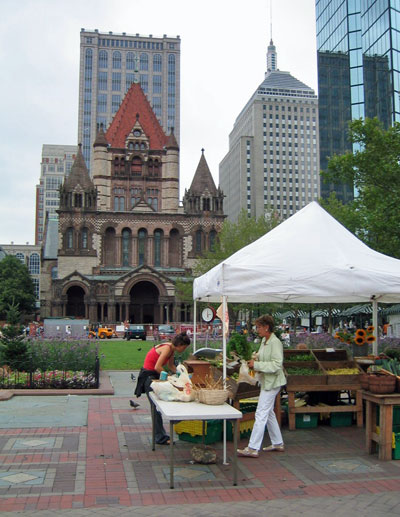
Copley Square, Boston

Copley Square, Boston

Eats for One is going on the road to see friends and sights in Boston and spend Thanksgiving with sons Eric and Brian in Maine, where Eric is raising his own turkey. I’ll surely have tales to tell when I get back.

Eric -- out standing in his field
Eric -- out standing in his field
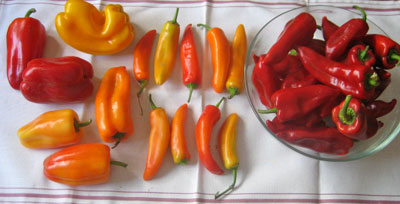
Roasting Peppers

“3 red, or colored peppers, roasted, seeded and peeled”

That’s often all the recipe says about the peppers. Everyone has their own roasting method and I’ve tried them all. Recently, the Mariquita Mystery Box was chock full of colored peppers, and not only that, Carol wanted an extra bag of Red Piquillo Roasting Peppers to make her famous pimento cheese spread.

m_lode_o_peppers.jpg

a mother lode of peppers

Roasting peppers takes time. My go-to method is to hold a pepper over a gas flame until blackened, put it in a paper bag to ‘steam’ and then scrape off the skin with the back of a knife. Easy, effective, messy, takes time. Since I had 15 assorted peppers (Hungarian Spicy Peppers and other red and yellow) plus an equal number of the Piquillo to deal with, I thought I’d check out another method, so I went on line to Cook’s Illustrated and searched for roasted peppers. Here’s what CI had to say:

‘After flaming, broiling, and baking dozens of bell peppers of every color, both whole and sliced, we find that slicing and oven-broiling the peppers yields superior results.’

STEP BY STEP: Steps to Perfect Roasted Peppers
Pre-heat the broiler for at least 5 minutes.
1. Slice 1/4 inch from the top and bottom of the pepper.
2. Gently remove the stem from the top lobe.
3. Pull core out of the pepper.
4. Slit down one side of the pepper, then lay it flat, skin side down, in one long strip. Use a sharp knife to slide along the inside of the pepper removing all ribs and seeds.
m_cleaned.jpg
5. Arrange the strips of peppers on a baking sheet, skin-side up. Flatten the strips with the palm of your hand.
6. Adjust oven rack to its top position. If the rack is more than 3 1/2 inches from the heating element, set a jelly-roll pan, bottom up, on the rack under the baking sheet.

m_broiled.jpg

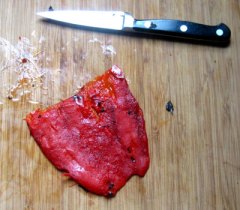
7. Roast until the skin of the peppers is charred and puffed up like a balloon but the flesh is still firm. You may steam the peppers at this point or not, as you wish. Start peeling where the skin has charred and bubbled the most. The skin will come off in large strips.

m_peeled_too.jpg

Sorry CI, that’s just WRONG.

The peppers turned out leathery and really really hard to peel, and why not, cut open, spending time in the broiler dries them out. I don’t know what equipment CI used, but I used a countertop convection oven, which is relatively new, reliable and holds its temperature very well.

C’mon CI: You’re usually reliable, but sometimes you over analyze. Continue reading

Lard

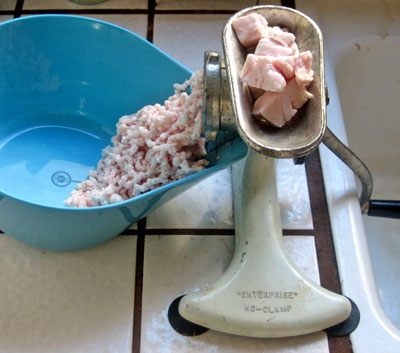
lard_14.jpgA few weeks ago, the Chronicle Food Section ran a story by James Temple called Loving Lard. While noting the bad rep of lard, it focused on top restaurants that are using lard for its nutrition and flavor. It included a detailed history of cooking fat, as well, from lard to Crisco, to “the other white meat” and back to the present yearning for flavor, moist, flavorful pork and yes, lard.This came at an appropriate time, as there have been enough murmurings in the foodie community to raise my curiosity and desire to cook with lard myself; but I didn’t know where to start. Viola! The article, as well as educating me, told me where to go.At the Golden Gate Meat counter at the Ferry Building on Saturday morning, I asked a butcher if they had lard. “Do you want the leaf lard?” he asked. Remembering something about leaf lard being the best, I said yes, and he handed me a shrink-wrapped packet of white matter, about two pounds.When I got home, I whacked off a bit and melted it to fry some potatoes for breakfast. Yum.I re-read the article and learned that my leaf lard needed to be rendered, a simple, but two-day process. This is what it looks like.

lard_2.jpg

leaf lard comes from the area around the abdomen and kidneys

lard_3.jpg

my meat grinder handed down from my mother… or perhaps her mother

Continue reading

Pappardelle with a ragu of tiny meatballs

    pappardelle.jpg

My brother and his wife were coming on Friday from South Carolina and I wanted to cook, rather than sample a fine San Francisco restaurant; specifically, I wanted to make pasta. I remembered seeing a scrumptious picture of pappardelle with tiny meatballs in Jamie Oliver’s book, Cooking with Jamie. Love pappardelle, love meatballs, it looked easy and could be made in stages. What’s not to like? I was so pleased with the idea, that we invited my nephew and his lady friend, as well.That same week, I was browsing the Cookbook section at Books, Inc and saw a stupid simple idea in the new A-16 cookbook: they use raw tomato sauce for their pizza. Just run San Marzano tomatoes through the medium disk of a food mill. I can do that!

san_marzano.jpg     early_girl.jpg

san marzano                           early girl


Generally, I use San Marzano tomatoes for sauce, but sometimes I like Early Girl tomatoes; they’re not as rich, but bright and tomatoey. I happened to have a couple pounds of them. I reckoned that a sauce of Early Girls, beef broth and red wine would work just fine. I was thinking of a brothy sauce rather than a saucy sauce.Another neat feature of this dish is that my brother, who likes to cook, could roll meatballs with me and catch pasta coming out of the roller while the girls have a glass of wine and kibitz.
Continue reading

Urban Farm Tour

Friday Sept 12, Urban Farm Tour, 10 am – 3:30 pm

Join CUESA for a tour of two urban farms: Happy Quail Farms in East Palo Alto and Alemany Farm in San Francisco. Farmer David Winsberg will take us on a tour of his greenhouse and shade houses that are home to hundreds of varieties of peppers. He’ll also walk us through his vegetable patch, introduce us to his flock of chickens, and treat us to a tasting of Happy Quail peppers.Next we’ll head to Alemany Farm, the largest farm in San Francisco. Manager Jason Mark will show us around this unique farm that provides fresh, organic food and creates jobs for residents of a nearby public housing development.

As a person who loves living in the city, and also loves fresh local produce, I had to sign up.Happy Quail Farms

    uft1_gathered.jpg

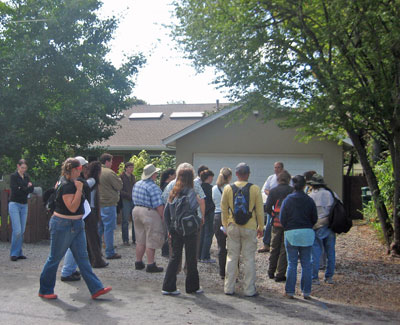
We got off the bus onto a suburban street of 1950’s tract houses. David Winsberg — facing the group — noted that he grew up on a 300-acre vegetable farm in Florida and when he moved to the Bay Area in 1984, he harvested quail eggs and sold them to sushi restaurants in the area, hence the name. This area of East Palo Alto was planned to be self sustaining, the residents, primarily Japanese, living on the street and farming the “back yard” of the one-acre lot. Now, the individual farms are a thing of the past, and David and his wife Karen farm their back lot and lease or “use” others to make up their two-acre farm.

    uft2_enter.jpg

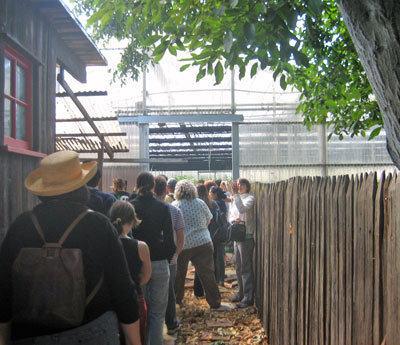
We entered the narrow passage between houses, not quite knowing what to expect.

    uft3_passage.jpg

We found a huge greenhouse — nearly one-acre — where they grow primarily peppers and cucumbers, getting an early start on the season.

    uft4_dry_peppers.jpg

Just outside the greenhouse entrance, peppers are dried and ground to make paprika.
Continue reading

KETCHUP

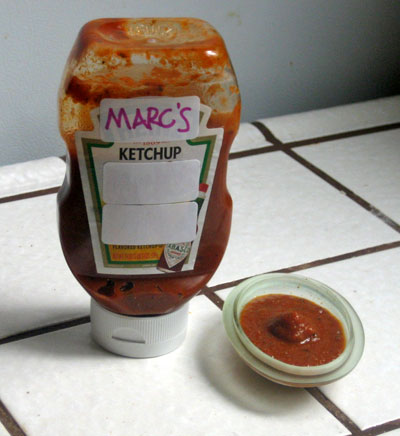
k_bottle.jpgWhy on earth would a person want to make his own ketchup?My wife saw Jamie Oliver make ketchup on his TV show and told me about it. I had no intention of actually making ketchup, but I downloaded the recipe from the Food Network website, just in case.

[Yes, I know, I’ve just done two other posts involving Jamie Oliver. It’s just that he’s doing tomatoes right now and they’re in high season. Besides, his cooking is simple and good.]

Continue reading

Meat the Manchurian Mothership

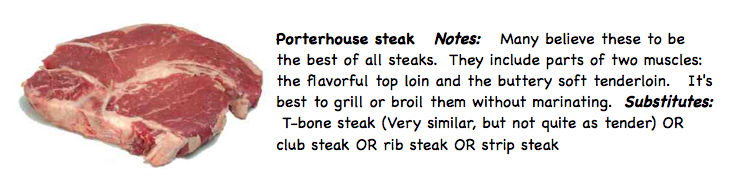
Grilled Porterhouse Steak sliced over Mashed Manchurian Shell Beans with Jamie’s Mothership Tomato Sauce.Sounds like something that might be on a “menu changes daily” restaurant menu. Actually, it’s what I made for dinner Friday night.It all started at the Marin Sun Farms stand at the Farmers Market. I was in the mood for steak and looking for a New York strip steak when I came across this big gorgeous Porterhouse. It cost $24, but was easily big enough for two meals. Oh boy.porterhouse.pngphoto: Cooks ThesaurusSlow Food Nation was over and the week was warm and lovely in San Francisco. I was in a grilling frenzy — grilled chicken thighs over summer vegetables and grilled brats with cabbage in a sweet sour sauce led off the week. I got the Porterhouse out of the meat drawer and showered it with salt and pepper. Now what?Manchurian shell beans are similar to Cranberry beans. I had some in the fridge that were crying to be used. In the same vegetable drawer was a head of broccoli. Leftover tomato salad could be used to complete the meal; all I needed was a method.
Continue reading

SLOW FOOD NATION

Slow Food Nation will bring together thousands of people: most will eat, drink and talk, a few will sing and dance, some will argue, and many will reflect, laugh out loud and learn. The legacy of these few days in San Francisco is that the conversations begun here will bloom into projects, changes, new passions and careers. Let’s work together to expand this moment of celebration, to build on the foundation of the broader food movement, and to create a food system for all Americans that is healthy, socially just, affordable and delicious.” From the Welcome, Slow Food Nation Program

img_lets_go_slow.jpg

FLASHBACK

In the summer of 2001, not yet aware of Slow Food, my wife and I made a road trip from son Brian’s house in Tifton, Georgia, just north of the Florida border, to son Eric’s house in Monroe, on the mid-coast of Maine. Our goal was to avoid interstates and to avoid fast food. We failed. Here’s what I said in my journal:

“When you get to the outskirts of Greenville, SC however, it’s Strip City; six lanes of it out US29 stretching for miles toward Spartanburg. We passed legions of McDonalds/Burger King/IHOP/Waffle House looking for a diner or some such place with real food, but finally relented and had “breakfast” at Burger King… sausage biscuits, hash nuggets (whatever they’re called) & coffee. The strip narrowed to four lanes and became almost unstriplike, but then, over the next hill, it got strippy again, getting ready for Spartanburg.”

Continue reading

Spicy Beef

divide and dish

Jack Sprat could eat no fat
His wife could eat no lean
And so betwixt the two of them
They licked the platter clean

steak_poblano.jpg     beans_beef.jpg

Cooking for two can present problems at times.I love beans. My wife tolerates beans. I can get away with a bean dinner about once a fortnight, so I satisfy my beans Jones at lunch with the leftovers when she’s away.I love spicy food. My wife is averse to spicy foods to the point where she says it’s painful. How can something so good for one, affect another in such a completely diverse way?Our experiences of the past two days illustrate a story of steak and chiles and leftover steak and other chiles; a wholly unsatisfactory dinner (for one), a delight (for the other), and ultimate harmony.It all starts with a flank steak. We both love flank steak. A flank steak is about 1 1/2 pounds — way too much for dinner for two — so leftovers make a second meal (or more).I do most of the menu planning and cooking — Carol has a real job — and I like to try new stuff. I saw a recipe in the Chronicle by Joyce Goldstein for Grilled Skirt Steak on a Bed of Grilled Poblanos & Onions. It looked really good to me, flank steak can stand in for the skirt steak, and I trust Joyce Goldstein’s recipes.
Continue reading

Cooking from the TV

Tomato and Sausage Bake

tom_served.jpg

Tomato and Sausage Bake Adapted from Sweet Cherry Tomato and Sausage Bake, from the Food Network show JAMIE AT HOME by Jamie Oliver. The show is based on the book of the same name.When I got home from the Farmers Market on Saturday, Carol had Jamie Oliver’s show, Jamie at Home, on the kitchen TV. He was doing a show on tomatoes. What luck, I had tomatoes in my bag. Jamie’s recipes are always easy and usually good, especially the ones from this show.I stopped and took notes, even as C was saying, “You can get the recipe on the internet.” When the show was over, I went to the Food Network website, found the “Tomatoes” show and copied the recipes to a Word document. Then I checked my notes against the recipes. As usual, there were differences.Warning: When you see something interesting on a food TV show — take notes. You can always look up the recipe on the internet, but sometimes it’s a similar recipe, not what you saw. Also, on TV you can see techniques that aren’t noted in the recipe.In this case, for example:

Recipe — cherry tomatoes, TV — he did it with whole tomatoes of varying sizes and colors. Recipe — 375 ° oven, TV — he cooked in an outdoor, wood fired brick oven. Now he wouldn’t write a recipe for an outdoor, wood fired brick oven, but the temperature in that oven is way higher than 375. Recipe — No bacon or salt pork. TV — he started with bacon or salt pork in the pan and rendered the fat, then took out the bacon and flavored the fat with herbs. Recipe — Chopped garlic. TV — Unpeeled garlic cloves. Recipe — He put everything in the pan at once and popped it in the oven. TV — He put the tomatoes in first to blister the skin, took the pan out and pulled the skins off. Then added the sausages and back in the oven.On TV, he did some “extra dishes” with the leftover sauce. The recipe on the internet said, “Our agreement with the producers of “Jamie at Home” only permit us to make 2 recipes per episode available online. Food Network regrets the inconvenience to our viewers and foodnetwork.com users”

Anyway, you get the drift. Take notes.

Continue reading