Chili: A New Year's Meditation

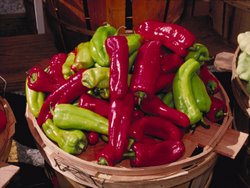
Cubanelle_Peppers
Base Recipe:
For 6 Servings plus leftovers;
(items in parentheses are optional):

(2 lbs. meat)
1 lb. onions
1 to 6 cloves garlic
3 Tablespoons fat
(1 lb. vegetables)
(1 lb. dry beans)
3 to 6 Tablespoons chili powder
(1 to 2 Tablespoons standard spices)
(1 to 2 teaspoons aromatic spices)
(thickener)
2 quarts liquid
(1 to 3 Tablespoons acid)

(starch substrate)
(your favorite condiments)

–Soak beans overnight in plenty of water;

–In a pot big enough to hold everything and then simmer for hours, brown the meat in 2 Tbsp. fat;

–Fry the chili powder and spices (and flour if used as thickener) with the browned meat for about 30 seconds, then set meat/spices aside;

–Add remaining 1 Tbsp. fat to pot and saute the onions over medium heat, scraping the meat/spice fond from the bottom and sides of the pot, until the onions achieve the desired shade of brown;

–Add chopped garlic and any vegetables to sweat until heated through;

–QUICK CHILI: Add soaked beans and liquid and simmer until the beans are cooked (1 to 2 hours);

–FULL CHILI: Add liquid, simmer 2 hours to soften the meat, add soaked beans and continue simmering until beans are done (1 to 2 hours);

–Serve over your favorite starch substrate with your favorite condiments

——–
NOTES:

For many years, on New Year’s Day, following the lead of my Father in some ways but heading in my own direction too, I’ve cooked chili. Lots of chili. I’ve tried many recommended recipes, but over time I’ve figured out that the very best way to do it is to find THE BEST ingredients that could go into a chili, and then create a new recipe around that. This year, in 2010, I made chili verde because we grew tomatillos in our garden and had frozen some at the end of the season; and I made a dark chili using beef heart and home grown beans. Both were outstanding, especially with a splash of Navarro verjus just before serving (see “ACID” below).

Let’s face it, more than almost any other meal, “chili” as a recipe is much more of a concept than a specific dish. Any recipe that ostensibly originates as a one pot dish from the Hispanic Southwest US (chili con carne = meat and pepper stew), yet has famous versions in Cincinnati (without chili powder!), New York, and Los Angeles, is inherently mutable.

That said, it’s still got a specific personality: a stew made in one pot that has meat and/or beans in it, and it should feature the namesake ingredient — Capsicum annuum — in one, several, or all of its glorified forms (sorry Cinci). And that’s pretty simple in concept: fry some meat, add spices, add onions and veg, add stock and beans, let bubble, and you’re done. It being that simple, there are millions of variations, all of them inevitably labeled “The Best…” or “The Ultimate…” or even “Traditional/Original/Authentic…”
Continue reading
Meatloaf fit for a foodie queen

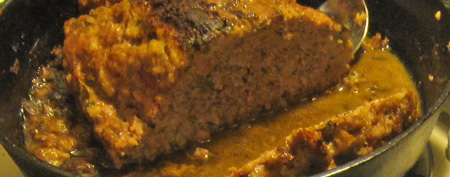
Love meatloaf. Love meatballs. Since I love them so much, I’m very discerning about the cooking and eating of them. I have my favorites. For meatloaf, it is K-Paul’s Cajun Meatloaf — dubbed the Best Meatloaf of all Time by me back in ought-six — but I’ve been making it since I got his cookbook in 1984. For meatballs, the Polly Dutton meatballs that I learned to make from Polly as an Ensign in the Navy, living in Coronado. That said, I’m always trying new stuff. If the recipe looks good, I’ll give it a shot in hopes that it can topple K-Paul or Polly.

m_detail_meatloaf This meatloaf was published in the New York Times Magazine in July, 2009 and called Fancy Meatloaf for Nora Ephron. It looked good enough to make and Sam Sifton’s story made it even more intriguing. I belatedly got around to making it recently. I’ll let Sam Sifton introduce his meatloaf:
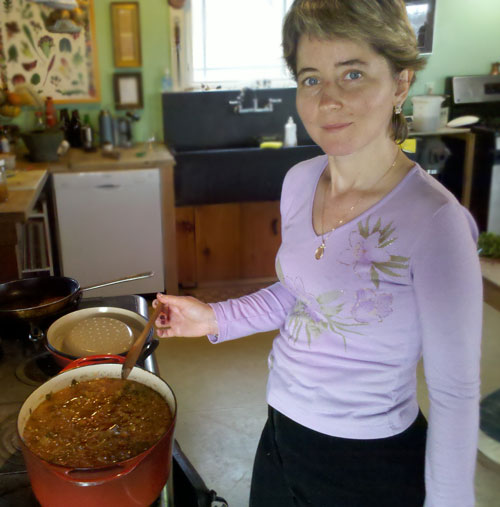
“I was invited to cook dinner for Nora Ephron. This is what happens if you hang around New York long enough, writing about food… You end up at ground zero. The invitation was to a potluck. Guests were meant to bring food inspired by Ephron’s career or by the woman herself. It was essentially high-stakes food charades. My draw was meatloaf. Ruh-roh. Ephron is famous for her meatloaf, a version of which is on the menu of Graydon Carter’s new restaurant and clubhouse, the Monkey Bar. And cooking plays no small role in her new film, “Julie & Julia.” Just thinking about cooking for her, I felt sick and wondered if bringing a few bottles of cold Pellegrino or Laurent-Perrier Champagne would do instead. I’ve read widely in the literature. Nora Ephron loves Champagne. But I got down to cooking. I started to grind. What was borne out by my experience I pass along as gospel: Do not make Nora Ephron’s meatloaf for Nora Ephron. This is a sucker’s play and remains true even if you’re cooking for someone’s aunt on a Saturday night in Fort Myers, Fla.: Don’t make a person’s signature recipe for that person, ever. Instead, take it as a starting point. Move the ball along. And practice. A couple of years ago, Ruth Reichl edited a huge cookbook that was built out of the recipe files of Gourmet. In it is a meatloaf recipe that combines beef and veal, pancetta and Parmesan, brightened with lemon zest and white wine. It’s a luxurious feed, and I’d run versions through the oven before deciding to take it on the road.”

I had all the ingredients on hand except the Italian bread and thin sliced pancetta. I was planning to try and recreate rice meatballs served to me at a dacha outside Kyiv, but reading about Sifton’s meatloaf made my mouth water so I usurped the meats. Meatballs next time. The last time I made K-Paul, I mixed the meat with my (sorta) new Kitchen Aid mixer toy. I found it gentle, quick and non-messy, although mixing meat with my hands is fun and sensual in a way. Continue reading

Topchii Ukrainian Borscht

transcribed 24 Nov 2010 in Monroe, Maine by Eric Rector

Our borscht professor, Natalia
Our borscht professor: Natalia Topchii

“Alison and I had the pleasure of hosting Brian and Natalia for Thanksgiving this year, and I took the opportunity to document the Ukrainian Borscht recipe that Natalia taught me in Reno in June. Alison and I have made borscht for as long as we’ve taken cooking seriously — it’s a versatile soup that can be vegetarian or not, chunky or smooth, served hot or cold. It’s basis in root vegetables and storage crops lends itself to the things we grow in our garden and on our land. We normally grow everything but the bay leaves and the peppercorns in this recipe.

Before we met Natalia, she had heard that we liked to cook borscht and she emailed us her recipe to try, which we did. But there was no cabbage in the recipe, and other ingredients were probably lost in the translation, like ‘is paprika the powder of dried Hungarian peppers? or is it a fresh green bell pepper?’ It was still good, of course — it’s hard to go wrong cooking beef and vegetables together into a satisfying soup. But, of course, I’m chasing authenticity.

In that search, I’ve visited the Polish and Ukrainian restaurants on Lower East Side of Manhattan many times — the food is good, filling, and cheap — and had several versions of their borscht. However, after I sent an article in the New York Times profiling the history of one of these restaurants to Natalia (through Brian), she declared: ‘I do not recognize these dishes…this is not Ukraine food.’ Definitively. I know that there is a wide variation in recipes for the same dish across cultures, but I also know that when foreign dishes are adopted by American diners, they necessarily change as well and take a life of their own. bratwurst becomes hot dogs…focaccia becomes pizza, etc. So I was interested in a taste from the source, and Natalia could provide that for me. (See also “Memories Of Borscht” in the New Yorker food issue this November.)

The first time she showed me how to make Ukrainian Borscht was in Reno this June right before the Anniversary Party we threw for Marc and Carol. There were lots of interesting differences in her recipe that I noted, but admittedly I was too focused on the Party to document the recipe appropriately. The next time we saw Natalia and Brian was Thanksgiving week, and I planned for one day to be devoted to Borscht (many other ‘smatch-no’ items were produced as well, but that may be for another post). Following is the result.

Oh, also, the most authentic instruction given by Natalia in the course of teaching me how to make a true Ukrainian Borscht: almost every ingredient is optional and variable. No beef shin? OK, any beef is good, or hamburger will do. Or pork, or lamb (but never chicken). But beef stock is not necessary — you make your stock with your fresh meat. It is much better that way. Beets? That which would seem to make soup borscht? Optional. Potatoes? If you wish, one or three or five. Apple is very good, but not necessary. Carrots can be left out, as can green pepper, or can be used in larger quantity if you wish. Some people don’t like cabbage — that’s OK. But NEVER add celery — we don’t do that. Garlic is good, but never more than one clove in the pot — save the rest to mash and mix with bread. Parsley (that’s what we used because it was still growing in our garden, improbably through many frosts) is OK — dill leaves are much better. So much better that Natalia normally grows dill through the year, outside in the spring and summer, inside in the fall and winter. Which means that borscht is really just a soup with dill. Go for it.”

–Eric

Ingredients:

vegetable oil (peanut oil is preferable)
1 medium onion
1 pound beef shin with bone
3 quarts water
1 teaspoon salt
2 medium carrots
1 large (or two small) beet
1 green bell pepper
3 medium waxy potatoes (like Yukon Gold, Kennebec, or other boiling potatoes)
1 clove garlic, chopped (not minced or pressed)
1 apple, peeled, cored, grated
1 handful of chopped fresh parsley, dill leaves, sorrel leaves, or other green herbs of your choice
1/2 medium green cabbage head
1 can tomatoes (small can paste, regular can sauce)
2 bay leaves
3 black peppercorns
salt and sugar to taste

Continue reading

Canning Tomatoes

“Last tomatoes of the season,” Julia wrote in the October 28th edition of Mariquita Truck Farm newsletter. Pick-up was at the nearby Greens Restaurant at Fort Mason, so I got right on it and ordered.

20 pounds flat of San Marzano
12 pounds flat of Early Girl

Ordering the last tomatoes of the season is not an unusual thing for me. But canning is a departure from my normal process.

t_jars_o_tomatoes

So why did I get into this canning thing?

A few reasons. I like to make tomato sauce when the tomatoes are at the peak of season, and freeze the sauce for winter and spring. This is good; but I have limited freezer capacity, and when I use the sauce I have to plan ahead for thawing.

t_kyiv_jar

Canning is totally new to me. My mother and grandmother canned tomatoes and lots of other vegetables, but I never paid much attention; everybody canned back then. Son Eric and Alison can 75 or more quarts of tomatoes a year. Brian’s (new) wife, Natasza and her mother, Ella can most everything from the garden at their dacha outside Kyiv in Ukraine. We visited recently, and noticed beautiful jars of tomatoes and such stored in nooks and crannies around their flat.

Once I picked up my tomatoes I spent a day researching recipes and buying equipment; jars and even a canning kettle. I dug out our book on home canning and fired off emails to Eric and Alison asking for tips or advice.

When I jump in, I go in all the way. No matter the initial investment in research and equipment, it’s way cheaper than a freezer.

t_equip_run

The weekend was consumed by cooking and partying for Games 3 and 4 of the World Series: SF Giants vs. Texas Rangers, and of course Sunday NFL.

t_practice_jarMonday, I went into tomato canning anxiety — the canning kettle package urged use of the Ball recipes and procedures for canning and preserving. It’s not like home canning is a mystery, but I’ve never done it before, thus, read research and generally go into paralysis by analysis. And I couldn’t start canning and have to finish after the Giants game started at 4:58pm. But Monday wasn’t a total waste. I made a trial quart of peeled Early Girls to see how they fit in the jar. Having experienced that, I made juice with those tomatoes. It tasted pretty good, but that’s a lot of work for tomato juice to drink with breakfast. Continue reading
Looed Chicken

… and a swell macaroni salad
… and a vibrant rice salad for good measure.

lc_detail

Back in the day, Looing Sauce was a staple in our household. It is a soy sauce based liquid used for poaching meat, primarily chicken, never fish. We glommed onto it back when Jeff Smith’s The Frugal Gourmet Cooks Three Ancient Cuisines: China – Greece – Rome was brand new, 1990. I was a big fan of his TVw_the-Frug show and bought the book when I was home on R and R from Jerusalem. I kept jars of Looing Sauce in the refrigerator and used it – at least – once a week. I transcribed it and included it as an early entry in my developing eats4one cookbook.

Years passed and it kind of got lost in the shuffle when we moved to San Francisco in 1992.

Recently, I bought a small half chicken – just 1.8 pounds – at the Mountain Ranch stand at the Saturday Market.

What to do with it? Hey, we haven’t had Looed Chicken for a while. I couldn’t find it in my computer recipe files. I still have the book, of course, but its gotta be somewhere on the computer. I went into the archives and found it in the original eats4one and made a copy for my active files.

I had to go out and find star anise. I still had some broken pieces in my spice cupboard, but its gotta be 20 years old. How else does one use star anise? So I whipped up a batch, and poached my little chicken.

lc_out_of_pot

OK, it ain’t pretty, but it sure tastes good and looks way better on the plate.

I served it over rice with a side of Romano beans and tomatoes. Oh my… it was nice and moist and flavorful.; better than I remembered. Way to go Frug.

lc_served_sitting

Even with that little bitty chicken, we had enough bits and pieces of meat left over to make a swell macaroni salad. When I did this year’s Super Bowl Party I fashioned a macaroni salad with ham, based on a Cooks Country recipe for BBQ Macaroni Salad. They add BBQ sauce to the mayonnaise and it was pretty good. In my version using Looed Chicken, I substituted Looing Sauce for the BBQ sauce. Continue reading

Scallops

Scallops with Pimento Relish and Red Bell Pepper Oil

s_scallops_detail
This was a quick dinner, but oh so good. It came down to about 90% inspiration and 10% perspiration. I like that ratio.

The Inspiration (90%)
1 – Shopping at the Saturday Market, I couldn’t resist the lovely scallops at the Shogun Fish Company stand. You can’t beat fresh sea scallops… as for supermarket scallops, just fuggedaboutit.

2 – Tom Colicchio’s Think Like a Chef, Clarkson Potter, 2000 (before he was all over TV) and Jacques Pepin’s Fast Food My Way, Houghton Mifflin, 2004. Both of these books are about technique and simplicity in cooking; ones to which I refer often.

We didn’t do any cooking on the weekend as we paid a visit to the Carneros wine country. We had a late lunch at the Boon Fly Café on Sunday, so we ate ad hoc from the fridge that evening.

Boon Fly Cafe, Carneros

Boon Fly Cafe, Carneros

Monday, we were ready for those scallops.

The Perspiration (10%)
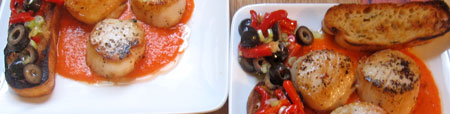
Sear the scallops and place on a warm plate in a pool of Red Bell Pepper Oil, served with two slices Acme green onion slab fried in butter and olive oil, one topped with Pimiento Relish. Damn fine meal.

s_scallops_served

To do: Continue reading

The magic of caul fat

Lamb Crepinettes, potato salad, haricot vert
K-Paul Meatloaf, melted potatoes, broccoli

c_caul_fat_detail

I volunteer at the CUESA Kitchen two Thursday evenings a month (more or less) to help with cooking classes. We prep food for the students, wash dishes and set up and break down equipment and furnishings. The most recent class was “Sausage Making” taught by Dave “the Butcher” Budworth.

On my way to the class I had visions of meat grinders and sausage casings arrayed around the rolling stainless steel pods used as counters. There was none of that. There were mounds of herbs ready to be chopped and spices ready to be portioned, boxes of ground pork, ground lamb and caul fat. The class would not be making sausages in casings as I had envisioned, but crepinettes.

I’m familiar with the word because Fatted Calf sells crepinettes at the Ferry Plaza Farmers Market, but I had never seen nor eaten a crepinette. That evening I learned how to make a crepinette and Saturday, dined on my own homemade crepinettes.

sage to pick and chop

sage to pick and chop

c_chopped

Sage was only one of many ingredients that went into the sausage. We also picked and minced fresh thyme leaves and parsley, and minced long green Anaheim chilies and garlic.

mise en place

mise en place

Each pod was set up with a tray of sausage making supplies. Ten students worked at each station.
.

Dave holds a piece of caul fat

Dave holds a piece of caul fat

Caul fat is the spider web of fatty membrane that encases the internal organs of pigs, cows, and sheep, and it can be used in a variety of meat-friendly ways. Chef Vuong Loc of Portage Restaurant in Seattle calls it “kind-of like the original combi oven, because it allows the meat to roast and steam at once. It can get to a super hot temp because it’s fat, but it also keeps the moisture locked inside. It gives the meat a unique texture and adds flavor.” Continue reading

Mom’s German Potato Salad

…and a visit to German Village

gps_potato_platter_det

Dad–
I raved so much about Gary’s rendition of the German Potato Salad to Alison that now she wants us to make it with our latest crop of potatoes. Therefore you *HAVE* to do an EatsForOne feature on the recipe, especially if you can track down Martha’s version (Gary might be able to help you there, a good excuse to give them a call).
–ER

And so the quest began. I called Amy and Gary.

When Amy answered, I said, “Eric’s on me to write something about “Mom’s” German Potato Salad you guy’s brought to the Pigroast. Can you give me the recipe?”

Amy said, “Gary made it, I just helped and coached.”
“Is Gary there?” I said.

“He’s outside, under his truck,” said Amy. “I’ll call him.”

Gary said, “Gosh, I just started cooking… Amy peeled the potatoes and I sliced them… we were just cooking together…

“I don’t remember the proportions… I know we started with a lot of bacon… 1 1/2 pounds, and a lot of onions… saute the onions until they’re good and caramelized… deglaze the pan with a bit of water, then start adding vinegar and sugar until it tastes like the German Potato Salad in German Village. I’ve never seen the recipe written down. Maybe next time, I can make some notes.”
gv_Schmidt_lunch

After thinking about it, I fired off an email with a couple more questions, to which Gary quickly replied:

Mustard? No mustard, but that could be a worthy secret ingredient.
What kind of potatoes? The potato was a russet  brown skin and Amy states that we once used some red skin potatoes. Peeled, sliced on a mandolin. and parboiled.

I tried to conjure up what I remember about Mom’s German Potato Salad — I’m sure my recollections were heavily influenced by what I had just eaten at the Pigroast.

Potatoes were sliced, not cubed
Potatoes were firm, not mushy
No other vegetables or eggs.
Sweet and sour taste.

I looked for German Potato Salad recipes on the internet. Surprisingly, none were very close to the picture in my mind. One, from House & Garden, February 1957, on Epicurious, by Eloise Davison was just potatoes, bacon and sauce, but she used cubed potatoes, and only four teaspoons chopped onion, coupled with flour to make a roux with the bacon fat.

The best clues came from Recipes from a German Grandma

What makes a good German Potato Salad?
The Potato
Any potato works well but it is good to understand the qualities of each potato to their advantage in your salad. ?Many Germans like the firm red skin potato but the russet works well as also.
The Dressing
The typical dressing is a very simple vinaigrette that is equal parts water, vinegar and sugar.
Trouble is, the pictures showed a mooshy mass of potatoes, so I didn’t read that recipe carefully before I started writing my own and cooking. (Looking back, its pretty close to what I did.) Continue reading

Jannie’s Keystone Pasta

Jackson, Ohio to San Francisco

Sent from my iPad
hello Marc. My typing skills are not very good.  I have room for Lots of improvement.  What are you having for supper.  We are having Keystone Pasta.  You put lots of basil in the bottom of a 9×13 pan.  Peal about 8 large tomatoes. Sprinkle o.o. Over salt, pepper bit of sugar.  Bake 350for@30minutes and serve Over pasta.  This is a Hale original.  I make this when I have lots of basil.  Just wanted to
Let you know we are enjoying the iPad.  I think it was a good choice.  Say hi to Carol.
Jan

Jackson, OH

On our way to the Hale Hollow Pigroast, we stopped for an overnight at Carol’s brother Mark’s farm in Jackson, Ohio. Jackson is about as far southeast as Ohio goes — you want to get away? — this is away.

Keystone tomatoes

Keystone tomatoes

When we walked into the house, I remarked on a gorgeous plate of sliced Keystone tomatoes we would be having for dinner. Mark and Jannie are proud of their tomatoes and this is peak season, so tomatoes are a big part of mealtime. I don’t remember ever having Keystones, but Mark pointed out they’re a close cousin to brandywine tomatoes.

Mark took me on a ride around his place on his Mule, a four wheel get-around-easy-to-keep-up-the-place toy. Fun.

t_mule

t_ripping_thru_woodsWe went rippin’ through the woods and crusin’ th’ dale.

t_cruisin_th_dale

Passing the garden he showed me the Keystone tomato plants, standing taller than me. Continue reading

Spring Cassoulet

… peach and tomato salad
Gone again… back again

the farm lane

the farm lane

This time we were off to Ohio, a land of heat and humidity, but one of family celebrations, as well. This one was Carol’s brother Alan’s annual pig roast on his farm just south of Lancaster – where Carol grew up – which is just north of Logan – my birthplace – and about 30 miles southeast of Columbus – where I grew up. Having lived in San Francisco for nearly 20 years, a trip “back east” is July is like a hot, wet slap in the face, and Carol tends to obsess over the heat. To my way of thinking, it’s good to go someplace really hot from time to time – not too often. I don the Ohio July uniform of a loose tee shirt, shorts and sandals and live with it. It’s the clammy, usually way too cold air conditioning that gets to me.

dude... check out these Ohio tomatoes!

dude... check out these Ohio tomatoes!

All of that, to say that I haven’t contributed to eats for a while.

sc_beans_sausages

I found this recipe for Spring Cassoulet in the CUESA newsletter and though it’s a bit past spring, I had all the ingredients and SF is cool enough just now to enjoy a bean dish.

So, you make a pot of beans and throw some sausages and pancetta on top, and sprinkle that with baby lettuces and edible flowers. How easy and yummy is that? Quite.

But Dominique Crenn of Luce at the InterContinental hotel showed me a few tricks to make this simple thing sophisticated and sublime.

For the beans, she cooked bacon, shallot, garlic, celery and carrot in a generous amount of olive oil and deglazed the pan (I used my bean pot) with white wine. OK so far… that’s the way I start beans. For the twist, she tied up that vegetable bacon mixture in cheesecloth and put it back in the pot for the beans. Viola… no pesky vegetable and bacon pieces in the beans, just their flavor. She used Rancho Gordo White Runner Beans, I used Golden Eye.

Chunks of lamb sausage, pork sausage and chopped pancetta, sautéed with onion and garlic, then cooked with red wine and chicken stock, made it a cassoulet. I used Fatted Calf Merguez and Mild Italian sausages. Continue reading