grilling again

There’s something special about a grilled meal. From the shopping to the eating there’s a protocol, choices and a routine. This meal started with me standing in front of the fish case at Raley’s. The weather in Reno has been beautiful; sunny, clear, a bit cool in the 40’s but occasionally easing up to 51 or 52. Makes a body think of breaking out the grill.

Thinking grill, I noticed some lovely Steelhead Trout fillets. This has become my favorite grilling fish ever since discovering it as a whole fish at Raley’s. I wrote about that guy, and have since grilled the fillets any chance I get.

Rainbow trout/steelhead are ray-finned fishes in the salmon family, and they are one of the top sport fish in North America. Rainbow trout and steelhead are the same species, but they have different lifestyles. Steelhead are anadromous, meaning they spend part of their lives in the sea, while rainbow trout spend their lives mostly or entirely in freshwater.


EGG moved to front courtyard

As soon as I could after our early December snow, I shoveled a path and moved the gas grill to the garage and the EGG to the front courtyard. And we bought an LED clip-on light — that makes winter (nighttime) grilling possible.
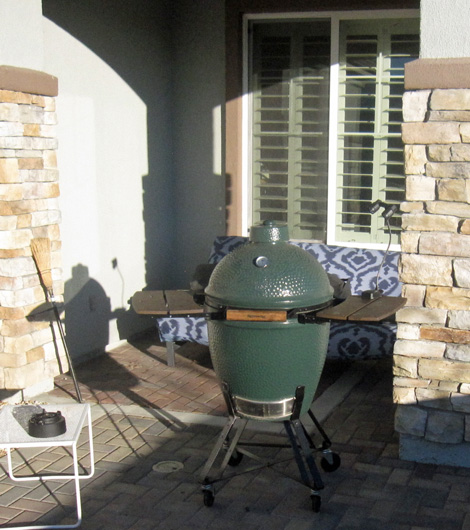
the light is clipped on the right “wing” and you can see its shadow on the wall

So on with the grilling. To eat at 7pm, I light the grill a little before six, and it is plenty dark at that time in January.
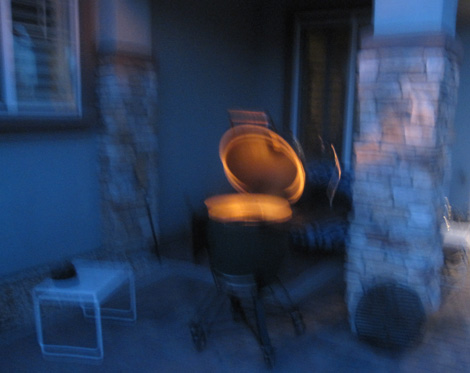
EGG Glows, but it doesn’t shake… I shake, it’s cold.

Tonight, I wanted to do everything on the grill. Trout, spinach and sliced potato. I boiled the potato until cooked through. Then slice it, oil and season it, and finish on the grill with the fish. The trout will cook in 6 to 8 minutes and I’ll hold that and the potato slices in a warm oven. The spinach cooks in about 3 minutes, is a bit messy, demands attention and cools quickly — especially outdoors in the winter — so I cook that last. Rinse the spinach and take it to the grill in a colander. Place it on my cast iron grill pan (the lid of my cast iron skillet), and toss while it cooks. That’s the attention demanding messy part. There’s way too much spinach to fit the grill pan, but it shrinks a lot as it cooks, so its put on as much spinach as possible, toss and shrink, put on more spinach, etcetera, all the while trying to keep it on the skillet and not scattering on the grill. [Harder to write than do…] And the fire is HOT.

trout over spinach with grilled potato slices

That went so well, I grilled again the very next day. We had three Maine lobster tails left from Christmas dinner. Excellent candidates for grilling. Those ‘tails plus grilled onion slice and baked potato. Not so fussy about doing everything on the grill this time. The onion slices take about 10 minutes to crisp tender, the lobster tails about six minutes. I timed so they both came off at once, figuring it’s no crime to cook the onion slices a few minutes longer.

Lobster tail, onion and baked potato. The M doesn’t Mean anything, just grill marks as a result of turning and rotating. Kinda cool, though.

A few days later, I had an appointment at my Dermatologist — near South Virginia and McCarran  — and not far from Whole Food. My must haves from Whole Food are Newman’s Own Organic Thin Sticks Pretzels, whatever fish looks good — and oh-by-the-way — they make the best Lamb Merguez Sausages. Another grill opportunity. They also had cippilini onions, so we got a few for grilling beside the sausages. We picked up some Brussels sprouts, as well. Those pretzels are just so crisp and crunchy and so good.

Merguez, Brussels sprouts, grilled cippilini and scraps of red bell pepper for color

Who ever heard of grilling Brussels sprouts? Not me. But I figured if I par-boiled them oiled them up and just threw them on the grill, what could go wrong? Turns out, nothing went wrong… delicious. Grilled cippilini onions are the best. Peel and slice in half… perfect thickness and caramelized a bit, they taste so sweet and good.

Altogether, three really good grilled meals. And just in time. This morning it snowed.

Christmas Eats 2013

What do you do Christmas week, but eat? We ate some strange and wonderful things, so I thought I’d write about it.

It started the week before at a neighborhood holiday party. Folks bring stuff and rather than making a casserole or something, we took a cheese plate.

from 12 o’clock, mixed olives, St. Agur, Cowgirl Creamery Mt. Tam, Mousse Pate over various candied and dried fruits and nuts.

Yummy. Last year we just took a fat piece of St. Agur, a double cream blue cheese from France and a piece of country pate. This year, we opted to have our favorite cheese store — Wedge — make up a cheese platter. Good choice. AND, believe it or not, there were leftovers (not many) and we got to take those home.

Christmas eve, we went to Brian and Natasza for dinner. Brian is often messing around with something interesting to cook. He finds “Manager’s Special” stuff at the supermarket (nobody else wants it) and he figures out something to do with it. On this occasion, it was pork belly, which is basically uncured bacon. He found a recipe in a food blog for Grilled Korean Pork Belly Lettuce Wraps (Daeji Bulgogi).

marinated pork belly

Marinate your “Manager’s Special” pork belly in a spicy marinade/dipping sauce.
Grill on direct medium heat flipping every two minutes, until the pork is browned and crispy. Brian’s pork took 3 or 4 flips.

the grilling is easy but demands attention and makes a lot of smoke

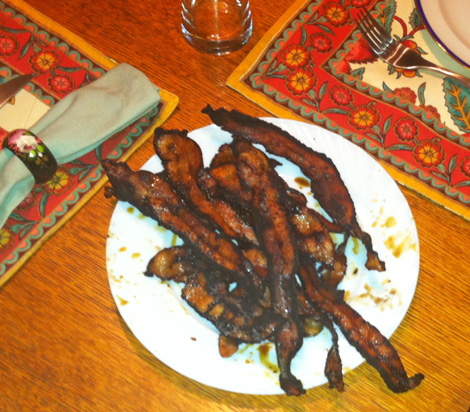
off the grill and onto the table — oh my, that is good

pork belly served with cabbage wrap and rice

Natasza made brown rice with mushrooms and a shredded beet salad with nuts and raisins. I kibitzed and took some pictures.

Brian and Natasza came to our house the next day for Christmas and dinner. A while back, we bought some mail order Maine Lobster Tails for this very occasion. Brian promised to make pasta and a caviar sauce. Carol found this marvelous recipe on Food 52 for Radicchio Salad with Manchego Vinaigrette. She made mashed sweet potatoes as well. Sounds like dinner. Continue reading

My new favorite kitchen thing

a cheese thing…

that’s Mt. Tam cheese from Cowgirl Creamery

It’s a cheese board with a glass cover. I’m pretty sure it has a name, but don’t know what it is. Anyway, it is great because good cheese shouldn’t be served or eaten cold. And if this is empty, it’s a reminder to get the cheese out of the fridge in time. I’d better go get mine out now.

Saw it at World Market for $20. They had one, and I bought it on the spot. WooHoo.

Dinner Salad

Breakfast Salad

DINNER
“I’m cooking some spaghetti and that 1 1/2 links sausage with red sauce for dinner. If you want a salad, make one, I don’t care.” Carol announced dinner plans while I watched “Sportstalk Live” a show on Comcast Sports Net Bay Area and picked up on my Direct TV. Gotta keep in touch, and the 49ers whupped up on the Seahawks yesterday.

When I saw her put the water on to boil, I started thinking about the salad. We both like what we call Israeli Salad, which is basically chopped vegetables. The true Israeli Salad (or Arab salad) has a base of tomatoes and cucumbers, but I make it with whatever — and tomatoes and cucumbers aren’t exactly in season (there’s six inches of snow out the window).

I started by littering the kitchen counter with all things choppable and started chopping. I know I started with three cornichons and that didn’t look like enough, so I chopped one more. This gave me a basic quantity to match for each vegetable. To chop a cornichon as wide as its diameter, gave me a size to work with. So… the rest of the vegetables are listed in alphabetical order. I can’t remember in what order I chopped and added, and it doesn’t matter.

  • • pickled asparagus from a jar
    • celery, the very very tender inner heart left from using stalks to make soup
    • green olives
    • mandarin orange, sectioned and chopped
    • red radishes
    • scallions
    • sugar snap peas
    and lastly, a sliced endive. Last because I didn’t know if one would be enough. It was.

I tossed those with Newman’s Own salad dressing and there you have it. (OK, I coulda shoulda made my own dressing, but I did the whole salad while the spaghetti was cooking. Besides, I like Newman’s.)

dinner — chopped salad, spaghetti with red sauce

That made more than enough for Carol’s and my dinner salad and I had a cup and a half or so left for my breakfast (that was not unplanned, I love salad for breakfast).

BREAKFAST
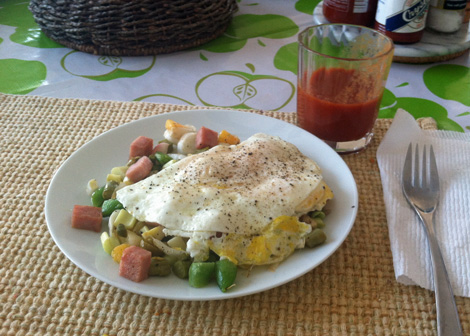
Salad out of the fridge. I like salad for breakfast, but not cold salad. I dumped it on a plate and put in the countertop convection oven for a while at 150°F while I fried some cubes of Spam (I chopped one slice, about 1/2 ounce). Added the Spam to the salad plate and fried a flat egg to go over.

plate of not cold chopped salad

with a flat egg

Yum.


A Great Day

… and a soup day

I had a great day today.
When I got up at 6:30 to make coffee, the temperature was 46°F, but it was snowing. I went back to bed as usual, and when I got up for good at 7:30, the temperature had dropped to 24°F and it was snowing hard, but with no wind.

6:50am I took this to show Carol in case the snow went away before she got up.

It snowed on until noon, first those tiny flakes, then bigger, fluffy ones. I measured four inches.

12:30pm The snow did not go away.

I love fresh snow. It is so pretty and everything is silent and still.

Won’t be going out today except to shovel, so I got busy in the warm indoors.

Made a Christmas gift for brother Wendell. It’s pretty cool, but I won’t disclose it here. That took the morning, because it required some thought and research.

Then I turned my attention to Turkey Barley Soup. It’s so good, that it can become a turkey leftover tradition. There is something very satisfying about making a hearty soup on a cold and snowy day.

Soup is an assembly process and it is like T’ai Chi to me to move around the kitchen, collecting vegetables and chopping, assembling the ingredients, stirring the big pot.

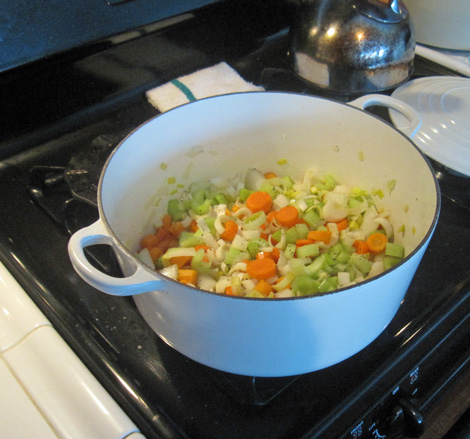
The big pot of vegetables. I like it because it’s wide and makes for easy stirring.

Lovely garlic from the spring farmers market

I especially liked working with the garlic that I got at the Farmers Market in the spring and hung in the kitchen to dry. It’s beautiful garlic and a joy to peel and smash.

The shopping was interesting. A key ingredient of the soup is pearl barley… not something you find just anywhere. Carol happened to be in Trader Joe’s — although we don’t usually shop there except for my favorite salted peanuts — and she got barley, but it is “ten minute barley.” Not the same, we cook the barley for this soup an hour or more.

On another day, we were in Raley’s and I cruised the rice and grain aisle. Astonishingly, there were three women with carts and me with no cart in that aisle all at once. Since I needed to peruse the shelves, I stood aside and mentioned I was looking for pearl barley. “I’m looking for pearl barley, too,” said a woman about my age. She found it first and offered me a package.

“You must be making Turkey Barley Soup,” I said, since I got the recipe last Thanksgiving from the Reno Gazette Journal.

“Yes,” she said, “I am.”

The recipe with plenty of pictures is in last year’s post, Turkey Left Over, but I made some modifications and clarifications, so I will repeat it here.

TURKEY STOCK
Based on an amalgamation of recipes and making stock much of my cooking life.
Yield, about 8 cups.

In a large stockpot, place Turkey carcass, and cover with water. When the water is nearly boiling, remove the pot from heat and pour off the water. (This takes care of the blood and scummy stuff so you don’t have to skim much.)
Cover the turkey carcass again with cold water, about 12 cups. Heat to a near simmer and add 2 each carrots and celery stalks; 1 onion, quartered; 1/2 lemon, rinsed and quartered; some peppercorns, a bay leaf; an herb bouquet. Cook uncovered at a bare simmer for about 2 1/2 hours. Turn off the heat and let stand for an hour or so. Remove meaty bones, strain the stock and refrigerate overnight.
The next morning, skim any fat from the broth and bring to a boil. Reduce to 8 cups.

NOTE:
I borrowed this method from Tom Colicchio, in his book Think Like a Chef.
Nancy Horn does her stock in the oven (her recipe is below).

TURKEY BARLEY SOUP
Nancy Horn of Dish Cafe and Catering Co.
Yield, about 3 quarts soup.
This soup is all about barley absorbing turkey broth, so make your own broth for the best soup. Store bought canned broth just doesn’t cut it, in this case.

Place a dutch oven (my 6Q white Le Creuset) on the stove over medium high heat. Add 1 Tbsp each of butter and olive oil. Peel and chop 3 carrots, 3 celery stalks, 2 large leeks (tender parts), 1 large yellow onion. Add to pot, along with 1 bay leaf. Stir and season with salt/pepper mixture and sauté until vegetables are softened and beginning to brown around edges. [Takes about an hour to this point.]
Peel and smash 4 cloves garlic; add to pot and cook a minute. Add 1 cup dry white wine and stir to deglaze the pot. Simmer to reduce wine by half.
Add 8 cups turkey stock, bring to a simmer and add 1 cup pearl barley and 3 sprigs thyme. Stir well to incorporate. Simmer, covered, stirring every now and then until barley is tender, about 1 hour.
Chop and stir in 1 bunch Italian Parsley and 2 cups shredded cooked turkey. Taste and season with salt and pepper. Adjust amount of stock for brothyness. Serve with Romano or Parmesan cheese.

NOTE:
I use a salt/pepper mixture of 2 parts kosher salt, 1 part coarsely ground pepper.
Instead of parsley I used a small, young and tender bunch of Swiss chard,
torn in pieces and stems removed. (At our winter Garden Shop Farmers Market there’s a guy that grows hydroponic vegetables in a cold frame. Young, tender Swiss Chard year ’round.)
That, my friends, is yummy soup. Even better the next day for lunch.

TURKEY STOCK – Oven Method
Nancy Horn of Dish Cafe and Catering Co.
Yield, about 6 quarts.

Preheat Oven to 225°F.
In a large stockpot, place Turkey carcass, 4 each carrots and celery stalks; 2 onions, quartered, unpeeled; 1 lemon, rinsed and quartered; 6 peppercorns, 3 bay leaves; an herb bouquet. Cover with cold water. Cover and place in oven for 12 hours.
Remove from oven, remove solids and strain. Let stand for at least an hour and skim or otherwise remove fat.

The Pig :: Day Three

“I love sausage, but don’t care to see how it’s made.”

Today, you’ll see how it’s made.

Although the recipes came from various sources, the ingredients are simple and similar:

  • ground pork
  • spices
  • herbs
  • often onions and garlic
  • liquid — usually wine

Breakfast sausage (sage and onions) from Better Than Store Bought by Helen Willyard and Elizabeth Coichie
Saucisson (black and white pepper sausage for dry curing) from La Technique by Jacques Pepin
Pork Liver Terrine Pate Campagnola from Cooking by Hand by Paul Bertolli
Boudin blanc (emulsified sausage) from Charcuterie by Michael Ruhlman and Brian Polcyn
Cotechino (classic Italian with Anise and boiled pork skin) from Cooking by Hand by Paul Bertolli
Crepinettes, each of the fresh sausage mixtures made into patties and wrapped in caul fat

The meat was all cut up yesterday and divided into portions for the various sausages.

prep for Pate Campagnole

Each team put together its recipe ingredients — this particular prep is for the Pate Campagnole — you can tell by the use of liver.

The meat is ground with a cast iron grinder attachment for the commercial mixer.

grinding

The ground meat, herbs, spices, etc. are mixed.

mixing

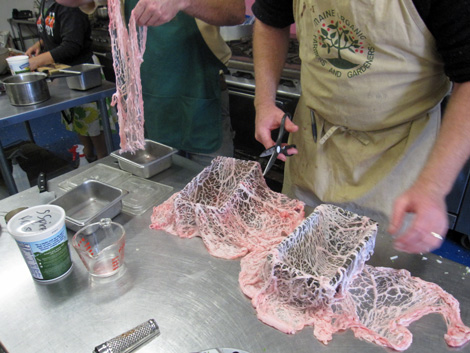
Here, we visit the terrine. Loaf pans are lined with caul fat and the ground meat mixture pressed into the pans.

pate underway

The pans are placed in a water bath and baked. Continue reading

The Pig :: Day Two

Breaking down the sides…

We are entering the middle day of our journey from two snorting and snuffling pigs to some hams, bacon, sausages and the like.

Today, we’ll smoke some bacon, make some headcheese, start some hams, render some leaf lard, and have a swell and somewhat unusual lunch, make big pieces into little pieces and sort them.

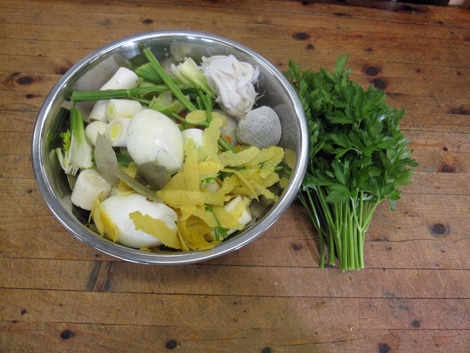
These are the vegetables for Head Cheese, or what Fergus Henderson in his book “Nose to Tail Eating” calls BRAWN. We’re looking at onions, carrots, leeks, celery, garlic, lemon zest, a splash of red wine vinegar, bundle of herbs and a small handful of black peppercorns. While I prepped the vegetables, the pig’s head in water was coming to a boil in a big pot. When it got to a simmer, I stuffed the vegetables into the pot.

vegetables for head cheese

After about 2 1/2 hours, everything comes out of the pot and the remaining liquor is reduced by half. The vegetables are discarded and all the good bits of meat are picked out of the head. A terrine will be lined with cling film, the bits of meat added, the reduced liquor poured over and refrigerated overnight to set. The bits leftover will be made into patties, breaded and fried. That’s for tomorrow’s lunch.

My other job-of-the-day was to cook up the pig lungs for lunch. When they were harvested yesterday and before going into their sterilized tray, one of the students picked it (them?) up and blew them full of air. Hey, they work.

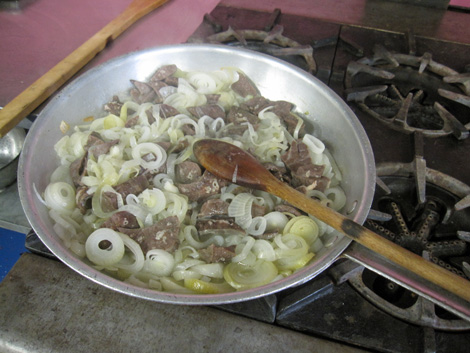
I trimmed the lungs of their gnarly parts, cut into small pieces and parboiled. Sliced a boatload of onions and got all that going over a very low flame. That would cook until lunchtime, almost three hours. Salt and pepper was the only seasoning.

lungs n onions saute very slowly

Meanwhile, the ribs were cut out, trimmed and roasted.

clockwise from bread: roasted potatoes, lungs n onions, roasted ribs, vegetable salad

This was a very nice lunch. When I went back for seconds on the ribs, the lungs were totally gone. Bummer. I was surprised that the lungs didn’t taste at all like organ meat. Probably because they are so fresh.

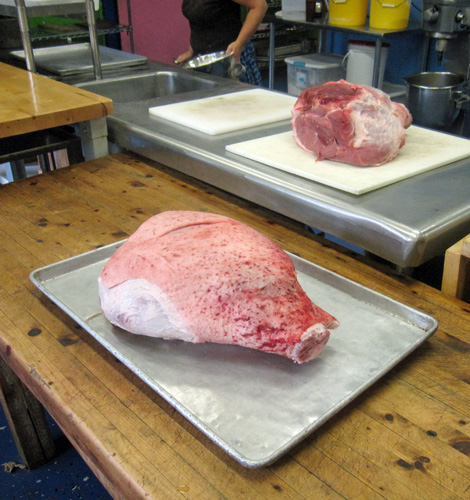
Meanwhile, the prime cuts; hams, loin, ribs, chops and roasts are cut and the balance of the meat is cut into bits for sausage. These bits are sorted by lean and fat so they can be mixed in proper proportion. The shoulder (Boston Butt) has perfect proportion by itself.

hams, cut two ways

some of the lean meat being cut

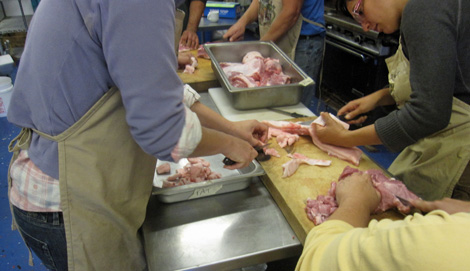
The cut meat is put in that yellow bucket, weighed and then sorted into hotel pans and labeled for its ultimate use. Tomorrow, we’re going to make 5 kinds of sausage and a pate.

These are the more fatty cuts.

The person top right is cutting the skin from the meat. The skin will be boiled until tender and go into sausage as fat.

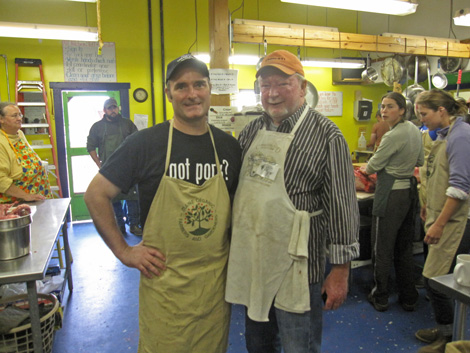
Alison requested this picture. It was hard to catch Eric standing still long enough to pose.

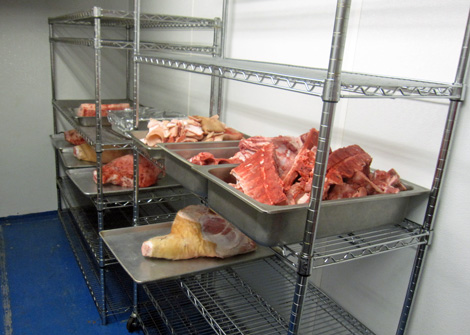
At the end of the day, what once had been carcasses, was transformed into hotel pans of various cuts of meat.

A cooler of pig.

another view showing meat sorted for sausages

The Pig

NEW ENGLAND, 14 DAYS IN OCTOBER, 2013

At age 30, we moved to Massachusetts. Our sons were five and three. At age 54 we moved to San Francisco. All but one year of that time, we lived at 48 Harrison Street, Newton Highlands MA 02138. 617-969-3359 It was the time when we embraced adulthood, raised our children and forged lasting friendships. A time like no other in our lives. This is about revisiting New England, not for reflection and nostalgia, but for activity and exploration.
Our visit was centered around the Maine Organic Farmers and Gardeners Association (MOFGA) annual Nose to Tail Pig Processing Workshop during Columbus Day weekend. Before, we made our way to the Belfast Maine environs, and after, we drove across the whole of New England to Cooperstown, New York, and from there to Newton Highlands.
The story has a beginning, middle and end. You recently read the beginning, “Getting to the Pig.” And here is the middle and the raison d’etre, “The Pig” where we will journey from two snorting and snuffling pigs to some hams, bacon, sausages and the like.

Pig One

We called this fella “Pig One” He’s been in this stall about two days to get used to his surroundings. He’s had his food withheld but given plenty of water. He’s met the farmers, Paul and Everett, so he knows them and is not afraid.

the big room with tables in a “U” shape

We met in this big, high room each morning for coffee and a muffin and to discuss what will be going on that day. Eric — at the corner table — says that today, Paul and Everett, our farmer instructors, will lead us through the process of killing and dressing two pigs.

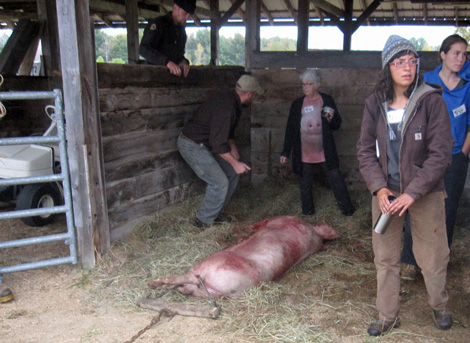
The day was cloudy and quite cool, perfect weather for our task at hand. We walked across the field to greet Pig One and be instructed how he will meet his demise. The killing must be quick and efficient and cause no trauma in the pig. In this case, Paul will shoot the pig with a .22 caliber pistol aimed at the center of a triangle formed by the pigs eyes and nose. — I was surprised at how calm the pig was, Paul walked into the stall and slowly up to the pig’s head and BANG. — The pig will writhe violently, so stand clear, a flailing leg could cause serious injury.

As soon as possible, the pig will be “stuck” by inserting a knife just above the breast bone and thrusting up. This will cut the main artery that runs above the breast bone and the pigs own heart will pump all of the blood out onto the straw of the pen. Very efficient. That whole process took about 30 seconds.

spreader attached to the pig

A spreader is attached to the pig’s hind feet and he will be picked up and hosed down to wash off mud, blood and straw.

We will process two pigs, the first will be scraped clean of his hair and dressed with his skin on. Often, for hams or bacon, the cut with skin on is preferred. Excess skin can be boiled and ground into sausage, as well. The other pig will be skinned.

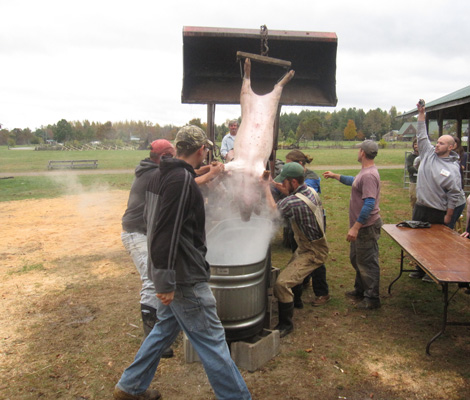
Very early, a trough was filled with water and a fire built under the trough. Now the water temperature is just under boiling and the pig will be lowered into the water and sloshed around. The hot water bath eases the scraping… just like shaving, guys.

the pig, being guided into very hot water

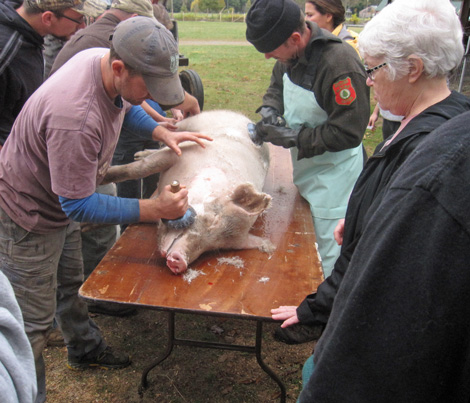
The table to the right has been washed and sanitized with a vinegar water solution. Out he comes, onto the table.

pig on the table

scraping starts at the head

For this pig, the head will be cut off whole, to be boiled and made into headcheese. Continue reading

pickled beets

NEW AND IMPROVED

roasted golden beets

I’ve written about beets from time to time, the first being April 2006, shortly after this blog was christened. There, I wrote about pickled beets, among other beety things.

Over the years, I fiddled with the recipe, the original was too sharp for my taste, too vinegary.

In September of 2011, I tried a new recipe from Mariquita Farm:

Balsamic-Pickled Roasted Beets
Adapted from Mariquita
A change o’ pace from the puckery Pickled Beets

1 bunch beets, roasted – about 2 cups
1/2 cup fresh orange juice
1/4 cup balsamic vinegar
1 tablespoon sugar
1 ounce Pastis
1/2 teaspoon salt
1/8 teaspoon freshly ground black pepper

Roast beets. Peel and cut as necessary to fit in a POM jar.
(Unfortunately, POM changed their packaging, so that straight sided jar only exists in my cupboard… I still have 5 of them.)
Combine all the other stuff in a small saucepan; bring to a boil, boil about a minute. Pour over beets.

Those were good; clearly enhanced, but not puckery tasting. I used it with both red beets and the golden beets. I like both, and will buy whatever looks best.

That was about two years ago. I love beets and eat them a lot. I kept tinkering. First, I substituted White Balsamic for the “regular.” Then I substituted white wine for half of the Balsamic.

Now, that’s a good recipe. Worth publishing.

Marc’s Balsamic-Pickled Roasted Beets
Adapted from Mariquita Farm and tinkered with by yours truly.

1 bunch beets, roasted – about 2 cups
1/2 cup fresh orange juice
1 ounce balsamic vinegar
1 ounce white wine
1 tablespoon sugar (I use brown sugar)
1 ounce Pastis (or anisette if you can’t find Pastis)
1/2 teaspoon salt
1/8 teaspoon freshly ground black pepper

Roast beets. Peel and cut as necessary to fit in a POM jar or pint jar.
Combine all the other stuff in a small saucepan; bring to a boil, boil about a minute. Pour over beets.

Fatted Calf Foray

I couldn’t resist emailing this to Brian, Eric, Carol, Sarah and Paula.

“These guys know how to throw a book signing. If I were still in SF…”
Marcus

Fatted Calf Newsletter September 19, 2013
At The Table

What better way to celebrate the publication of our book, In The Charcuterie, then to join at the table with friends and colleagues for a leisurely lunch? And what better table than the one under the arbor at Robert Sinskey Vineyards in Napa! Rob and Maria Sinskey, huge supporters of The Fatted Calf, generously offered up their stunning digs.

stunning digs

Sinskey Chef, Erin Ramsey, laid out quite a feast for us, including some Fatted Calf favorites. There were pork rillettes toasts topped with nectarine mostarda, thin slices of finocchiona accompanied by marinated olives and green tomato chutney, and the pièce de resistance, plump sausage and fig stuffed quail roasted in the wood oven. Tasting Room Manager, Jennifer Gallagher, poured glass after glass of perfectly matched vintages of organic and biodynamic Sinskey wine (while professing her love of liverwurst). Good food, great wine and good people made for a memorable day.
Come make some happy memories of your own. Join us this coming Sunday, September 22, at Robert Sinskey Vineyards from 11 am to 3 pm. We’ll be preparing some meaty bites, enjoying a glass of one of our favorite wines and signing copies of In The Charcuterie. Reservations can be made through Robert Sinskey Vineyards.

Brian fired back:
Why don’t we go?  Leave yer place at 8-ish, get there as the thing’s getting started, good food & wine, good-looking book, chance to chat with FC folk, stroll around the grounds a bit, and be home in time for a light supper (after what should be a rich FC spread).  It’s $50 each with the book, $35 without.  On normal days, it’s $25 just for wine-tasting with nibbles.

I checked with Carol… She doesn’t want to spend Sunday car-riding. Said she will babysit Tuzik. I called the Sinskey Winery and made reservations for me and Brian, hoping they wouldn’t be sold out.

The newsletter went on…

Want to skip the read and head straight to the table? Visit The Fatted Calf table at the Ferry Plaza Farmers Market this Saturday and pick up some rillettes, finocchiona and fig and sausage stuffed quail for a feast of your very own.

Anytime I’m in San Francisco, I stock up on stuff from Fatted Calf… Just can’t get that stuff in Reno. So after the event, Brian and I did just that… not at Ferry Plaza but at the Fatted Calf shop at Oxbow Market in Napa. I got me some duck crepinettes, fennel sausages, sausage and fig stuffed quail, greens sausages, a slice of Terrine Forestiere and packs of Sugo di Carne. Brian did similar.

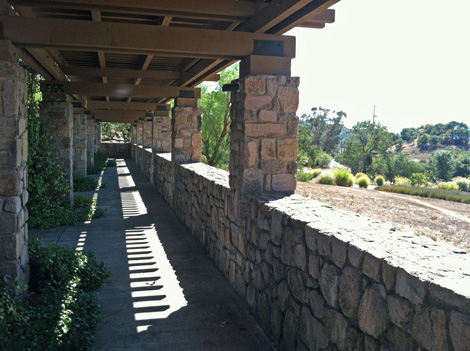
colonnade bordering parking lot

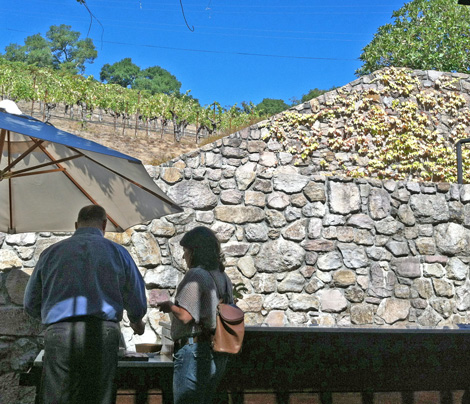
We got there minutes before noon and I was surprised to find empty parking spaces near the door. Inside, the tasting bar was packed. We passed by that to the open kitchen and back garden with a white marble bar. Tables under the arbor were provided a stunning view of a massive stone wall and vineyards above and behind.

the view from my table

Several folks milled around the bar laden with delectable food. Brian and I were still getting our bearings when the woman behind the bar offered a glass of Abraxas, a white wine blend of Riesling, Pinot Gris, Pinot Blanc and Gewürztraminer. Yum. I took a plate and a meaty item or two and found a nice seat.

one of my many samplings of food and wine

Again, I was surprised that there were only about 20 people there, but glad that we were uncrowded and unhurried. The day was a spectacular late summer Napa day; they hardly get better than that. We easily fell into a routine of going for the next wine, picking up some foodie goodies, and sitting to enjoy. Four wines were being poured, a Vin Gris of Pinot Noir, a Pinot Noir and POV (Point of View), a blend of Cabernet Sauvignon, Cabernet Franc and Merlot; the classic Bordeaux blend. My favorite was the Vin Gris of Pinot Noir and I bought a bottle to enjoy with my own food at home.

no caption needed

just in from the kitchen

From time to time, a young woman would come out of the kitchen with a plate of hors d’oeuvresy things — duck sausage skewered on a stalk of lemongrass, a cube of lamb skewered with a shiny green blistered padron pepper… good ol’ Brian knows how to pick an event.

raison d’etre

As Taylor and Toponia were signing my book, I said, “Fatted Calf goodies are good enough to buy and eat at home, but to have them served, perfectly prepared, in such a place as this, is a heavenly experience.”

Back on I-80, our Sunday afternoon eastbound lanes were lightly occupied while the westbound lanes to the Bay Area were packed. Brian and I agreed that the Food and Wine experience was well worth the drive. We were home about six, in time to watch Football Night in America on a slight tape delay and eat some Terrine Forestiere.