Good Dinner; chicken, tomato, corn

So Carol said, “What a good dinner.”

Wow. Don’t hear that very often. The thing is, it was dead simple: looed chicken over rice, roasted Costaluto Genovese tomatoes, faux grilled Mexican corn; but I do have some ‘splainin’ to do.

LOOED CHICKENgd_plate_above
I wrote about that last September when I unearthed my recipe from back in Jerusalem days. On this occasion, I did three bone-in chicken thighs. I removed the skin before looing… the skin would just add fat to the sauce and not really contribute any flavor to the chicken as it would if it were fried or roasted. Good and juicy and yummy. There’s no way to screw it up.

RICE
For small amounts of straightforward long grain boiled rice, I cook the rice in my new favorite throw-it-in-boiling-water-like-pasta method. Throw whatever amount in boiling water; 10 minutes later, taste for doneness and strain it. Keep it warm in the strainer in the same pot with the lid on over a little bit of hot water.

ROASTED TOMATOES
I wrote about roasted tomatoes just last May 2010 when I discovered Costaluto Genovese tomatoes. I did the same way with bread crumbs (fresh from an Acme Herb Loaf) and a bit of butter and cheese — this time mozzarella remaining from what I used for a pizza last week.

gd_grill_corn

Instead of roasting in the oven, I put the pan on the grill while I was grilling the corn (10 minutes). Didn’t really get any “grilled flavor,” but didn’t have to heat up the oven.

CORN
I’m not a fan of corn-on-the-cob, but I am a fan of grilled corn. I have a recipe for Mexican Grilled Corn that I like from Readers Digest Recipes – probably a newspaper insert – in 2007. (Guess what, Mark Bittman did an almost identical recipe in the New York Times in 2010.) In any case, I made it my way for off-the-cob eating.

I just mixed the butter, mayo, parmesan and chili powder together and mixed that up with the hot corn cut off the cob. I used a little less parmesan and a little extra chili powder. My convoluted reasoning was that when you roll the corn-on-the-cob in the Parmesan, you don’t use it all, so use a little less to mix. Likewise, when you sprinkle with chili powder, that’s right up against your lips, so it’s like mainlining chili powder; thus, mixed in, use a little more. Carol thought it was pretty spicy (just the way I like it).

and that was dinner. yum

and that was dinner. yum

Mexican Grilled Corn
Readers Digest Recipes 2007

4 ears corn, cleaned
1 tablespoon butter
salt & pepper
2 tablespoons mayonnaise
1/3 cup grated Parmesan
1/4 teaspoon chili powder
lime wedges

Brush corn with butter and season with salt & pepper.
Grill over high heat, turning every 2 to 3 minutes until tender and slightly charred, 10 to 12 minutes. Rest 2 to 3 minutes.
Brush corn with mayo and roll in cheese to coat. Sprinkle with chili powder. Serve with lime wedges.

July 23, 2010
Grilled Corn, Mexican Style
NYT Mark Bittman Yield: 4 servings.
Time: About 20 minutes

4 ears of corn, husked
2 tablespoons mayonnaise
1 to 2 tablespoons freshly squeezed lime juice, or to taste
1/4 teaspoon chili powder, or to taste
Salt and freshly ground black pepper.

1. Prepare a grill, with heat medium-high and rack about 4 inches from the fire. Put corn on grill and cook until kernels begin to char, about 5 minutes, then turn. Continue cooking and turning until all sides are slightly blackened.

2. Mix together mayonnaise, lime juice, chili powder and some salt and pepper in a small bowl. Taste and adjust seasoning, adding more lime juice or chili powder if you like. Serve corn with chili-lime mayo.

There are other options: olive oil, chopped basil and Parmesan make an unexpected and very good combo; crumbled feta mixed with plain yogurt, lemon juice, oregano and cumin is amazing; and you can’t go wrong with mayo mixed with minced garlic, pimentón and parsley.
Joyce Goldstein's Sardinian Meatballs

LA Times via Wednesday Chef

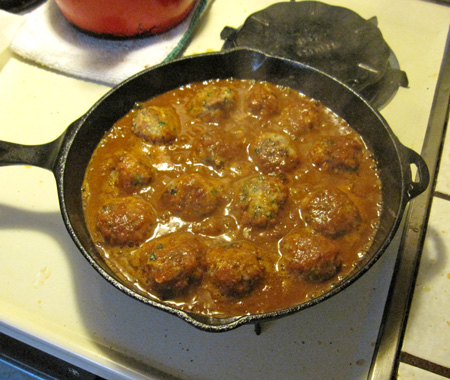
I got this recipe from the Wednesday Chef who got it from the LA Times and I’ve been cooking it since at least 2006… that’s what my notes say. So it’s got to be a favorite.mb_detail

Here are some of my notes:

Cooked 6.06… I made the simple tomato sauce she suggested using my frozen San Marzano sauce. Made CI Buttermilk Mashed Potatoes to go with. That’s good-eatin’ comfort food… couldn’t put down my fork.
Cooked 4.08 – Just keeps on bein’ good. – see below
Cooked 3.11 — Dang all, these are good… why don’t I do them more often? Mixed about 1/4 ground beef and 3/4 sausage in the Kitchen Aid. The recipe doesn’t say to brown the balls, but I did. Used my chunky tomato sauce.

Why don’t I do them more often? As you readers of eats… know, I’m always up for trying new stuff, so that’s one reason. But then, I have several other good meatball recipes and really, how often does a meatball craving come around on the big wheel?
I’ve written about meatballs only twice on eats: Polly Dutton Meatballs in ‘aught six and Pappardelle with a ragu of tiny meatballs in 2008; so it’s been a while.

Generally I vary the ingredients for these Sardinian Meatballs each time, depending on whim or what I have on hand. Joyce Goldstein calls for all pork, but for this occasion, I used 3 Italian sausages from Golden Gate Meat — about 5/8 pound — and the balance ground beef. I’ve incorporated beef before, but never more than a quarter of a pound. They seemed a little heavier than usual this time. Just go with Joyce… pork rules, let it rule.

So, just assemble the ingredients and mix ‘em together. Its easy to mix by hand, but since I got my Kitchen Aid stand mixer, that is my preferred method; easy, clean and more thorough mixing without overmixing.

The recipe suggests that they be served over spaghetti or mashed potatoes. I have gone both ways, but today I was in the mood for spaghetti.

A word about spaghetti. For long pasta, I like thin spaghetti or store-bought fresh fettuccine or especially my homemade egg noodles. I find “regular spaghetti” too fat and heavy — just me. At my local Real Food market, they had shelves of DeCecco dried pasta, but no thin spaghetti. I could have walked two blocks to Cheese Plus, but instead bought a box of Bella Italia Capellini. That was fine (in more ways than one), but I still prefer thin spaghetti.

For sauce, I got out a container of roasted cherokee purple tomato sauce that I made and froze last fall. That stuff is serious good; rich and dark and sweet and dense and perfect. (I thought I had featured this sauce on eats, but no. Good subject for the next entry.)

The meatballs with their sauce were served over capellini with a side dish of braised carrots, a hunk of pecorino to grate and a very nice Simi Cabernet Sauvignon.

mb_served

Sardinian Meatballs
Serves 4 to 6

1 pound ground pork
1/4 cup dried or 1/2 cup fresh bread crumbs [I almost always make my own breadcrumbs. This time from an Acme Herb Slab about three days old.]
6 tablespoons grated pecorino cheese
2 cloves garlic, minced
1/4 cup chopped flat-leaf parsley
1/2 teaspoon salt
1/8 teaspoon freshly ground black pepper

Give these ingredients an initial brief mix, then add

2 eggs [I prefer to lightly beat the eggs before adding.]

For the sauce:
2 to 3 tablespoons olive oil
1 yellow onion, chopped
1 3/4 cups canned tomatoes, seeded and chopped
1/2 cup water
I always use my own tomato sauce, made with fresh tomatoes.

1. In a bowl, combine the pork, bread crumbs, eggs, cheese, garlic, parsley, salt and pepper and mixed together until smooth. Form the mixture into balls about 1 inch in diameter.

In a saute pan, heat the olive oil over medium heat. Add the onion and saute until softened, about 8 minutes. Add the tomatoes and water, mix well, and then add the meatballs.
Here, I depart from the recipe. I brown the meatballs lightly in olive oil, then pour my sauce over them to continue cooking.

4. Bring the sauce to a gentle boil, reduce the heat to low and simmer, covered, until the meatballs are cooked through and tender, about 45 minutes. Season with salt and pepper. Serve with mashed potatoes or spaghetti.

meatballs brown

meatballs brown

meatballs cook in tomato sauce

meatballs cook in tomato sauce

Yum. Good stuff.

Not Your Average Beans n Ham

Ham Loaf LO
White Beans with Celery
The cutest Cauliflower you’ve ever seen

b_caulif_detail We were getting ready for the first “regular” night of the San Francisco International Film Festival (SFIFF54 or “The International”); we had been to Opening Night, Thursday, and it featured a party after with all the food you could eat… much of it good. The International runs for two weeks and most of the films occur before, during or after dinnertime, so we home cooks need to plan ahead… something easy that can be eaten without fuss.

On this night, a Friday, I planned leftover (LO) ham loaf with something. Perusing my ‘to cook’ files on the computer, I came across White Beans with Celery by Martha Rose Shulman who writes Recipes for Health in the New York Times. I thought I had cooked that, but there were no notes to prove it. In any case, I had a half-pound of flageolet beans and a big head of supermarket celery, so I went for it. I got four lovely tiny baby cauliflower from Dirty Girl Produce at the Market and they hadn’t yet found their way into our bellies. Those would be nice as a side dish.

It’s a whole day affair, what with the soaking of the beans, cooking of the beans and baking of the dish, but the active time is scant. Again, plan ahead for this dish:

11am beans in to soak
4pm ready to cook
5pm beans cooked
5:30 beans in oven
6:30 beans on table
8pm leave for Kabuki
9pm Meeks Cutoff (Carol)
9:30 The City Below (Marc)

I cooked the beans in plain water… the flageolets take only about 45 minutes. I hacked 5 cups of celery in about half inch pieces from the top of my head and carefully rinsed them. My time schedule worked just fine as I cooked the celery. That went in the baking dish, a soufflé dish. I lifted the beans from their liquid with a slotted spoon and mixed that together with the celery, mixed in my home made tomato sauce. It took all of the bean cooking water to cover the beans as directed and into the oven it went for an hour. Continue reading

Roast Chicken

…and reviews of two bistro cookbooks, Bouchon by Thomas Keller and Les Halles Cookbook by Anthony Bourdain

I wrote this in February 2009 and somehow it slid to the bottom of the drawer. I’ll blame it on getting busy preparing my income tax. In any case, its just as relevant today. Roast chicken does not go out of style, and Bouchon and Les Halles Cookbook are still in print, so you can rush right out and get your own copy (don’t get it from Amazon, they don’t pay California sales tax and owe the state about a bazillion dollars).

I had never roasted a plain, whole chicken before, always left that to Carol. I loved eating roast chicken, either home made by Carol or brought home from a rotisserie shop or the roli roti truck at the Farmers Market. I don’t know, a roast chicken always seemed mysterious to me.

In his book House:A Memior, Michael Ruhlman, co-author of Bouchon, described inaugurating the new kitchen of his new house with a simple roast chicken:

“I turned on the oven. I took a cast iron pan off its hook. I set a fresh chicken in it and salted the bird well.

“There was never a doubt what the first meal n the new kitchen would be. Roast chicken, baked potatoes, green beans with lemon and butter. Roast chicken is to me the iconic meal of the home. Many pleasures attended its cooking; in a way it seasoned the kitchen, the way you’d season a pan. Its smell filled the room, the house. I like to baste a chicken, to hear the crackling juices from the cavity spill into the fat, to spoon hot, clear fat over the darkening skin. A perfectly roasted bird is a beautiful sight.”

I was envious of his ability to simply and effortlessly roast a chicken. I read House in 2004. It took me until now to roast a chicken myself.

Roast Chicken Bouchonw_bouchon_ckbk
My Favorite Simple Roast Chicken
Mon Poulet Roti
, Thomas Keller

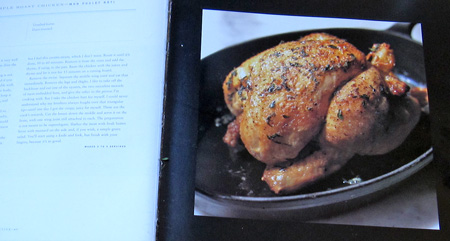
I was looking through Bouchon, one of my favorite books about cooking. I think of a cookbook as a book of recipes. Bouchon is so much more than that, it’s about food and cooking, with recipes used as illustration. In any case, I was thinking of writing a review of Bouchon. As I leafed through, I came across a two-page spread entitled My Favorite Simple Roast Chicken, Mon Poulet Roti. Below the title was Thomas Keller’s narrative description of how he roasts a chicken at home. On the facing page was a gorgeous picture of a roast chicken. It looked so good, I just had to give it a try.

Here’s the picture from the book that enticed me to make THAT chicken.

rc_book

rc_wrapped_chixIt looked pretty simple: Heat the oven to 450°F. Rinse and thoroughly dry the chicken. Truss it with butcher’s twine. Rain salt and pepper over the bird.
“Place the chicken in a roasting pan and, when the oven is up to temperature, put the chicken in the oven. I leave it alone – I don’t baste it, I don’t add butter; you can if you wish, but I feel that creates steam, which I don’t want. Roast it until it’s done, 50 to 60 minutes.”

I had questions. Roast on a rack? Brine the bird? I referred to page 192 to learn how to truss the bird and found the restaurant recipe, answering my questions. Rack: no. Brine: he brines in the restaurant, but not when he does it for enjoyment at home.

I can do this. I got out my chicken and my cast iron skillet. Continue reading

Pot Roast of Pork

Here’s what Fatted Calf had to say in their first week of March newsletter:

While I will gladly pile up stacks of dirty pans and bowls in pursuit of culinary glory and happily turn up the radio, roll up my sleeves and attack a sink of dirty dishes, if it’s the price for a good meal I have to admit there is something awfully appealing about a one pot wonder, the kind of cooking that takes its time but not yours.
The Versatile Pork Country Rib Roast slow cooked atop a bed of root vegetables makes for a tender, juicy pot roast.

I bought the Pork Country Rib Roast. This is not my first time, but I haven’t yet fixed on the perfect way to roast it.

When Niman Ranch was in the Market, they sold a Pork Country Rib with about 2 ribs and they sold it on the cheap, about $6 the pound. Then they changed their operation around and moved out of the market and I haven’t seen a similar “country rib.” I believe they described it to me as the first two ribs at one end or the other. I bring this up because Carol had a perfect way of roasting that country rib, so when I got one of those, I was pleased to let her do it.

p_pork_detail

But that country rib is not this country rib and I have a checkered history with this country rib:

Roasted Country Rib 12.09
I have a country rib roast from Fatted Calf, 3 ribs, 2.3 pounds, marinated with Mandarin oranges and Tournantes olives. C sez stick in the countertop convection oven on fan bake at 400° for 30 to 45 minutes.
Took 50 minutes to reach 150°. Yum.
I put it in the square roasting pan on no stick foil with a splash of water in the bottom. C sez she uses the pan that came with the oven and the wire rack to hold it off the bottom.

11.10
FC Country Rib roast with apples and walnut. 2.09 pounds.
Not so good.
First, on the wire rack the roast barely fit in the oven.
Second, it took way long to cook, and was more stringy than tasty, which I attribute to the HOT oven and the tight fit. I think I would go longer and slower next time (see Pernil Pork Roast by Mark Bittman).

My solution was to do nothing until I had an idea.

After rumination, the idea came on a trip to Sonoma to pick up some Cline wine and have Sunday brunch on a drizzly but not nasty day… “cook it like a pot roast, using a beef recipe as a guide.” I have a bunch of root vegetables from Mariquita that are taking up space in the refrigerator. Perfect. Continue reading

Fried Chicken

“The french fry did not become America’s most popular vegetable until industry took over the jobs of washing, peeling, cutting, and frying the potatoes – and cleaning up the mess. If you made all the french fries you ate, you would eat them much less often, if only because they’re so much work. The same holds true for fried chicken…”

Chapter 39: Eat all the junk food you want as long as you cook it yourself. FOOD RULES: An Eaters Manual by Michael Pollan

“Frying chicken is so much trouble that people didn’t used to make it unless they had guests coming over and a lot of time to prepare. The amount of work involved kept the frequency of indulgence in check.”

Chapter 60, Treat treats as treats.

FOOD RULES: An Eaters Manual by Michael Pollan

Back when I was in the Navy, stationed on a destroyer out of Norfolk, I was often invited to my cousin’s wife’s mother’s house in Suffolk, Virginia for Sunday Dinner. Fried chicken, mashed potatoes and all the good Southern stuff was a standby. That was the sixties and I’ve eaten fried chicken since – especially in the South when we would visit Eric at Duke or later when Brian lived in Tifton GA – but when I’d think about making it, I stopped when I read, “Pour about three-inches of oil into a deep heavy pot…” and looked for another recipe. And I never cared for Colonel Sanders fried chicken. Besides, how can you beat a roast chicken?

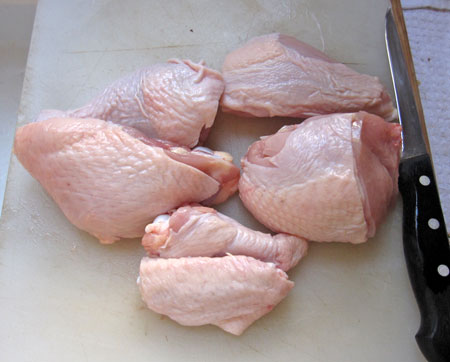
Now, I was fresh from a Knife Skills class taught by Dave-the-Butcher and I had a nice half-chicken from Marin Sun Farms. I needed to cut that chicken up for practice. Why not make Fried Chicken? I searched “fried chicken recipes” on the Internet – there are a gazillion of them out there – and settled on one from Emeril Lagasse when he was with the Food Network. It seemed straightforward and used his “Essence” to “kick it up a notch.” I had used his Essence before in other dishes… its good. I cut up my half-chicken. My knife skills class paid off; the pieces are tidy and beautiful, not “mangled as usual.” Six pieces: leg, thigh, two pieces of wing and two pieces of breast. Perfect for two.

c_six_pieces Combine a pint of buttermilk with 1 ounce Essence, 1 tablespoon salt, 1 tablespoon sugar, and 6 cloves garlic, peeled and crushed in a large nonreactive bowl. Stir to blend. Immerse the chicken in the mixture and refrigerate for at least 4 hours and for up to 24 hours. Continue reading
Chili: A New Year's Meditation

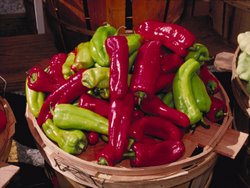
Cubanelle_Peppers
Base Recipe:
For 6 Servings plus leftovers;
(items in parentheses are optional):

(2 lbs. meat)
1 lb. onions
1 to 6 cloves garlic
3 Tablespoons fat
(1 lb. vegetables)
(1 lb. dry beans)
3 to 6 Tablespoons chili powder
(1 to 2 Tablespoons standard spices)
(1 to 2 teaspoons aromatic spices)
(thickener)
2 quarts liquid
(1 to 3 Tablespoons acid)

(starch substrate)
(your favorite condiments)

–Soak beans overnight in plenty of water;

–In a pot big enough to hold everything and then simmer for hours, brown the meat in 2 Tbsp. fat;

–Fry the chili powder and spices (and flour if used as thickener) with the browned meat for about 30 seconds, then set meat/spices aside;

–Add remaining 1 Tbsp. fat to pot and saute the onions over medium heat, scraping the meat/spice fond from the bottom and sides of the pot, until the onions achieve the desired shade of brown;

–Add chopped garlic and any vegetables to sweat until heated through;

–QUICK CHILI: Add soaked beans and liquid and simmer until the beans are cooked (1 to 2 hours);

–FULL CHILI: Add liquid, simmer 2 hours to soften the meat, add soaked beans and continue simmering until beans are done (1 to 2 hours);

–Serve over your favorite starch substrate with your favorite condiments

——–
NOTES:

For many years, on New Year’s Day, following the lead of my Father in some ways but heading in my own direction too, I’ve cooked chili. Lots of chili. I’ve tried many recommended recipes, but over time I’ve figured out that the very best way to do it is to find THE BEST ingredients that could go into a chili, and then create a new recipe around that. This year, in 2010, I made chili verde because we grew tomatillos in our garden and had frozen some at the end of the season; and I made a dark chili using beef heart and home grown beans. Both were outstanding, especially with a splash of Navarro verjus just before serving (see “ACID” below).

Let’s face it, more than almost any other meal, “chili” as a recipe is much more of a concept than a specific dish. Any recipe that ostensibly originates as a one pot dish from the Hispanic Southwest US (chili con carne = meat and pepper stew), yet has famous versions in Cincinnati (without chili powder!), New York, and Los Angeles, is inherently mutable.

That said, it’s still got a specific personality: a stew made in one pot that has meat and/or beans in it, and it should feature the namesake ingredient — Capsicum annuum — in one, several, or all of its glorified forms (sorry Cinci). And that’s pretty simple in concept: fry some meat, add spices, add onions and veg, add stock and beans, let bubble, and you’re done. It being that simple, there are millions of variations, all of them inevitably labeled “The Best…” or “The Ultimate…” or even “Traditional/Original/Authentic…”
Continue reading

Meatloaf fit for a foodie queen

Love meatloaf. Love meatballs. Since I love them so much, I’m very discerning about the cooking and eating of them. I have my favorites. For meatloaf, it is K-Paul’s Cajun Meatloaf — dubbed the Best Meatloaf of all Time by me back in ought-six — but I’ve been making it since I got his cookbook in 1984. For meatballs, the Polly Dutton meatballs that I learned to make from Polly as an Ensign in the Navy, living in Coronado. That said, I’m always trying new stuff. If the recipe looks good, I’ll give it a shot in hopes that it can topple K-Paul or Polly.

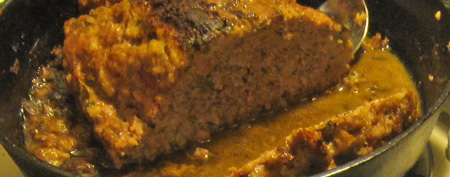
m_detail_meatloaf This meatloaf was published in the New York Times Magazine in July, 2009 and called Fancy Meatloaf for Nora Ephron. It looked good enough to make and Sam Sifton’s story made it even more intriguing. I belatedly got around to making it recently. I’ll let Sam Sifton introduce his meatloaf:

“I was invited to cook dinner for Nora Ephron. This is what happens if you hang around New York long enough, writing about food… You end up at ground zero. The invitation was to a potluck. Guests were meant to bring food inspired by Ephron’s career or by the woman herself. It was essentially high-stakes food charades. My draw was meatloaf. Ruh-roh. Ephron is famous for her meatloaf, a version of which is on the menu of Graydon Carter’s new restaurant and clubhouse, the Monkey Bar. And cooking plays no small role in her new film, “Julie & Julia.” Just thinking about cooking for her, I felt sick and wondered if bringing a few bottles of cold Pellegrino or Laurent-Perrier Champagne would do instead. I’ve read widely in the literature. Nora Ephron loves Champagne. But I got down to cooking. I started to grind. What was borne out by my experience I pass along as gospel: Do not make Nora Ephron’s meatloaf for Nora Ephron. This is a sucker’s play and remains true even if you’re cooking for someone’s aunt on a Saturday night in Fort Myers, Fla.: Don’t make a person’s signature recipe for that person, ever. Instead, take it as a starting point. Move the ball along. And practice. A couple of years ago, Ruth Reichl edited a huge cookbook that was built out of the recipe files of Gourmet. In it is a meatloaf recipe that combines beef and veal, pancetta and Parmesan, brightened with lemon zest and white wine. It’s a luxurious feed, and I’d run versions through the oven before deciding to take it on the road.”

I had all the ingredients on hand except the Italian bread and thin sliced pancetta. I was planning to try and recreate rice meatballs served to me at a dacha outside Kyiv, but reading about Sifton’s meatloaf made my mouth water so I usurped the meats. Meatballs next time. The last time I made K-Paul, I mixed the meat with my (sorta) new Kitchen Aid mixer toy. I found it gentle, quick and non-messy, although mixing meat with my hands is fun and sensual in a way. Continue reading

Looed Chicken

… and a swell macaroni salad
… and a vibrant rice salad for good measure.

lc_detail

Back in the day, Looing Sauce was a staple in our household. It is a soy sauce based liquid used for poaching meat, primarily chicken, never fish. We glommed onto it back when Jeff Smith’s The Frugal Gourmet Cooks Three Ancient Cuisines: China – Greece – Rome was brand new, 1990. I was a big fan of his TVw_the-Frug show and bought the book when I was home on R and R from Jerusalem. I kept jars of Looing Sauce in the refrigerator and used it – at least – once a week. I transcribed it and included it as an early entry in my developing eats4one cookbook.

Years passed and it kind of got lost in the shuffle when we moved to San Francisco in 1992.

Recently, I bought a small half chicken – just 1.8 pounds – at the Mountain Ranch stand at the Saturday Market.

What to do with it? Hey, we haven’t had Looed Chicken for a while. I couldn’t find it in my computer recipe files. I still have the book, of course, but its gotta be somewhere on the computer. I went into the archives and found it in the original eats4one and made a copy for my active files.

I had to go out and find star anise. I still had some broken pieces in my spice cupboard, but its gotta be 20 years old. How else does one use star anise? So I whipped up a batch, and poached my little chicken.

lc_out_of_pot

OK, it ain’t pretty, but it sure tastes good and looks way better on the plate.

I served it over rice with a side of Romano beans and tomatoes. Oh my… it was nice and moist and flavorful.; better than I remembered. Way to go Frug.

lc_served_sitting

Even with that little bitty chicken, we had enough bits and pieces of meat left over to make a swell macaroni salad. When I did this year’s Super Bowl Party I fashioned a macaroni salad with ham, based on a Cooks Country recipe for BBQ Macaroni Salad. They add BBQ sauce to the mayonnaise and it was pretty good. In my version using Looed Chicken, I substituted Looing Sauce for the BBQ sauce. Continue reading

The magic of caul fat

Lamb Crepinettes, potato salad, haricot vert
K-Paul Meatloaf, melted potatoes, broccoli

c_caul_fat_detail

I volunteer at the CUESA Kitchen two Thursday evenings a month (more or less) to help with cooking classes. We prep food for the students, wash dishes and set up and break down equipment and furnishings. The most recent class was “Sausage Making” taught by Dave “the Butcher” Budworth.

On my way to the class I had visions of meat grinders and sausage casings arrayed around the rolling stainless steel pods used as counters. There was none of that. There were mounds of herbs ready to be chopped and spices ready to be portioned, boxes of ground pork, ground lamb and caul fat. The class would not be making sausages in casings as I had envisioned, but crepinettes.

I’m familiar with the word because Fatted Calf sells crepinettes at the Ferry Plaza Farmers Market, but I had never seen nor eaten a crepinette. That evening I learned how to make a crepinette and Saturday, dined on my own homemade crepinettes.

sage to pick and chop

sage to pick and chop

c_chopped

Sage was only one of many ingredients that went into the sausage. We also picked and minced fresh thyme leaves and parsley, and minced long green Anaheim chilies and garlic.

mise en place

mise en place

Each pod was set up with a tray of sausage making supplies. Ten students worked at each station.
.

Dave holds a piece of caul fat

Dave holds a piece of caul fat

Caul fat is the spider web of fatty membrane that encases the internal organs of pigs, cows, and sheep, and it can be used in a variety of meat-friendly ways. Chef Vuong Loc of Portage Restaurant in Seattle calls it “kind-of like the original combi oven, because it allows the meat to roast and steam at once. It can get to a super hot temp because it’s fat, but it also keeps the moisture locked inside. It gives the meat a unique texture and adds flavor.” Continue reading