K-Paul Realized

Stuffed Pork Chops

I got so hungry writing the review of Chef Paul Prudhomme’s Louisiana Cooking that I just had to cook something from that book.As luck would have it, a colleague of Carol’s was coming over for dinner the following Sunday to watch the Academy Awards. Good timing.

I went through the book carefully to find something appropriate. I wasn’t in the mood for fish or seafood, so that limited the possibilities. Pork Chops stuffed with a spiced up sausage-apple mixture looked good. It can be prepped ahead and it spends over an hour in the oven so that once Sarah arrives, the cooking would be virtually completed. I wanted to roast some beets, as well, so they could share the 400-degree oven with the chops.

12w-chops-served1

Saturday at the Farmers Market, I stopped by Golden Gate Meat and got 4 Frenched pork chops. I had the butcher cut a pocket in each for stuffing – not a difficult task, I could do it myself, but he’s a pro. Looking at the chops in the meat case, they didn’t look extra big, so instead of 3 folks, 3 chops, I got four. Besides, the recipe is for six chops and can’t readily be halved… leftovers of any K-Paul dish are good. I got some mild Italian sausages to use as the ground pork ingredient.

Sunday was chilly and rainy, a perfect day for cooking. I started the mise en place mid-afternoon. Once the “meez” (as Anthony Bourdain calls it) is done, the cooking is a breeze, K-Paul writes very explicit instructions. Continue reading

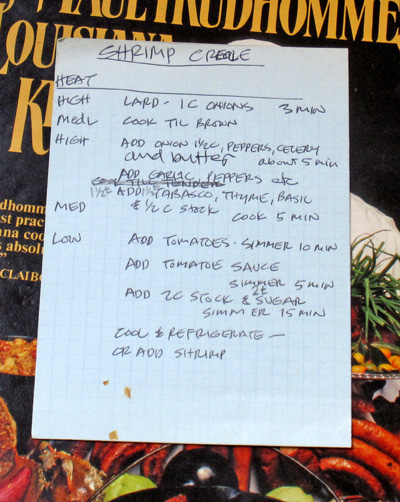
Chef Paul Prudhomme’s Louisiana Kitchen

Chef Paul Prudhomme’s Louisiana Kitchen, Morrow, 1984
A Review

My hardcover copy of Chef Paul Prudhomme’s Louisiana Kitchen is dog-eared, food-stained and some of the pages are coming out of the binding. It is inscribed, “From Robert and Katy, 1984,” and it is still a “top shelf” cookbook in my kitchen library.

I prize it because the recipes have a zing to them and it contains the best meatloaf recipe of all time. Chef Paul calls it Cajun Meat Loaf. I call it K-Paul Meatloaf.
63w-k-paul-book

That’s just by way of introduction. His “saucy” foods – Creoles, Gumbos, Jambalayas – are spicy devils, but in no way fiery; even my wife-of-tender-palate likes them. His Basic Cooked Rice and Dirty Rice make a good bed for sopping up the juices.

His recipes seem intimidating at first – long lists of ingredients and long descriptions of methods. I made little go-by cards to put up over the stove. Once I dutifully did my mies en place I learned they had a drib of this and a drab of that, and the preparation had a rhythm to it. Not so hard after all.

64w-k-paul-go-by

I had the good fortune to eat at K Paul’s Louisiana Kitchen in New Orleans when I was there on business on a balmy night in the late 80’s. I was about 20th in a long line – they don’t do reservations – and noticed that some people in line had drinks – hey, it’s New Orleans. Just as I was about to go to a nearby bar for my own drink, a woman came down the line asking, “any singles.” I quickly volunteered and was seated with a dentist, his wife and son from San Diego. I don’t remember what I had after the Dirty Martini and before the Sweet Potato Pecan Pie, but the experience is etched in my brain.

When BUTTER was BAD, Chef Paul wrote a book called Fork in the Road. His name on the cover caused me to buy the book straightaway. Can Chef Paul really do “healthy low fat?” I guess he did it, but all the taste went away. After one meal, I banished that book from my library.

I went on using Chef Paul Prudhomme’s Louisiana Kitchen two or three times a year – OK, more times just for the meatloaf – moderation is the key.

Dang all, I’m hungry!

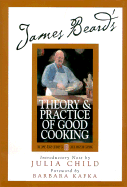
James Beard’s Theory and Practice of Good Cooking

James Beard’s Theory and Practice of Good Cooking, Knopf, 1977
A Review

9780762406135

This is my go-to book about cooking. As the title implies, its more a book about cooking than it is a cookbook.

It has recipes, of course, but the recipes are there to illustrate the principles and methods of cooking. The chapters tell the tale. From the front: Boiling, Roasting, Broiling and Grilling, Braising, Sautéing, Frying, Baking. For example, when I buy a piece of Corned Beef for a St. Patrick’s Day feast of New England Boiled Dinner, James Beard starts with corned beef and concentrates on getting that and the vegetables cooked properly… indeed, cooked separately and for different lengths of time and brought together only at the end.

We bought a fish poacher in Boston to poach a four-pound salmon for a party. In James Beard’s Theory and Practice of Good Cooking there is more than one recipe for poached fish and in my cooking-for-parties phase I poached a few salmon, as well as other fish and shellfish. I especially like the Poached Fish with White Wine Sauce and Shellfish a la Nage, “a la nage” is the French term for a style of preparation in which shellfish are both cooked and served “swimming” in a white wine court bouillon and eaten hot, tepid or cold. Shrimp, crayfish or small lobsters are excellent prepared in this manner. Lovely.
I could cite similar examples from the other chapters, but these will give you the drift.

I grew to love James Beard. Beard encouraged me to use my fingers to mix pate, to press my fingers on the meat to feel for proper doneness; to substitute ingredients and to feel the cooking, rather than read it. He told me about meats and fish and vegetables and herbs and spices, where they come from, what they’re about, in an interesting, chatty way. It would have been nice to know James Beard. He led me to make up recipes based on what caught my eye in the market, or more likely, what was on hand. It is illustrated with informative line drawings. Sadly, it’s out of print, but it can be found used.

1300 on Fillmore

A Birthday Treat

ms1

Carol was being very mysterious about my birthday. She kept saying she would take me out, but she said she wouldn’t say where. Then, “The place I wanted to take you closed, but I have another place in mind, but I won’t say where.”

Okay by me… as long as I know I won’t have to cook.

When she got home from work, she said, “I couldn’t get a reservation, but maybe we should just go anyway.”

“It’s your party,” I said. Clearly, she couldn’t wait to surprise me.

“Well… let’s go,” she said, “I’ll drive. It’s someplace we’ve never been before.”

“So we’re driving,” I said, “That rules out about 20 places.”

As she crossed Van Ness, I said, “I smell Fillmore Street.” She grunted. She turned left on Fillmore. Where haven’t we been on Fillmore, I wondered. She drove on. “Hmmm, maybe Yoshi’s?” I said. She said no, but when we got to Yoshi’s, she said to look for parking. A space opened up on the other side of the street. She made a quick left into it, a three-point turn and parked… a very city-like maneuver. In the near corner of the glass Yoshi’s building, we could see a restaurant looking place. No sign, but a big wooden door welcomed us. We went in. Continue reading

Thanksgiving 2008

Eats goes to New England

We came from San Francisco to Brunswick, Maine. Folks assembled came from Monroe, Maine; Providence, Rhode Island; Seattle, Washington; Beacon, New York; Bar Harbor, Maine; Columbus, Ohio; Portland, Maine, Brookline, Massachusetts, London, England; and Grundisburgh Woodbridge Suffolk England. All are connected to our hosts, Katy and Bill, and have been part of this gathering over the years. Katy was our neighbor on Harrison Street in Newton for many years.

Eric and Katy

Eric and Katy

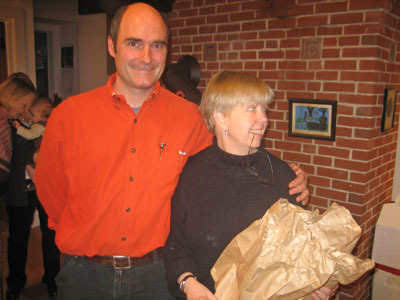
“Marc, Carol, Brian, Eric and Alison,” Katy said, “meet Ethan and Sally, Chloe, Kareim, and Suha, Michael and Felicity, Conner, Elisa, and William, Dan and Jill, Susan and Andy, Peggy and Marie, Donna and finally, Phoebe.” Eric and Alison live nearby in Monroe, Maine and attend this Thanksgiving celebration annually, so they know folks, the rest of us haven’t been for years so we’ll get to know them over the afternoon and evening.

It all began on Madison Avenue in Newton Massachusetts somewhere in the early 1990’s and continued when Katy moved to Maine in the mid ‘90s.

As with all good gatherings, the kitchen is the hub. Everybody is involved at one time or another, cooking, assembling, serving, carving and of course, eating. A spread of appetizers occupies the breakfast area: cheeses, liver pate, dilly beans, bread and butter pickles, breads and crackers. Grazing was happening.

Continue reading

Fennel and Berkswell Cake

I saw some really nice, fennel at the farmers market recently and it reminded me of a fennel cake I’d had in London, so I went to Cheese Plus and asked if they had “Beekswell” cheese (that’s what was in my notes). Ray, the owner, said they had Berkswell, a raw milk sheep cheese from England. I figured that must be it, and bought a wedge of nearly a half-pound.

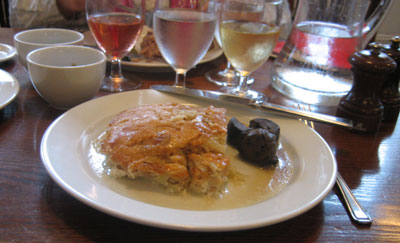
Fennel and Berkswell Cake at St John Bread and Wine in London

Fennel and Berkswell Cake at St John Bread and Wine in London

St. John Bread and Wine is Fergus Henderson’s smaller restaurant in the Spitalfields area of London (northeast). We visited last October when we also toured France and Spain. I asked the server how it was made, it seemed so simple. She consulted the kitchen and advised that, “it is sliced fennel, layered with Beekswell goat cheese and baked. To finish, the top was spread with a mixture of milk and cheese and broiled for 2 or 3 minutes to brown.”

They served the cake with pickled walnuts.  (After making my cake, I learned that Cheese Plus sells Pickled Walnuts in a can.)

Continue reading

Eats goes to Boston

…on the way to Thanksgiving in Maine

Since son Brian moved to Southern France six years ago, we’ve met in Europe for our family get-togethers – except for son Eric’s 40th birthday in 2004, celebrated in New Hampshire and Maine. This year, it was great to get reacquainted with Boston friends and spend Thanksgiving with friends and family in Maine.

Millennium Bostonian Hotel

Millennium Bostonian Hotel

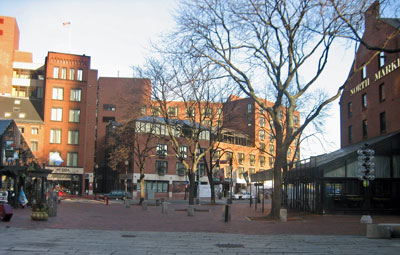
We touched down in Boston about six o’clock Friday and checked into the Millennium Bostonian Hotel, tired and hungry. If you’ve lived in Boston, you don’t return to Boston without dinner at Legal Seafood. We didn’t even take the time to unpack before walking through Faneuil Hall Marketplace to State Street and across the “Big Dig” park. It was plenty cold for us Californians – about 25 degrees – but we were comfortable in our saved Boston overcoats… until we turned the corner onto State Street and the wicked wind cut through our woolens like a serving spoon through soufflé. The lights of Legal warmed our soul and a few steps later; the blast of warmth from the vestibule took care of our bodies – quickly followed by a Macallan and Manhattan, which provide their own kind of heat.

Legal Seafood

Legal Seafood

some fine steamed clams

some fine steamed clams

Sooner than expected, we were escorted from the bar, through the busy and cheerful dining room to our table. We ordered the quintessential Legal Seafood antipasto: cup o’ chowdahbucket o’ steamers and , to be dipped in broth and/or melted butter before dropping the morsel in to one’s mouth, open like a baby bird’s, to receive it. Yum. That’s livin’.

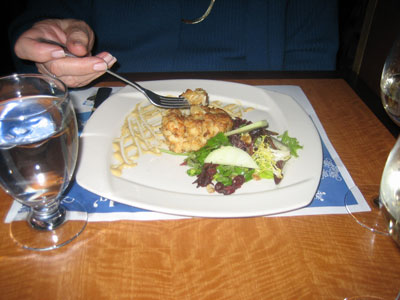
Carol's Crab Cake

Crab Cake for Carol

As entrees I had the Scrod and Carol a big ol’ Crab Cake. What a lovely welcome to New England.
Continue reading

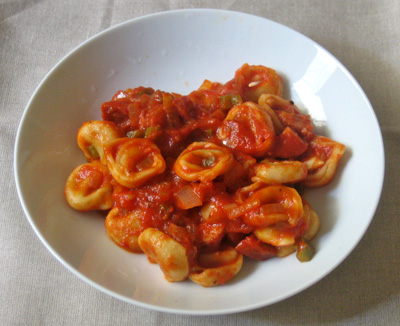
Tortellini with Tomato Sauce

This is what Eats for One is all about.

tortellini served

tortellini served

You have noted my harping on the creative use of leftovers; Monday’s lunch presented a perfect example. In order to have leftovers, you have to have meals (duh!), and this is what I had been cooking.

About a week ago, I made a K Paul Meatloaf and had half a green bell pepper left over. I put it in a baggie and stuck it in the crisper.

Last Wednesday I made a pan stew of scallops, peas and pearl onions. The recipe –from the Tra Vigne Cookbook – calls for 1/2 pound fresh pasta in a shape about the size of a pearl onion. I usually use conchiglie (little shells) or gigli (little lily) but this time I used fresh cheese tortellini, which comes in a ten ounce package. So I had some fresh pasta left over.

Thursday, I cooked Swordfish Provencal from a recipe I found on the Beyond Salmon blog. It calls for a 28 ounce can of diced tomatoes, drained. I saved the juice/puree in a POM jar.

Saturday, I made braised chicken thighs with tomato, capers, anchovies & olives from a Janet Fletcher story on chicken thighs in the Chronicle. It calls for a 28 can of whole peeled tomatoes, drained. More drained goodness. In both cases, I used cans of Italian San Marzano tomatoes; they’re more expensive, but well worth it.

Looks like lunch.

I put a pot of water on to boil. While that was going on, I diced the bell pepper put it on to sauté in olive oil, about 5 minutes. While the pepper softened I chopped half an onion and put that in with the pepper (another 5 minutes). I diced an Aidells Cajun Style Andouille (not left over) sausage and threw that in followed by the tomato sauce and seasoned it with salt, pepper and thyme. While the sauce cooked down a bit, I cooked the pasta (3 minutes), drained it and added to the tomato mixture. I let that bubble a little to get the flavors all going together, and served myself a nice lunch.

EATS ON THE ROAD

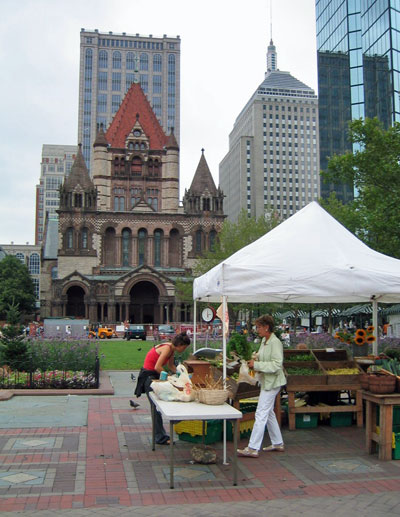
Copley Square, Boston

Copley Square, Boston

Eats for One is going on the road to see friends and sights in Boston and spend Thanksgiving with sons Eric and Brian in Maine, where Eric is raising his own turkey. I’ll surely have tales to tell when I get back.

Eric -- out standing in his field

Eric -- out standing in his field

Roasting Peppers

“3 red, or colored peppers, roasted, seeded and peeled”

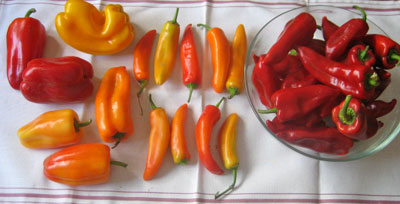
That’s often all the recipe says about the peppers. Everyone has their own roasting method and I’ve tried them all. Recently, the Mariquita Mystery Box was chock full of colored peppers, and not only that, Carol wanted an extra bag of Red Piquillo Roasting Peppers to make her famous pimento cheese spread.

m_lode_o_peppers.jpg

a mother lode of peppers

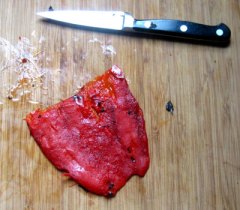
Roasting peppers takes time. My go-to method is to hold a pepper over a gas flame until blackened, put it in a paper bag to ‘steam’ and then scrape off the skin with the back of a knife. Easy, effective, messy, takes time. Since I had 15 assorted peppers (Hungarian Spicy Peppers and other red and yellow) plus an equal number of the Piquillo to deal with, I thought I’d check out another method, so I went on line to Cook’s Illustrated and searched for roasted peppers. Here’s what CI had to say:

‘After flaming, broiling, and baking dozens of bell peppers of every color, both whole and sliced, we find that slicing and oven-broiling the peppers yields superior results.’

STEP BY STEP: Steps to Perfect Roasted Peppers
Pre-heat the broiler for at least 5 minutes.
1. Slice 1/4 inch from the top and bottom of the pepper.
2. Gently remove the stem from the top lobe.
3. Pull core out of the pepper.
4. Slit down one side of the pepper, then lay it flat, skin side down, in one long strip. Use a sharp knife to slide along the inside of the pepper removing all ribs and seeds.
m_cleaned.jpg
5. Arrange the strips of peppers on a baking sheet, skin-side up. Flatten the strips with the palm of your hand.
6. Adjust oven rack to its top position. If the rack is more than 3 1/2 inches from the heating element, set a jelly-roll pan, bottom up, on the rack under the baking sheet.

m_broiled.jpg

7. Roast until the skin of the peppers is charred and puffed up like a balloon but the flesh is still firm. You may steam the peppers at this point or not, as you wish. Start peeling where the skin has charred and bubbled the most. The skin will come off in large strips.

m_peeled_too.jpg

Sorry CI, that’s just WRONG.

The peppers turned out leathery and really really hard to peel, and why not, cut open, spending time in the broiler dries them out. I don’t know what equipment CI used, but I used a countertop convection oven, which is relatively new, reliable and holds its temperature very well.

C’mon CI: You’re usually reliable, but sometimes you over analyze. Continue reading

Lard

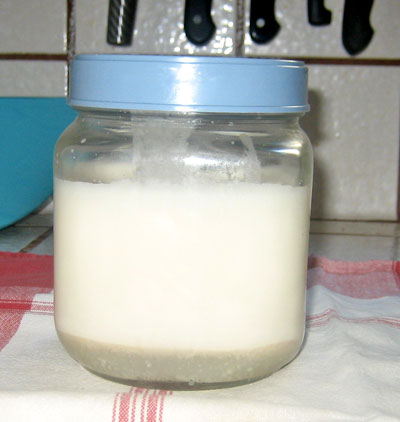
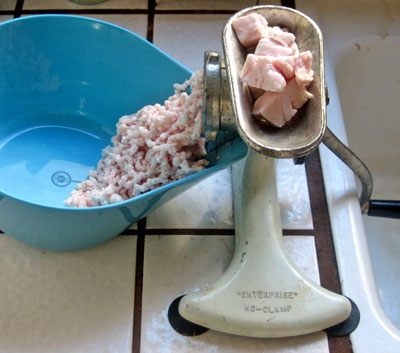
lard_14.jpgA few weeks ago, the Chronicle Food Section ran a story by James Temple called Loving Lard. While noting the bad rep of lard, it focused on top restaurants that are using lard for its nutrition and flavor. It included a detailed history of cooking fat, as well, from lard to Crisco, to “the other white meat” and back to the present yearning for flavor, moist, flavorful pork and yes, lard.This came at an appropriate time, as there have been enough murmurings in the foodie community to raise my curiosity and desire to cook with lard myself; but I didn’t know where to start. Viola! The article, as well as educating me, told me where to go.At the Golden Gate Meat counter at the Ferry Building on Saturday morning, I asked a butcher if they had lard. “Do you want the leaf lard?” he asked. Remembering something about leaf lard being the best, I said yes, and he handed me a shrink-wrapped packet of white matter, about two pounds.When I got home, I whacked off a bit and melted it to fry some potatoes for breakfast. Yum.I re-read the article and learned that my leaf lard needed to be rendered, a simple, but two-day process. This is what it looks like.

lard_2.jpg

leaf lard comes from the area around the abdomen and kidneys

lard_3.jpg

my meat grinder handed down from my mother… or perhaps her mother

Continue reading