English Peas and…

grilled things…
and pasta.

english-peas

It’s the height of the season for English peas. I get my peas from the Iacopi stand at the Ferry Plaza Farmers and find them hard to resist, though I limit myself to a bag about every two weeks. A small bag of the Iacopi peas produces about two cups of shelled peas.

I love the concept and the look of English peas. I even enjoy the shelling. But often, I just don’t know what to do with them. One of my favorites is creamed potatoes and peas. Peas and noodles are good, as well. I don’t like to just cook the peas as a vegetable… it reminds me of grabbing a bag of frozen peas and cooking them as a last minute vegetable addition to a meal. Not that there’s anything wrong with that; it’s just so… ordinary. It seems to me that the cost and effort it takes for fresh English peas demand more than that.

Last night I had a lovely piece of swordfish and was thinking about doing it on the grill. What to go with? During the evening news, I sat on the couch and shelled my peas. How to prepare?

red-spring-onion

I had a couple of spring onions and a larger red spring onion. Those sweet things are good with peas, and hey… I could grill the onions with the fish. I was on to something. When I went to get some noodles out of the cupboard, I saw a box of Piccolini – tiny farfalle pasta, a new product from Barilla – “cooks in only seven minutes.” Interesting. The fish will cook in seven minutes, the onions will take about seven minutes on the grill and the peas will cook in four or five minutes. I had a plan.

barilla-piccolini

I lit the grill, rinsed, dried and seasoned the swordfish with salt and pepper. The peas were shelled, I had about 2 cups, so I measured two cups of pasta. I trimmed the onions, cut each in half and, in a shallow bowl, tossed them with olive oil and seasoned with salt and pepper. I put on a pot of water for the pasta and peas and preheated the countertop oven to 175°F.

When the grill was ready, on went the onions and the swordfish. Seven minutes later the onions were soft with a bit of crunch and mildly charred. I chopped those and put the fish in the oven to keep warm.

Just before the pasta went into the pot, I generously salted the water, threw in the pasta and set the timer for 7 minutes. A bit after the timer read 5 minutes, I threw the peas into the pot.

When the dinger dinged, I drained the pasta and peas, tossed a couple pats of butter and a gurgle of good olive oil into the hot empty pot, poured in the peas, onions and pasta and tossed.

pasta-peas

That was dinner, and oh so fine. The fish was fresh and succulent, the peas, onions and pasta were the perfect counterpoint. Yum.

I sometimes wonder; is it worth lighting the grill and letting it warm up for 15 minutes to use it for only 7 minutes? The answer is an emphatic YES. And that’s why I retired my trusty Weber charcoal grill and got the swell Weber Q gas grille.

Postscript:
The leftover pasta with peas and onions made a great lunch, heated with a can of tomato soup.

soup-w-pasta-peas

Sunday Breakfast

Carol and I religiously eat dinner together at the dining room table. As for other meals, it’s catch as catch can – we each prepare what we want when we want it and eat at the kitchen table. She’s a sandwich person, I’m not; I tend toward soup or anything made in a skillet.

Sunday morning, I had a hankering for eggs poached in some kind of tomato sauce. That’s a good start. Although I have various homemade tomato sauces in the freezer, none were ready to go.

I did have a can of Progresso Vegetable Classics Tomato Basil Soup in the drawer. That’s pretty good for use as tomato sauce, thick and tomatoey.

I got out some celery to chop into the soup, but with the refrigerator door open, spied some excess fava beans that I had shelled and blanched for a lamb stew. Even better.

I got out the eggs and put two in a bowl of hot tap water. That will warm them up a bit… it doesn’t seem right to put cold eggs into hot sauce.

favas in one bowl, shells in another

favas in one bowl, shells in another

Put a small skillet on the stove over medium high heat, and when it was pretty hot, covered the bottom with olive oil, added the favas and cooked a bit, tossed and cooked a bit more. Continue reading

Tomato Sausage Bake

Last August, I wrote a piece called Cooking from the TV which compared the TV version of a recipe to the book version – and the perils thereof. The subject was Tomato and Sausage Bake from the Food Network show, JAMIE AT HOME by Jamie Oliver.

This week I had some heirloom tomatoes from Bruins Farms market stand (greenhouse tomatoes to be sure), some thick bacon, and a fine coil of sausage from The Fatted Calf. What a perfect circumstance to revisit that recipe.

Starting ingredients

tomato-sausage-bake

Clockwise from the tomatoes:
Tomatoes – three kinds of heirlooms… you can see some rosemary in the pan already.
Focaccia — goes onto the serving plate to capture the juices
New potatoes – not part of the original recipe, but what the hell, they can roast right along with the rest.
Unpeeled cloves of garlic just below the potatoes.
Bacon – this has already been rendered in the roasting pan for about five minutes.
Thyme
Basque sausage from The Fatted Calf

Assembled in the roasting pan

tomato-sausage-bake-1

First, I put the roasting pan in a 375 oven for five minutes or so to render the bacon. Drain the bacon on paper towels. Put the tomatoes in until the skins blistered and I could pull off most of the skins with tongs.
Out of the oven, I slid the bacon under the tomatoes and added the potatoes and sausages. Back in the Countertop Convection Oven on fan bake for 30 minutes.

tomato-sausage-bake-2

Out of the oven and ready to serve over the focaccia. Drizzle with your good olive oil and you are set for a flavorful and comfortable dinner. Yum.

Dinner Goat

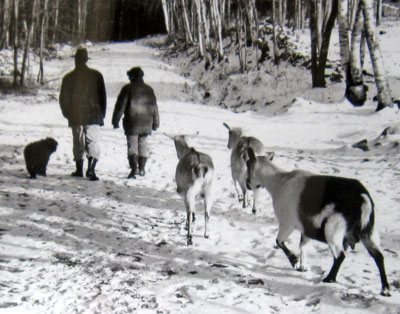
Winter Walk, Waldo County (Maine) Independent, 1992

Winter Walk, Waldo County (Maine) Independent, 1992

With five-hour goat on my mind, I bought a 3 1/4 pound Goat Leg at the Saturday Farmers Market from Marin Sun Farms [$26]. I’d been looking since the Five-Hour Goat story appeared in the New York Times the first of April.

Monday, I took the fine looking goat leg out of the refrigerator at 12:30 and, still wrapped, checked to see if it would fit in one of my Dutch ovens; wouldn’t. The leg had a four-inch Frenched bone protruding out of the meat. What to do? I could take it to Whole Food and have the butcher there whack off the bone. That would be uncool. Better idea… go to Cole Hardware and buy a small hacksaw.

The Palestinian convenience store is a few doors down from Cole; intimidated by the 26 cloves of garlic, I walked over and bought two heads, just in case. Six bucks for the hacksaw, two bucks for the garlic, $26 for the leg; enough for two or three meals, pretty good.

58w_leg_w_saw

I sawed off the bone and the leg fit nicely in my blue oval Le Creuset pot. Continue reading

Food in Wine Country

Healdsburg is a bit of a trip from San Francisco, but we needed
to go to Simi Winery to pick up our Wine Club shipment. You know how the wine clubs work… you join, they ship two or three bottles of wine to you each quarter and in exchange, a you get a big discount – 25 to 30% – on any wine purchased. At Simi, I had signed up for pick-up only; that saves on shipping and makes a good excuse to go to the wine country from time to time.

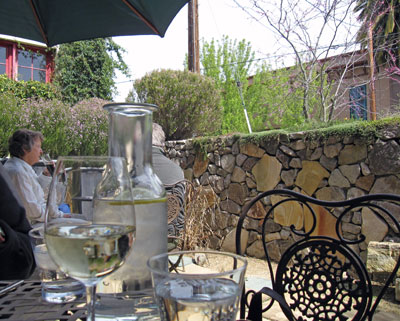
Of course, by the time we got to Healdsburg, we were ready for lunch. Barndiva is a restaurant that Carol and I had visited a number of times and always enjoyed. We sat outside in the garden and delighted, still, in the spring day as we ordered Tempura Beer Battered Shrimp to start.

Barndiva garden

Barndiva garden

After bringing wine, the waiter returned with a plate of unexpected goodies: “We’re out of shrimp, so the chef whipped up a little something in its stead – Tempura Beer Battered Cod with a celeriac remoulade for dipping, and Tempura Beer Battered goat cheese with honey for dipping.”

Oh my… I’m glad they were out of shrimp. The cod was light and moist in a tender batter, the remoulade lending a nice tangy complement. The cheese ball dipped in honey exploded in my mouth with warm creamy sweet and salty goodness. Yum. Continue reading

Curried Carrot and Fennel Soup

03w_carrot_soup

I’m a fairly regular subscriber to the Mariquita Mystery Box and it’s all my wife and I can do to use it up in two weeks. We ate out a couple times, so I recently had a plethora of carrots from two installments of the Mystery Box. I needed something to use up a LOT of carrots.

Janet Fletcher did a piece on Simple Spring Soups for the Chronicle a few springs ago (2006) including Carrot, Fennel & Potato Soup. I made that soup a couple of times, but thought, while good enough, it needed some oomph. I decided curry might do the trick so I modified her recipe to suit my taste thoughts.

Curried Carrot and Fennel Soup
Based on Janet Fletcher’s Carrot, Fennel & Potato Soup
Serves 4 to 6

INGREDIENTS:
2 tablespoons unsalted butter
1/2 yellow onion, minced
1 1/2 tablespoons good curry powder
3 to 4 medium carrots, peeled, in large dice
1/2 large bulb fennel, cored and chopped
1/2 pound Yukon Gold potatoes, peeled, in large dice
4 cups chicken or vegetable stock, plus more if needed

Heavy cream or half-and-half, optional
Salt and freshly ground black pepper

Well, judging from what I had on hand in my onion basket and vegetable drawer – the Mystery Box again – here’s what I actually put together: Continue reading

Meet Your Meat

Panel on the Art of the Butcher
The Society for Agriculture and Food Ecology (SAFE) and Meatpaper present a panel discussion highlighting the stark contrast between animals delivered from local slaughterhouses and plastic-wrapped grocery store steak. They will talk about the retail component of the local meat system and how this can change the relationships that chefs, home cooks, and diners have with their meat. “We want to show how animals can be part of a vibrant and diverse agricultural system and some part of our diet as responsible omnivores.” The discussion will be followed by a demonstration by Chef Ryan Farr on how a whole carcass is broken down into cuts of meat. 7:00pm, 105 North Gate Hall, UC Berkeley Campus.

meet-meat

I took the opportunity to attend The Art of the Butcher on a balmy Thursday evening. Geez Louise, I hadn’t been in a college lecture hall for a long time. North Gate Hall is the Journalism building at Berkeley, an excellent Arts and Crafts building with steps inside meandering up through the building, mirroring the topography outside.

the hall

the hall

I entered Room 105 at the top of a stepped hall with loose, “writing-arm” wooden chairs on the risers. I was there for the panel on good meat practices and to see a pig butchered.

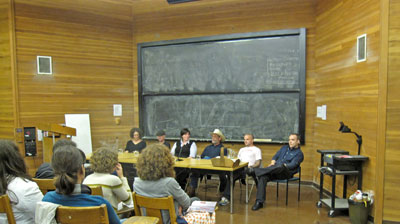
30w_art_of_butcher_panel

The panel, left to right:
Melanie Eisemann (Avedano’s),
David Budworth (Marina Meats, Avedano’s),
moderator Marissa Guggiana (Sonoma DirectMeatpaper)
Mark Pasternak (Devil’s Gulch Ranch),
Nate Appleman (A16, SPQR, Urbino),
Ryan Farr (Ivy Elegance)

Some notes from the panel discussion –

Butchers David, Nate and Ryan were chosen because they break down whole carcasses at their respective establishments, rather than buy meat by the box. A16 buys two pigs a week on Wednesday, Nate Appleman breaks them down in the restaurant, and they use every bit, including the skin. A16 is “based on Southern Italy, which is based on poverty.” While they serve all the familiar cuts, they also serve those you probably won’t find in your supermarket. Continue reading

A Movable Feast

A Movable Feast
Tuesday, March 3, 2009
Luce at the InterContinental San Francisco

28w_movbl_feast

The Center for Urban Education about Sustainable Agriculture (CUESA) presented the first installment of the First Annual Movable Feast: Twelve Chefs Celebrate Six Farmers in a Series of Seasonal Suppers. Occurring once a month, the Series is intended to honor the relationships within the chef community and between chefs and farmers all while bringing attention to CUESA’s mission.
Chefs: Dominique Crenn of Luce and Chris Kronner formerly of Slow Club and Serpentine.
Featured Farmer: Louis Iacopi of Iacopi Farm, Half Moon Bay.

About 50 folks gathered for a true feast in the elegant and spacious Luce, where the curved glass windows looked out on the active corner of Howard and Fifth Streets. My wife and I were seated at a banquette on the inside wall. There were no speeches or ceremony, just good food and wine. Those present knew why they had come. Between courses, CUESA Executive Director Dave Stockdale circulated among the guests and introduced farmer Louis Iacopi. The chefs, Dominique and Chris, circulated throughout the evening to answer questions and check on our reaction to the dishes. Wines were paired with each course and served with an explanation of the selection.

The menu was served in courses on large white plates. The portions for each course were small, but by the end of the evening, our bellies were full and our senses heightened.

The menu is presented below, with my comments in italic. I took no food-porn pictures because I thought it inappropriate for the occasion – also, I forgot my camera.

It was a most agreeable and enjoyable evening, and we look forward to others in the series.

Menu

Early Spring Vegetable Garden
A mélange of flavors and textures including a very thin crisp slice of raw carrot, a cooked white carrot, half of a baby turnip, slice of beet with mustard seeds and grainy mustard, and dehydrated basil nestled with a dollop of pureed potato.
Graziano Fontana, Muller Thurgau, Sudtirol, Alto Adige, Italy 2005

Baby Octopus / Cauliflower / Potatoes Fondant
The octopus, served warm, was extremely tender and tasty – I’m guessing it was marinated in a vinegary, briny solution and briefly cooked. The cauliflower was shaved longitudinally through the floweret, served cold and very crisp. Julienne strips of fennel were presented cooked and lightly dressed. The potatoes were balls the size of a large marble. I’m guessing that “fondant” means they were pureed, gelatin or agar agar added, cast into balls and re-cooked. They were very white and served on dry basil and a dollop of mayo. The potatoes themselves were rather bland, but with the basil/mayo were quite tasty.
Iron Horse, Chardonnay, Green Valley, Sonoma, California 2006

Mint English peas / Spring onion /

Slow Roasted Spring Sonoma Lamb
About 12 peas presented in an open pod with a sauce of pureed peas and mint. An eight-inch stalk of grilled spring onion with a crunchy interior complimented two-rib portion of roasted medium rare Frenched lamb chops, suitable for gnawing. Yum
La Spinetta Ca da Pian, Barbera d’Asti, Piedmont, Italy 2004

Gigante Beans Cassoulet
Amazing flavor! Giant butter beans, an Iacopi favorite of mine, served with a rich sauce and topped with a thick scrumptious slice of tender pork belly. Chef Crenn told me that the sauce was a reduction of some of the beans, pureed, with wine and the bean juices.
Marquis-Phillips S2, Cabernet Sauvignon, McClaren Vale, Australia 2004

Evolution of Strawberries
Raw, cooked, candied, sorbet, dried, gelato, and foam strawberries were arranged around the plate, each displaying its own color, texture and temperature.
Vinoptima, Late Harvest Gewurztraminer, Gisborne, New Zealand 2002

Super Bowl Explosion

Bacon Explosion

I got this recipe from the NY Times just in time to make it for my 10th annual Super Bowl Party. When I mentioned to Carol – who sent me the link – that I wanted to make it, she said, “Oh no, the guests will explode!”

“What better time,” I said, “we’ll have 15 people here, the perfect opportunity.”

The Times story, by Damon Darlin, was entitled, “Take Bacon. Add Sausage. Blog.” They did it in a smoker; I don’t have a smoker and Super Sunday turned out to be a beautiful day, so I did it on my Weber Q grill.

So, here’s my story, dedicated to my brother, Tom, who was in Atlanta, weeping. Continue reading