Natasza Salad

beets and more

w_n_salad_fish

Visiting son Brian in Reno, we were treated to a fine meal of grilled fish and what I will call “Natasza Salad.” It is a traditional Ukraine salad of beets, carrots, potatoes and celery and was prepared by Brian’s friend Natasza from Kiev. It was simple and delicious, so naturally, I wrote down how to make it:
“Roast and dice beets, dice and steam carrots, potatoes and celery, dice cornichons. Combine and toss with oil and vinegar.”

I got around to making it for dinner yesterday as root vegetables are prevalent this time of year. I love beets and get a few about every week at the Farmers. Though I find red beets incredibly beautiful, I’ve taken to buying golden beets lately; they taste the same and don’t bleed, so they’re great for salads.
w_nataza_ingred

Carol asked me to get celery root (celeriac) a couple of weeks ago. She does that, saying she wants to make this or that. It’s time to use it or lose it, so I substituted celeriac for the celery. I didn’t have quantities, so I decided to start with a small and a medium beet and match the other ingredients to that.

2 beets cubed – slightly more than a cup
1 cup diced carrots
1 cup diced Carola potatoes
1 cup diced celeriac
5 cornichons sliced thick
Sea salt and freshly ground pepper
1 head lil gem lettuce, leaves separated

Steam carrots, potatoes, celeriac for 5 minutes. While hot, toss with beets. Fold in cornichons. Dress with vinegar and olive oil.

Arrange lil gem leaves on a plate and spoon salad on to the leaves.

w_natasza_served3

Notes:
Dressing – I used a traditional mix of 1 part red wine vinegar to 3 parts xv olive oil — olio nuovo in this case. This salad needed more acid. Next time, I’ll use 1 part vinegar, 1 part cornichon juice, 3 parts oil.

Cornichons – 5 cornichons yield less than 1/4 cup. Needs double that amount.

Served with leftover ham loaf, sliced and fried in butter.

Good. Yum.

Flounder with Mustard

w_rayes_stackSon Eric and Alison in Maine sent six jars of Raye’s mustard for Christmas. They swear by this mustard. Of course those Mainers stick together.

Being grateful, I fired off an email thank you which precipitated a lively dialog.

Me — So the catcher sez to the pitcher, he sez, “Nice pitch, but put some mustard on it!” We now have no lack of mustard.
Thanks!

E — You are welcome. Not sure if we’d sent you Rayes before. But it’s still my favorite mustard in the world. I sent it ahead of Xmas so you could plan for some mustard-centric courses for Christmas dinner.


Me — Do you have suggestions for mustard centric dishes?

E — How about Fra Mani sausages n stuff? Especially some Boudin Blanc for Xmas?  Knockwurst? How about smoked salmon for the sweeter mustard? How about corned beef? Ham and cheese sandwiches?


Me — I was thinking something exotic like a mustard crusted roast or something.

E — Use your weak west coast mustard for crusts. Use this mustard when you want to take a flavor and turn it up to 11…


Well, it was getting close to dinnertime. I had some nice flounder fillets and jars and jars of mustard. In spite of his advice, I Googled “mustard crusted” and got all kinds of results for salmon, pork, beef and so on. I took the concept of a couple of the salmon dishes and started dinner. It surely wouldn’t take long.

w_flounder_prepped

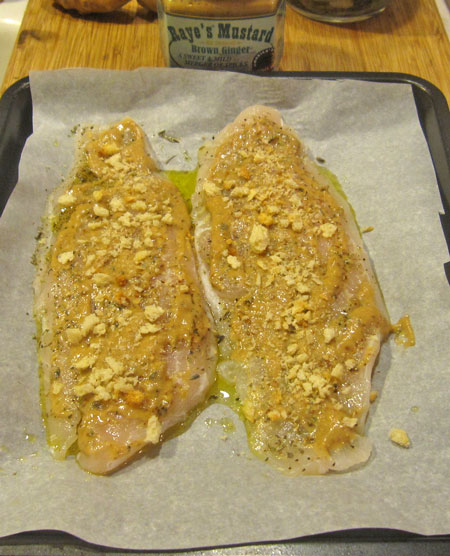
I started by putting the fillets on parchment paper on the Countertop Convection Oven baking sheet, oiled them up and sprinkled them with salt, pepper and herbs d’ Provence. Preheated the CCO to 375°F on regular bake.

w_mustard_flounder_prep
Next, I generously slathered on Raye’s Brown Ginger mustard and sprinkled fresh bread crumbs over the fish. That went in the oven for about 10 minutes until the flounder was tender and lovely.  It wasn’t crusted so much as dressed with the mustard.

I served the flounder with lard fried fingerling potatoes and sauteed cauliflower leaves.

w_greens_n_flounder
Yum.

Barndiva Revisited

w_barndiva

Oh yes, and maybe for the enth time. We happened upon it in April of 2006, having read about it in a New York Times story on Healdsburg Restaurants by Frank J. Prial. I wrote about it then, and again in April of this year when we made our semi-annualish trip to Simi Winery to pick up our wine “shipments.”

I belong to five wine clubs — a self imposed limit — Simi, Cline, Bonny Doon, Navarro and Mahoney. I’ve been in many others over the years, but settled on these because I consistently like their wines. The good part; they send bottles of their choice periodically at substantial discounts. The discounts also apply for re-order. The bad part; they send bottles of their choice periodically. I choose to pick up the wines at Cline, a short trip, I save the shipping cost and use it as an excuse to stock up on their California Zinfandel and Syrah; tremendous values, with the discount. Simi, on the other hand, makes an excuse to go to Healdsburg — and Barndiva — a couple times a year.

The last weekend in May, Simi had their garden cafe open to members for their Wine and Pizza Forage.

Here’s my journal entry for that trip:
Saturday afternoon, we went to Simi for their members only Wine and Pizza Forage. Turns out they have a lovely; lower patio off of their party room. For $25 we got pizzas of our choice made in their brick oven, and all the wine we dare drink. They were pouring Reserve Cabernet Sauvignon 1993, 1999, 2001, a 2000 Reserve Zinfandel and a 2005 Reserve Chardonnay. They had a few bottles of each left, priced at $100 — $70 for us on this day only. Great wine, but… great wine is even better when its free. Continue reading

Chicken Liver Pate

Back in July, 2007, I posted a story called A Chicken’s Liver, about what to do with the liver you find inside your chicken — make a quick one-liver pate. I do that as a matter of course when I have the occasion to use a whole chicken.

And that’s good, but not plenty. Carol recently said, “You know what we haven’t had for a while? Chicken livers.” I listened.

From time to time, I make the traditional Chopped Chicken Liver — liver, onions and hard cooked eggs mixed together — most recently for my Super Bowl XLIII Party. Good, but it lacks finesse; and on that occasion it was overshadowed by my Bacon Explosion, wildly popular at the time.

I went in search of a real chicken liver pate — buttery and boozy and rich — and found the answer on the KQED blog in a recipe by Thy Tran, a food writer I had seen in the Chronicle from time to time.

Here’s what she thinks about a real chicken liver pate:

“For those trying to watch their cholesterol intake, you can stop reading right now. Ditto for the vegetarians and the hard-core dieters. Teetolers might also want to move along.

For those remaining — those of us who still manage to reward ourselves during the dark days of winter — it’s time to whip up some chicken liver paté.

As buttery treats go, liver is dense with protein, vitamins and minerals. A few crackers spread thinly with this paté will make the bitterest salad sweeter. Accompanied with a thinly sliced apple and a glass of wine, it becomes a very adult way to enjoy a movie at home. And little ramekins set out for guests never fails to impress.”

That’s my kind of food treat — I’m not much into sweets — so I set to work.

w_chix_liversFirst, marinate the livers in cognac and thyme to get all flavorful and joyful. OK, it doesn’t look all that good… yet. But chicken livers, cognac and thyme… there’s no bad in there. I did a half recipe, so that’s a half pound chicken livers, an ounce of cognac and one and a half tablespoons fresh thyme. Continue reading

Noodle Beef

w_nb_ingred_det

“Thorne has an accompanying recipe for Noodle Beef. The beef takes eight hours to poach, but based on the results with the chicken, I’m ready to embark on a beef adventure.”

So I said at the end of my Noodle Chicken story. Well, I have now cooked the beef. As a bonus, I cooked another batch of chicken during the first three hours of beef cooking. Both went in the fridge.

I used boneless beef short ribs from Golden Gate Meats. The meat poaches for eight hours at 170°F. I learned to control the water temperature by cracking the lid on the pot to a greater or lesser degree to keep the temperature in the acceptable range of 165 to 175. Although 8 hours is a long time, the cooking doesn’t require much attention. I checked every 30 to 45 minutes.

w_nb_somen

The poached beef was almost as tender and velvety as the chicken, but there was no mistaking the rich beef taste. Once cooled and shredded, the beef and its broth can be kept in a covered bowl in the refrigerator for a week or so.

The next day I made the Noodle Beef. The method is the same, but the ingredients vary to go with the meat — red bell pepper and Napa Cabbage to complement the chicken, carrots and bok choy for the beef — along with the common ingredients; scallions, garlic, ginger, chile paste and noodles.

When cooking the chicken version I found the recipe hard to follow. It’s written as though John Thorne made it up as he went along and prepped his vegetables while he was cooking. Maybe he did make it that way, but I’m not seasoned enough to cook like that. I have learned that if I get my mise en place together before starting to cook I don’t forget stuff. What one does with the carrot, for example, (2 medium to large carrots, peeled, cut into thirds and sliced vertically into wide thin strips.) I would note in the ingredients, rather than in the instructions. So I altered the recipe for the way I work. Continue reading

Noodle Chicken

Chicken Noodle Soup
… without the soup

w_mwo_cover

I was browsing the cooking section of my local Books Inc on Chestnut Street in San Francisco. I had a list of potential books on cooking, but none appealed to me at the time. I spied a copy of Mouth Wide Open by John Thorne and bought it without looking inside. I know John Thorne, not personally to be sure, but I have his books Outlaw Cook and A Serious Pig and I once received his Simple Cooking newsletter, a gift from son Eric. Sadly, I allowed the subscription to expire. I guess I’d rather read books… newsletters tend to get misplaced. And I’d rather read books about cooking than cookbooks.

John Thorne writes the way I write — except way better. He takes a subject and explores it and usually invents something to suit his whims. In Mouth Wide Open, he addresses subjects such as Cod and Potatoes, The Grist on Grits, Go Fry an Egg, Swedish Meatballs, and my current delight, Noodle Chicken… comfort food, but comfort food with wit, substance and personality. He cooks the way I cook when I do breakfast or lunch for myself… I’ve got this and that… I wonder how those would go together? And what else might go with them?

One doesn’t necessarily read his books from cover to cover, but by skipping around, seeking out what’s interesting, or landing on a subject you know nothing about. I came upon his Two With the Flu chapter… what’s that about… probably chicken soup. I was right, but he took an entirely new approach. Regular chicken soup is a time tested method handed down from grandmother to mother to daughter or son: poach a chicken in a pot of water, pick off the meat and put back in the (now) broth, add carrots and celery and sometimes potatoes and noodles. There, chicken soup.

Tom Colicchio in the Stock Making chapter of his book, Think Like a Chef, has a twist where he puts his chicken in water, brings it to a boil and then pours off the water and starts over. “Pouring off the original water after the first boil will remove all of the blood and a lot of the coagulated protiens, which form a gray scum on the surface. Don’t worry that you’re throwing out flavor, you’re not. The bones need to cook a good deal longer to extract flavor.” His method — I call it “the Colicchio method” (duh!) — works well and I get a nice clear broth without scumming. I hate scumming, it’s never ending.

John Thorne takes an entirely different approach. He cooks his meat in a Ziplock w5_bag_coolingplastic bag at relatively low temperature for a long time. Sort of a poor man’s sous-vide. “The method … has three unique advantages: (1) The meat’s juices and flavor are neither diluted nor lost during the cooking process; (2) the scum produced in the cooking clings to the side of the bag, eliminating the need for skimming; and (3) the meat can be cooked in a small amount of liquid with no worry that it will overcook or dry out.”

Bingo. I’m hooked. I have to do this. Continue reading

Bouillabaisse

I was browsing through Mark Bittman’s NY Times blog, Bitten, looking for something interesting to do with squid (found that) and came across a narrative on Bouillabaisse. I had never made bouillabaisse… it always seemed complicated and mysterious, but this one seemed easy enough. I was inspired to get a couple of fish frames from San Francisco Fish Co. in the Ferry Building and get to work. w_fish_frames

Here’s what Mark Bittman had to say:

September 18, 2009, 12:01 pm A Long Island Bouillabaisse By Mark Bittman Speaking of Julia Child, as people seem to be doing, her version of bouillabaisse was among the first things I cooked when, in the mid-70s, I returned from my first trip to Provence. I doubt I’ve made it the same way twice since then. But I was at my friend Bob’s house the other day and we decided to more-or-less follow the recipe, since we had just about everything it took. The drill is pretty easy, once you assemble the ingredients, but assembling the ingredients can take a while. I gently sauteed (the chefs would say “sweated”) leeks, onions, and garlic in a lot of olive oil. (There are those who argue that the most important element of this style of fish soup is the emulsion of olive oil in water, and that there must be plenty of the former.) To that I added parsley, thyme, basil, fennel seeds, and chopped tomatoes. Then came 3 or 4 big, fresh and meaty skeletons of fish, and heads, roughly chopped. Am I forgetting anything? Water of course, and more olive oil, and I think I saw Bob sliding some Cointreau in there (we had no orange peel, always a nice addition). Cover and simmer for less than a half-hour. At that point I turned it off and left for an hour to allow it to steep and cool for a bit, then strained it and voila — gorgeous. Now you can do whatever you like. We chose to add potatoes (noodles are good, too) and celery (and/or carrots, fennel is a natural also) then cooked it until they were almost tender, then added big chunks of white fish (nearly any seafood will “work”), while we made the garlicky-spicy mayonnaise called rouille and toasted some bread. But it’s all in the broth, and I must say Julia nailed that one.

Simple enough, and I can do that, but since it’s my first time, I thought it prudent to check out Julia Child’s Mastering the Art of French Cooking to get the basic quantities to go with Mark Bittman’s narrative. I found a clue on page 52: Continue reading

Tomato Soup Two

Roasted Tomato Soup

Another recipe from my “to cook” file is Roasted Tomato Soup. I clipped that one only last year from the 101 Cookbooks website. Since I’m on a tomato binge just now and my winter sauce needs are nearly satisfied, I’m looking for soups. I did a Tyler Florence Roasted Tomato Soup recipe from the Food Network, and it was okay, but the FN recipes always seem contrived to have an “angle” for TV sensation (especially his). In this case, he roasts cherry tomatoes on the vine for garnish. C’mon.

So I wanted a roasted tomato soup from a real cook and turned to 101 Cookbooks. Roast tomatoes, bell pepper, onions, garlic. Puree and thin with broth. That’s it. The recipe called for 5 tomatoes, but I’m using Early Girls, which are pretty small, so I figured about 2 1/2 pounds, and sure enough, that’s what fit on the roasting pan.

roasted tomatoes

roasted tomatoes

w1_101_soup
The soup was good. It’s very thick. I guess I could have made it thinner by adding more broth… but I like it thick, and what th’ hell, I’ll call it a sauce. In fact, I served it with bits of Italian sausage over whole wheat spaghetti… I just really wanted to do that. That was good, but I DO NOT like wheat spaghetti for tomato sauce. It has way too strong a taste for this sauce. [I originally bought the Whole Wheat spaghetti for a CI recipe tester recipe of Whole Wheat Pasta with Zucchini and Sun-Dried Tomatoes, a dish where the pasta flavor is the flavor of the dish.] But I digress.

I had a bowl of the soup for lunch. In spite of going through the blender, there were still a few seeds and bits of skin. Those are not tasty. Continue reading

Tomato Soup

Pappa al Pomodoro

w_early_girl_flatMarlena Spieler is one of my favorite food writers. Her stories and recipes appear in the SF Chronicle from time to time. Her recipes are always imaginative, reliable and not dumbed down. Her stories are entertaining, often coming from Europe, most often from Italy.

Since it’s tomato season and I was working on my third flat of tomatoes – this one Early Girls – I dug into my “to cook” files and pulled out this story that I clipped two years ago, but hadn’t got around to trying. She spun a yarn of the bakers of Napoli, their fabulous breads and tomatoes.

“Slice up a tomato or two, lay them on a slab of sourdough bread, douse with olive oil and various aromatics. This is lunch to get you through a summer, or to take to picnics, to eat alone, or to prepare for 100.”

w_soup_served

Being a soup guy, rather than a sandwich guy, I was more interested in her simple bread and tomato soup creation.

“I’ve also been making pappa pomodoro, a savory tomato soup thickened with chunks of flavorful, stale bread that one can actually prepare with canned tomatoes and it’s surprisingly good. But you can’t prepare it with bad bread; you’ve got to have the good stuff.”

w_garlicWell, I had my good Early Girl tomatoes from Mariquita Farm and good Acme bread, herbs and plenty of garlic… all set.

Since I had great tomatoes, I used 4 cups of tomatoes rather than add the juice. I had some tomato water as well, so I used a cup of that and 3 cups chicken stock. Rather than the ubiquitous basil, I used arugula – I like its spice – to finish the soup.

w_bread_n_tomatoes

Other tomato bread soups I’ve made are thick and rich – not a bad thing – but this is tasty and light, thanks to the added broth.

Another reason to like this soup is that the tomatoes are not processed, neither before nor after cooking. The texture of the tomatoes is a perfect accompaniment to the bread chunks. And yet the soup is so light and flavorful, its good anytime: as a soup course at dinner, or as a lunch – maybe with some cooked shrimp thrown in. The last cup, I had for breakfast, heated and poured over good buttered toast. Yum, yum and yum.

w_soup_cooks

Here’s Marlena Spieler’s recipe with my [notes]:

Pappa al Pomodoro with Basil or Arugula

1 onion, chopped
5 cloves garlic, thinly sliced + 2 whole cloves garlic
3 to 4 tablespoons extra virgin olive oil + more for drizzling
About 3 cups chopped fresh ripe flavorful tomatoes [just under 3 pounds = 4 cups]
1 cup dry white wine (or substitute water)
1 quart vegetable or chicken broth [used 1C tomato water, 3C chicken stock]
6 to 8 slices (about 1/2 loaf) sour country-style
bread, cut into bite-size chunks
1 cup tomato juice; if your tomatoes are amazing, omit and add another cup of tomatoes
Sea salt
Chopped fresh basil or arugula [1C arugula]

Instructions: Lightly saute the onion and sliced garlic in the 3 to 4 tablespoons olive oil until softened, then add the tomatoes [be patient, cook onions until caramelized, otherwise the onions are crunchy]. Raise the heat to medium or medium-high, letting the tomatoes cook into a saucelike consistency.

Pour in the wine and raise the heat to high, letting the alcohol burn off and the liquid reduce, then lower heat again and add the broth and bread. Bring to simmer and ook over a low heat for a few minutes while the bread falls apart and thickens the soup. Add the tomato juice (if using).

Meanwhile, crush the whole cloves of garlic with a pinch of sea salt using either a mortar and pestle or a knife on a cutting board. [Add 2t salt plus ground pepper.]

Just before serving, stir the crushed garlic into the soup, and add the basil or arugula, then ladle the soup into bowls, with a drizzle of olive oil.

w_soup_served

Monday Lunch

… after Sunday Dinner

It’s tomato season. I love it!

This year Mariquita Farm instituted a Buying Club in addition to they’re Mystery Boxes… they had a lot of tomatoes and peppers to move. In years past, I’ve gone to their U-Pick days at the farm and enjoyed picking my own tomatoes, but that’s 100 miles one way. To make that drive worthwhile, we’ve often combined it with a weekend trip to the Santa Cruz area or the Sierra foothills. This year, I’m content to let Julia do the driving.

In any case, I got into the tomato swing with a 10 pound box of heirloom tomatoes, then a 20 pound flat of San Marzanos, and now I’m working on a 20 pound flat of Early Girls.

20 pound flat of Early Girls

20 pound flat of Early Girls

I’ve written extensively on tomatoes in the past: Tomato Water, Tomatoes Tomatoes Tomatoes, Meet the Manchurian Mothership and Tomato Sausage Bake, but that won’t stop me from recounting some recent adventures. This first is oh so simple, but it illustrates the value and versatility of tomatoes.

Carol made Sunday dinner while I was enthralled with NFL games — all close, and my teams won. She lifted a Tagliatelle with Corn and Cherry Tomatoes recipe by Anne Burrell from the Food Network website. It was easy and quick and pretty good, but I thought it rather bland, for good reason. It called for a pint of halved grape tomatoes, and Carol used what we had on hand… far fewer than that. The good thing is, it was finished with LOTS of grated parmigiana.

cheesy pasta and tomatoes about to get together

cheesy pasta and tomatoes about to get together

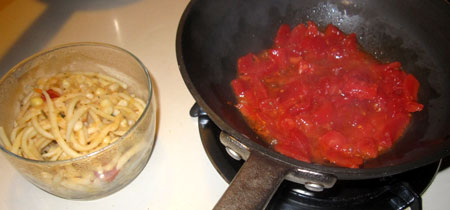
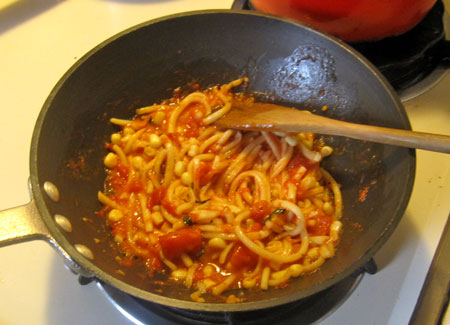
In any case, on Monday, since I had a whole box of Early Girl tomatoes, I picked out four beauties, peeled and seeded them and cooked them down with a little olive oil. To that, I added a leftover portion of Sunday night’s pasta.

together at last

together at last

Whoa, that’s just what the food doctor ordered. The tomatoes blended nicely with the cheese of the pasta and brightened up the dish to yumminess.