A Great Day

… and a soup day

I had a great day today.
When I got up at 6:30 to make coffee, the temperature was 46°F, but it was snowing. I went back to bed as usual, and when I got up for good at 7:30, the temperature had dropped to 24°F and it was snowing hard, but with no wind.

6:50am I took this to show Carol in case the snow went away before she got up.

It snowed on until noon, first those tiny flakes, then bigger, fluffy ones. I measured four inches.

12:30pm The snow did not go away.

I love fresh snow. It is so pretty and everything is silent and still.

Won’t be going out today except to shovel, so I got busy in the warm indoors.

Made a Christmas gift for brother Wendell. It’s pretty cool, but I won’t disclose it here. That took the morning, because it required some thought and research.

Then I turned my attention to Turkey Barley Soup. It’s so good, that it can become a turkey leftover tradition. There is something very satisfying about making a hearty soup on a cold and snowy day.

Soup is an assembly process and it is like T’ai Chi to me to move around the kitchen, collecting vegetables and chopping, assembling the ingredients, stirring the big pot.
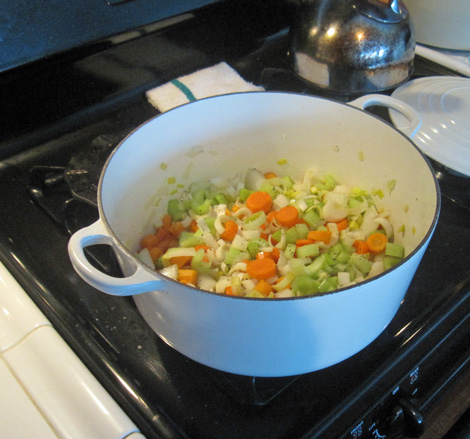
The big pot of vegetables. I like it because it’s wide and makes for easy stirring.

Lovely garlic from the spring farmers market

I especially liked working with the garlic that I got at the Farmers Market in the spring and hung in the kitchen to dry. It’s beautiful garlic and a joy to peel and smash.

The shopping was interesting. A key ingredient of the soup is pearl barley… not something you find just anywhere. Carol happened to be in Trader Joe’s — although we don’t usually shop there except for my favorite salted peanuts — and she got barley, but it is “ten minute barley.” Not the same, we cook the barley for this soup an hour or more.

On another day, we were in Raley’s and I cruised the rice and grain aisle. Astonishingly, there were three women with carts and me with no cart in that aisle all at once. Since I needed to peruse the shelves, I stood aside and mentioned I was looking for pearl barley. “I’m looking for pearl barley, too,” said a woman about my age. She found it first and offered me a package.

“You must be making Turkey Barley Soup,” I said, since I got the recipe last Thanksgiving from the Reno Gazette Journal.

“Yes,” she said, “I am.”

The recipe with plenty of pictures is in last year’s post, Turkey Left Over, but I made some modifications and clarifications, so I will repeat it here.

TURKEY STOCK
Based on an amalgamation of recipes and making stock much of my cooking life.
Yield, about 8 cups.

In a large stockpot, place Turkey carcass, and cover with water. When the water is nearly boiling, remove the pot from heat and pour off the water. (This takes care of the blood and scummy stuff so you don’t have to skim much.)
Cover the turkey carcass again with cold water, about 12 cups. Heat to a near simmer and add 2 each carrots and celery stalks; 1 onion, quartered; 1/2 lemon, rinsed and quartered; some peppercorns, a bay leaf; an herb bouquet. Cook uncovered at a bare simmer for about 2 1/2 hours. Turn off the heat and let stand for an hour or so. Remove meaty bones, strain the stock and refrigerate overnight.
The next morning, skim any fat from the broth and bring to a boil. Reduce to 8 cups.

NOTE:
I borrowed this method from Tom Colicchio, in his book Think Like a Chef.
Nancy Horn does her stock in the oven (her recipe is below).

TURKEY BARLEY SOUP
Nancy Horn of Dish Cafe and Catering Co.
Yield, about 3 quarts soup.
This soup is all about barley absorbing turkey broth, so make your own broth for the best soup. Store bought canned broth just doesn’t cut it, in this case.

Place a dutch oven (my 6Q white Le Creuset) on the stove over medium high heat. Add 1 Tbsp each of butter and olive oil. Peel and chop 3 carrots, 3 celery stalks, 2 large leeks (tender parts), 1 large yellow onion. Add to pot, along with 1 bay leaf. Stir and season with salt/pepper mixture and sauté until vegetables are softened and beginning to brown around edges. [Takes about an hour to this point.]
Peel and smash 4 cloves garlic; add to pot and cook a minute. Add 1 cup dry white wine and stir to deglaze the pot. Simmer to reduce wine by half.
Add 8 cups turkey stock, bring to a simmer and add 1 cup pearl barley and 3 sprigs thyme. Stir well to incorporate. Simmer, covered, stirring every now and then until barley is tender, about 1 hour.
Chop and stir in 1 bunch Italian Parsley and 2 cups shredded cooked turkey. Taste and season with salt and pepper. Adjust amount of stock for brothyness. Serve with Romano or Parmesan cheese.

NOTE:
I use a salt/pepper mixture of 2 parts kosher salt, 1 part coarsely ground pepper.
Instead of parsley I used a small, young and tender bunch of Swiss chard,
torn in pieces and stems removed. (At our winter Garden Shop Farmers Market there’s a guy that grows hydroponic vegetables in a cold frame. Young, tender Swiss Chard year ’round.)

That, my friends, is yummy soup. Even better the next day for lunch.

TURKEY STOCK – Oven Method
Nancy Horn of Dish Cafe and Catering Co.
Yield, about 6 quarts.

Preheat Oven to 225°F.
In a large stockpot, place Turkey carcass, 4 each carrots and celery stalks; 2 onions, quartered, unpeeled; 1 lemon, rinsed and quartered; 6 peppercorns, 3 bay leaves; an herb bouquet. Cover with cold water. Cover and place in oven for 12 hours.
Remove from oven, remove solids and strain. Let stand for at least an hour and skim or otherwise remove fat.
POST PIG

pig to eat and an actual recipe

DAY 8 TUESDAY 10.15
Funny. No pig to process. But Eric fried up some sausage for breakfast.

lovely morning

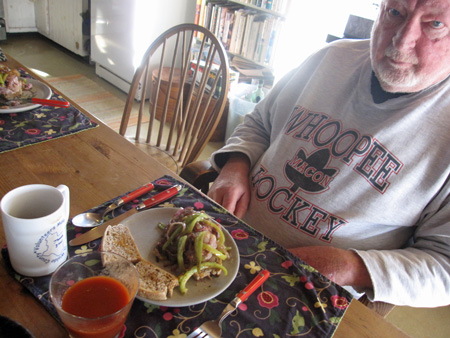
Of course, he doesn’t just fry up some sausage, he adds the trimmings, in this case, onions and peppers and bread toasted on the wood stove.

sausage and stuff, V8 and coffee

We got back to real life. Eric catching up on work while Carol and Alison did some laundry and I did some reading and journal writing.

laundry swinging in the breeze

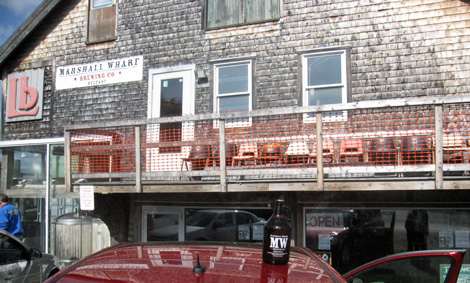
We took a ride into Belfast to look around. Stop on the waterfront for a Growler of beer at the Marshall Wharf Brewing Company.

Marshall Wharf Brewing Co… growler on top of car.

Belfast has a new waterfront walk…

and a new industry, the Front Street Shipyard,  biggest on the coast of Maine (not including Bath Ironworks, of course, where the Navy’s newest destroyer was built). It’s a clean industry — as opposed to a chicken operation formerly on this site — and they can handle some pretty large boats.

a pretty large boat, I’d say…

last tomatillos of the season

While we were doing pig things, Alison picked all the tomatillos left standing in the garden. I was volunteered to make something with them, using as much pork loin as I could manage. Maybe a green chili. I recalled using tomatillos for the chili I made for the Sierra Canyon Chili Cookoff, so I looked that up on eats, and looked for ideas in Mark Bittman’s How to Cook Everything. There was one chili recipe, “Chili Non Carne.” I adapted it to use the pork and the tomatillos and used his spices and suggested cooking times.

Marc’s Tomatillo Chili con Carne

Cook 2 cups of dry beans with one onion by your usual method. Drain and reserve bean juice, just in case you need some. (Or open a can of beans.)

Select enough tomatillos to produce 2 cups and peel off their papery skins. Roast  at 400°F for one hour. Wrap 6 to 8 cloves garlic in foil and roast with the tomatillos.

Mash garlic and mix in with tomatillos. If you don’t have 2 cups, add some bean juice.

Add tomatillos mixture to beans and mix. Stir in 1 fresh or dried chopped chili or 1 Tbsp chili powder. (Eric chopped a dried ancho chili.) Add 1 tsp ground cumin, 1/2 tsp dried oregano.

Cut up 1 pound meat (our pork tenderloin). Brown with peanut oil, season with salt and pepper, and add to pot. Cook about 15 minutes more.

a nice bowl of green

DAT was good.

The Pig :: Day Three

“I love sausage, but don’t care to see how it’s made.”

Today, you’ll see how it’s made.

Although the recipes came from various sources, the ingredients are simple and similar:

  • ground pork
  • spices
  • herbs
  • often onions and garlic
  • liquid — usually wine

Breakfast sausage (sage and onions) from Better Than Store Bought by Helen Willyard and Elizabeth Coichie
Saucisson (black and white pepper sausage for dry curing) from La Technique by Jacques Pepin
Pork Liver Terrine Pate Campagnola from Cooking by Hand by Paul Bertolli
Boudin blanc (emulsified sausage) from Charcuterie by Michael Ruhlman and Brian Polcyn
Cotechino (classic Italian with Anise and boiled pork skin) from Cooking by Hand by Paul Bertolli
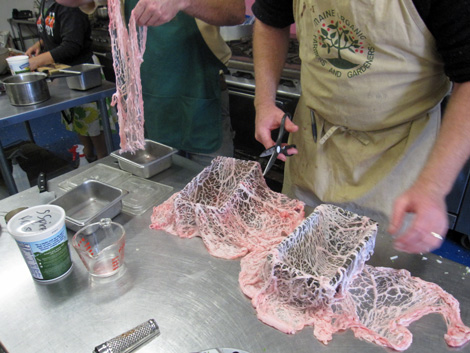
Crepinettes, each of the fresh sausage mixtures made into patties and wrapped in caul fat

The meat was all cut up yesterday and divided into portions for the various sausages.

prep for Pate Campagnole

Each team put together its recipe ingredients — this particular prep is for the Pate Campagnole — you can tell by the use of liver.

The meat is ground with a cast iron grinder attachment for the commercial mixer.

grinding

The ground meat, herbs, spices, etc. are mixed.

mixing

Here, we visit the terrine. Loaf pans are lined with caul fat and the ground meat mixture pressed into the pans.

pate underway

The pans are placed in a water bath and baked. Continue reading

The Pig :: Day Two

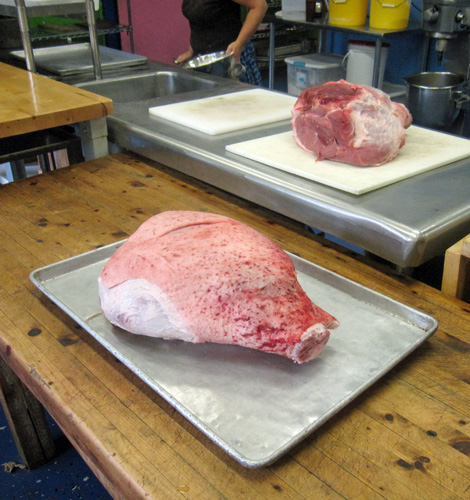
Breaking down the sides…

We are entering the middle day of our journey from two snorting and snuffling pigs to some hams, bacon, sausages and the like.

Today, we’ll smoke some bacon, make some headcheese, start some hams, render some leaf lard, and have a swell and somewhat unusual lunch, make big pieces into little pieces and sort them.

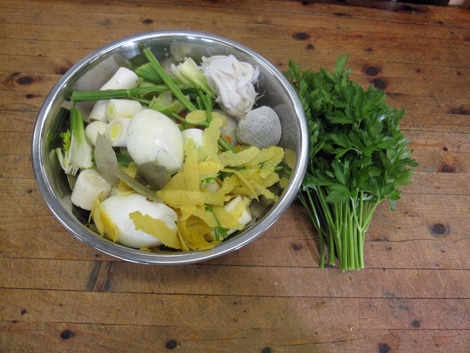
These are the vegetables for Head Cheese, or what Fergus Henderson in his book “Nose to Tail Eating” calls BRAWN. We’re looking at onions, carrots, leeks, celery, garlic, lemon zest, a splash of red wine vinegar, bundle of herbs and a small handful of black peppercorns. While I prepped the vegetables, the pig’s head in water was coming to a boil in a big pot. When it got to a simmer, I stuffed the vegetables into the pot.

vegetables for head cheese

After about 2 1/2 hours, everything comes out of the pot and the remaining liquor is reduced by half. The vegetables are discarded and all the good bits of meat are picked out of the head. A terrine will be lined with cling film, the bits of meat added, the reduced liquor poured over and refrigerated overnight to set. The bits leftover will be made into patties, breaded and fried. That’s for tomorrow’s lunch.

My other job-of-the-day was to cook up the pig lungs for lunch. When they were harvested yesterday and before going into their sterilized tray, one of the students picked it (them?) up and blew them full of air. Hey, they work.

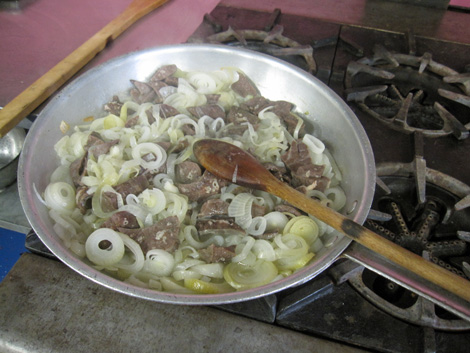
I trimmed the lungs of their gnarly parts, cut into small pieces and parboiled. Sliced a boatload of onions and got all that going over a very low flame. That would cook until lunchtime, almost three hours. Salt and pepper was the only seasoning.

lungs n onions saute very slowly

Meanwhile, the ribs were cut out, trimmed and roasted.

clockwise from bread: roasted potatoes, lungs n onions, roasted ribs, vegetable salad

This was a very nice lunch. When I went back for seconds on the ribs, the lungs were totally gone. Bummer. I was surprised that the lungs didn’t taste at all like organ meat. Probably because they are so fresh.

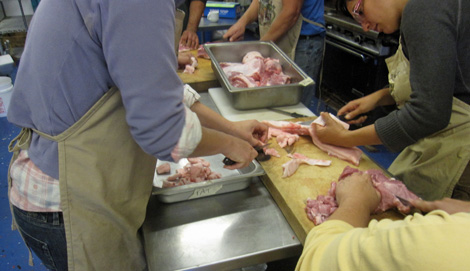
Meanwhile, the prime cuts; hams, loin, ribs, chops and roasts are cut and the balance of the meat is cut into bits for sausage. These bits are sorted by lean and fat so they can be mixed in proper proportion. The shoulder (Boston Butt) has perfect proportion by itself.

hams, cut two ways

some of the lean meat being cut

The cut meat is put in that yellow bucket, weighed and then sorted into hotel pans and labeled for its ultimate use. Tomorrow, we’re going to make 5 kinds of sausage and a pate.

These are the more fatty cuts.

The person top right is cutting the skin from the meat. The skin will be boiled until tender and go into sausage as fat.

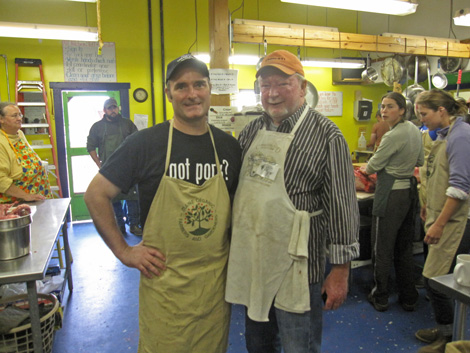
Alison requested this picture. It was hard to catch Eric standing still long enough to pose.

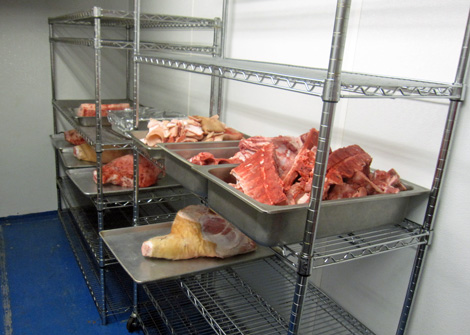
At the end of the day, what once had been carcasses, was transformed into hotel pans of various cuts of meat.
A cooler of pig.

another view showing meat sorted for sausages

The Pig

NEW ENGLAND, 14 DAYS IN OCTOBER, 2013

At age 30, we moved to Massachusetts. Our sons were five and three. At age 54 we moved to San Francisco. All but one year of that time, we lived at 48 Harrison Street, Newton Highlands MA 02138. 617-969-3359 It was the time when we embraced adulthood, raised our children and forged lasting friendships. A time like no other in our lives. This is about revisiting New England, not for reflection and nostalgia, but for activity and exploration.
Our visit was centered around the Maine Organic Farmers and Gardeners Association (MOFGA) annual Nose to Tail Pig Processing Workshop during Columbus Day weekend. Before, we made our way to the Belfast Maine environs, and after, we drove across the whole of New England to Cooperstown, New York, and from there to Newton Highlands.
The story has a beginning, middle and end. You recently read the beginning, “Getting to the Pig.” And here is the middle and the raison d’etre, “The Pig” where we will journey from two snorting and snuffling pigs to some hams, bacon, sausages and the like.

Pig One

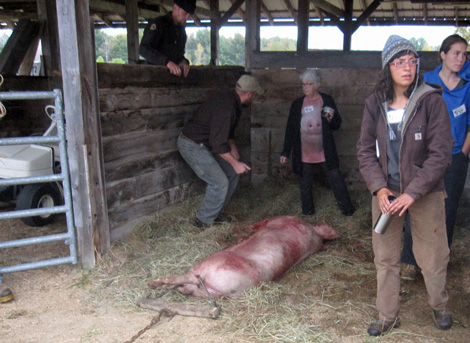
We called this fella “Pig One” He’s been in this stall about two days to get used to his surroundings. He’s had his food withheld but given plenty of water. He’s met the farmers, Paul and Everett, so he knows them and is not afraid.

the big room with tables in a “U” shape

We met in this big, high room each morning for coffee and a muffin and to discuss what will be going on that day. Eric — at the corner table — says that today, Paul and Everett, our farmer instructors, will lead us through the process of killing and dressing two pigs.

The day was cloudy and quite cool, perfect weather for our task at hand. We walked across the field to greet Pig One and be instructed how he will meet his demise. The killing must be quick and efficient and cause no trauma in the pig. In this case, Paul will shoot the pig with a .22 caliber pistol aimed at the center of a triangle formed by the pigs eyes and nose. — I was surprised at how calm the pig was, Paul walked into the stall and slowly up to the pig’s head and BANG. — The pig will writhe violently, so stand clear, a flailing leg could cause serious injury.

As soon as possible, the pig will be “stuck” by inserting a knife just above the breast bone and thrusting up. This will cut the main artery that runs above the breast bone and the pigs own heart will pump all of the blood out onto the straw of the pen. Very efficient. That whole process took about 30 seconds.
spreader attached to the pig

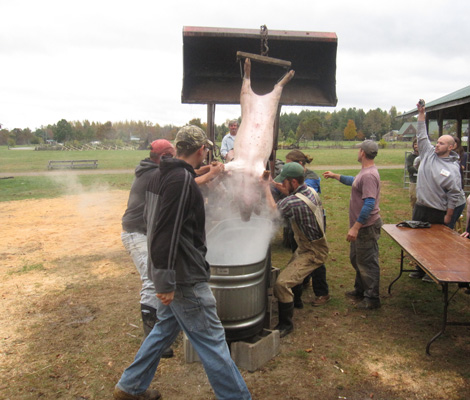
A spreader is attached to the pig’s hind feet and he will be picked up and hosed down to wash off mud, blood and straw.

We will process two pigs, the first will be scraped clean of his hair and dressed with his skin on. Often, for hams or bacon, the cut with skin on is preferred. Excess skin can be boiled and ground into sausage, as well. The other pig will be skinned.

Very early, a trough was filled with water and a fire built under the trough. Now the water temperature is just under boiling and the pig will be lowered into the water and sloshed around. The hot water bath eases the scraping… just like shaving, guys.

the pig, being guided into very hot water

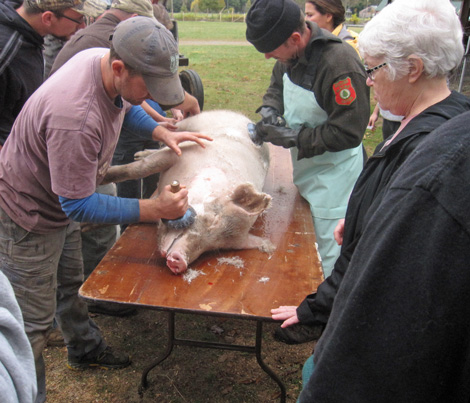
The table to the right has been washed and sanitized with a vinegar water solution. Out he comes, onto the table.

pig on the table

scraping starts at the head

For this pig, the head will be cut off whole, to be boiled and made into headcheese. Continue reading

Getting to the Pig

NEW ENGLAND, 14 DAYS IN OCTOBER, 2013

At age 30, we moved from Virginia to Massachusetts. Our sons were five and three. At age 54 we moved to San Francisco. All but one year of that time, we lived at 48 Harrison Street, Newton Highlands MA 02138. 617-969-3359 It was the time when we embraced adulthood, raised our children and forged lasting friendships. A time like no other in our lives. This is about revisiting New England, not for reflection and nostalgia, but for activity and exploration.

Our visit was centered around the Maine Organic Farmers and Gardeners Association (MOFGA) annual Nose to Tail Pig Processing Workshop during Columbus Day weekend. Before, we made our way to the Belfast Maine environs, and after, we drove across the whole of New England to Cooperstown, New York, and from there to Newton Highlands.
The story has a beginning, middle and end. This is the beginning, “Getting to the Pig.”


“We left home more than 12 hours ago, and we’re still in Reno,” I said to Carol.

We were waiting to board the 5am shuttle bus from Grand Sierra Resort to the Reno Tahoe airport. Brian and Natasza had picked us up Tuesday evening for dinner and we stayed over due to our 6:05am flight to Denver and Boston.

For locals, the Room is $58 and they paid the first $25 at Briscola, Charlie Palmer’s take on Italian. And they provide a free shuttle to airport. Not bad.

Grand Sierra Resort, 5 am

DAY 2 WEDNESDAY 10.09

Our Southwest flight was EZ. About an hour out of Denver, I had my second Bloody Mary. It is good. In Denver we had just enough time to grab some eats at Lefty’s Grill. It’s an airport place, so I didn’t expect much, but how could I pass up the Sausage Gravy Biscuits for brunch? The biscuits were thin and soft… nice, and all the gravy needed was salt, pepper and Tabasco. Not photogenic, but… Yum.

Lefty’s Grille sausage gravy over biscuits, Denver Airport

The continuing flight to Boston was without incident and I recounted the cool things I had learned about Southwest Airlines on two previous flights.

  • The no-assigned seats. Who knew? It’s so simple, get on, pick a seat, sit down. OK… pay a $12.50 fee to be in the first 60 to board, guaranteeing an aisle seat. What else do you need?
  • Flight attendants take your order for drinks and bring them to you NO AISLE CARTS and as many assorted snacks as you can eat; peanuts, pretzels wheat crackers, etc. They come back for empty wrappers, glasses, etc and say, “Would you like another Bloody Mary? Yes, thank you.”
  • Two bags per person fly free. I noticed some airlines are now charging $75 per bag.
  • And when we got to the baggage claim at Logan Airport, our bags were there.

Logan airport has a new feature since we were last there: Go to the blue curb for a shuttle bus to rental cars… all rental cars are in one building. Check in on one floor, take the escalator to one of the two floors above. Get in your car. Go. From touch-down to the Ted Williams tunnel, under an hour.

Eric and Alison had arranged to meet us in Portland for dinner, since we couldn’t get their house until almost 10pm if everything went perfectly. And we would be tired. He got that right.

We followed Eric’s directions to the Franklin Street exit off I-295 and as he said, went up the hill and down the hill through several traffic signals until we reached Commercial Street and the Hilton Garden Inn. Meet them in the bar at the Fore Street Restaurant, just behind the hotel. That was EZ.

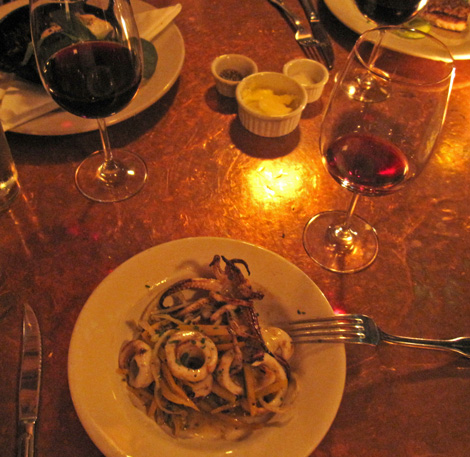
Fore Street is a New England kinda place of wood and brick. The centerpiece is a wood fired brick oven built by the same guy that built Eric and Alison’s oven/chimney. The building, food, service were all of a piece — everything in harmony to produce sensory satisfaction.

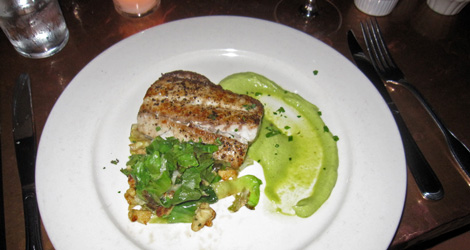
Fore Street: my baked halibut

Fore Street: grilled squid appetizer

Fore Street: Eric’s baked blue fish

our shirts are in harmony, as well

Long day, good day. I woke with the sun at 7am.

Portland ME: our Hilton Garden Inn harbor view

DAY 3 THURSDAY 10.10
Brian and Natasza’s Kyiv Wedding Anniversary: 10.10.10 Continue reading

pickled beets

NEW AND IMPROVED

roasted golden beets

I’ve written about beets from time to time, the first being April 2006, shortly after this blog was christened. There, I wrote about pickled beets, among other beety things.

Over the years, I fiddled with the recipe, the original was too sharp for my taste, too vinegary.

In September of 2011, I tried a new recipe from Mariquita Farm:

Balsamic-Pickled Roasted Beets
Adapted from Mariquita
A change o’ pace from the puckery Pickled Beets

1 bunch beets, roasted – about 2 cups
1/2 cup fresh orange juice
1/4 cup balsamic vinegar
1 tablespoon sugar
1 ounce Pastis
1/2 teaspoon salt
1/8 teaspoon freshly ground black pepper

Roast beets. Peel and cut as necessary to fit in a POM jar.
(Unfortunately, POM changed their packaging, so that straight sided jar only exists in my cupboard… I still have 5 of them.)
Combine all the other stuff in a small saucepan; bring to a boil, boil about a minute. Pour over beets.

Those were good; clearly enhanced, but not puckery tasting. I used it with both red beets and the golden beets. I like both, and will buy whatever looks best.

That was about two years ago. I love beets and eat them a lot. I kept tinkering. First, I substituted White Balsamic for the “regular.” Then I substituted white wine for half of the Balsamic.

Now, that’s a good recipe. Worth publishing.

Marc’s Balsamic-Pickled Roasted Beets
Adapted from Mariquita Farm and tinkered with by yours truly.

1 bunch beets, roasted – about 2 cups
1/2 cup fresh orange juice
1 ounce balsamic vinegar
1 ounce white wine
1 tablespoon sugar (I use brown sugar)
1 ounce Pastis (or anisette if you can’t find Pastis)
1/2 teaspoon salt
1/8 teaspoon freshly ground black pepper

Roast beets. Peel and cut as necessary to fit in a POM jar or pint jar.
Combine all the other stuff in a small saucepan; bring to a boil, boil about a minute. Pour over beets.

Fatted Calf Foray

I couldn’t resist emailing this to Brian, Eric, Carol, Sarah and Paula.

“These guys know how to throw a book signing. If I were still in SF…”
Marcus

Fatted Calf Newsletter September 19, 2013
At The Table

What better way to celebrate the publication of our book, In The Charcuterie, then to join at the table with friends and colleagues for a leisurely lunch? And what better table than the one under the arbor at Robert Sinskey Vineyards in Napa! Rob and Maria Sinskey, huge supporters of The Fatted Calf, generously offered up their stunning digs.

stunning digs

Sinskey Chef, Erin Ramsey, laid out quite a feast for us, including some Fatted Calf favorites. There were pork rillettes toasts topped with nectarine mostarda, thin slices of finocchiona accompanied by marinated olives and green tomato chutney, and the pièce de resistance, plump sausage and fig stuffed quail roasted in the wood oven. Tasting Room Manager, Jennifer Gallagher, poured glass after glass of perfectly matched vintages of organic and biodynamic Sinskey wine (while professing her love of liverwurst). Good food, great wine and good people made for a memorable day.
Come make some happy memories of your own. Join us this coming Sunday, September 22, at Robert Sinskey Vineyards from 11 am to 3 pm. We’ll be preparing some meaty bites, enjoying a glass of one of our favorite wines and signing copies of In The Charcuterie. Reservations can be made through Robert Sinskey Vineyards.

Brian fired back:
Why don’t we go?  Leave yer place at 8-ish, get there as the thing’s getting started, good food & wine, good-looking book, chance to chat with FC folk, stroll around the grounds a bit, and be home in time for a light supper (after what should be a rich FC spread).  It’s $50 each with the book, $35 without.  On normal days, it’s $25 just for wine-tasting with nibbles.

I checked with Carol… She doesn’t want to spend Sunday car-riding. Said she will babysit Tuzik. I called the Sinskey Winery and made reservations for me and Brian, hoping they wouldn’t be sold out.

The newsletter went on…

Want to skip the read and head straight to the table? Visit The Fatted Calf table at the Ferry Plaza Farmers Market this Saturday and pick up some rillettes, finocchiona and fig and sausage stuffed quail for a feast of your very own.

Anytime I’m in San Francisco, I stock up on stuff from Fatted Calf… Just can’t get that stuff in Reno. So after the event, Brian and I did just that… not at Ferry Plaza but at the Fatted Calf shop at Oxbow Market in Napa. I got me some duck crepinettes, fennel sausages, sausage and fig stuffed quail, greens sausages, a slice of Terrine Forestiere and packs of Sugo di Carne. Brian did similar.

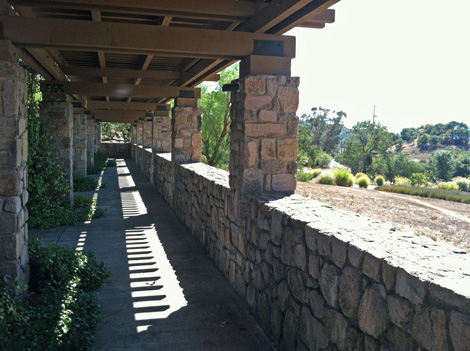
colonnade bordering parking lot

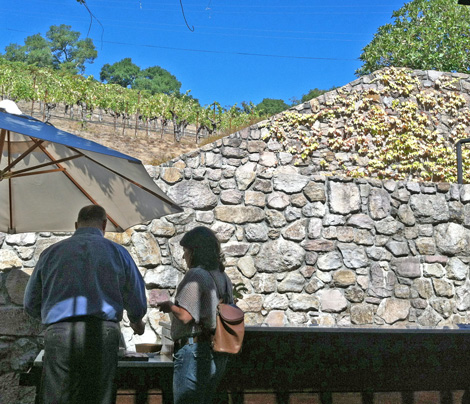
We got there minutes before noon and I was surprised to find empty parking spaces near the door. Inside, the tasting bar was packed. We passed by that to the open kitchen and back garden with a white marble bar. Tables under the arbor were provided a stunning view of a massive stone wall and vineyards above and behind.

the view from my table

Several folks milled around the bar laden with delectable food. Brian and I were still getting our bearings when the woman behind the bar offered a glass of Abraxas, a white wine blend of Riesling, Pinot Gris, Pinot Blanc and Gewürztraminer. Yum. I took a plate and a meaty item or two and found a nice seat.

one of my many samplings of food and wine

Again, I was surprised that there were only about 20 people there, but glad that we were uncrowded and unhurried. The day was a spectacular late summer Napa day; they hardly get better than that. We easily fell into a routine of going for the next wine, picking up some foodie goodies, and sitting to enjoy. Four wines were being poured, a Vin Gris of Pinot Noir, a Pinot Noir and POV (Point of View), a blend of Cabernet Sauvignon, Cabernet Franc and Merlot; the classic Bordeaux blend. My favorite was the Vin Gris of Pinot Noir and I bought a bottle to enjoy with my own food at home.

no caption needed

just in from the kitchen

From time to time, a young woman would come out of the kitchen with a plate of hors d’oeuvresy things — duck sausage skewered on a stalk of lemongrass, a cube of lamb skewered with a shiny green blistered padron pepper… good ol’ Brian knows how to pick an event.

raison d’etre

As Taylor and Toponia were signing my book, I said, “Fatted Calf goodies are good enough to buy and eat at home, but to have them served, perfectly prepared, in such a place as this, is a heavenly experience.”

Back on I-80, our Sunday afternoon eastbound lanes were lightly occupied while the westbound lanes to the Bay Area were packed. Brian and I agreed that the Food and Wine experience was well worth the drive. We were home about six, in time to watch Football Night in America on a slight tape delay and eat some Terrine Forestiere.

Whiskey Piggy

One dinner, three more meals…

From time to time, Sierra Canyon has a dinner and show deal. The show in this case was GREASE at the El Dorado Showroom. Bus picks us up, Tuesday at 5pm, takes us to the El Dorado, we eat at our choice of the Buffet, La Scala or the Roxy Steakhouse. Fixed price for dinner and show plus drinks. The Roxy was only $10 per person more than the Buffet, so we chose that. We had eaten at La Scala a couple of times.

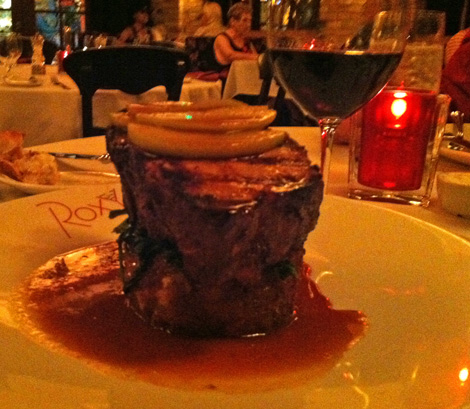
This is about my meal(s). I ordered the pork chop called Whiskey Piggy.

Bourbon Whole Grain Mustard Marinated Center Cut Pork Chop — Pork Belly Greens — White Cheddar Bacon Mac & Cheese — Whiskey Glazed Pink Lady Apples (menu description)

Unstacked, so I could get at the food. The ball of Mac & Cheese on the right is breaded, deep fried and wrapped with the aforementioned greens.

The dinner was way good, served with bacon cheese bread to die for, but somehow, I didn’t manage to finish.

This is dinner at home the next day. All that we added to the Roxy meal was yellow beans. I made an identical plate for Carol. Not quite as pretty, but quite as tasty.

I didn’t take a picture, but today (Friday) I had the leftovers of that for lunch. Still good. All gone.


EGG Grilling

Wings and Fish on the Big Green Egg

I bought the Big Green Egg Cookbook, but it doesn’t seem to have recipes for things we like to cook and eat. By including my adapted recipes here, I can share them and know where to find them.

Seems like I’ve done nothing but grilling, lately. That’s not a bad thing. We’ve fallen into a cycle: Shop for food to grill, adapt recipes to the Big Green Egg, grill food, eat leftover grilled food, pull something out of the freezer to grill, go shopping.

This is about three recent meals; foods we love and with which we are familiar, but for various reasons we’ve never cooked them on the grill. Now is the time.

  • Chicken Wings
  • Cajun Catfish
  • Whole Petrale Sole

CHICKEN WINGS
Love chicken wings. Of course, they are a sports bar staple and I eat plenty of them there, but I rarely cook them at home. I don’t deep fry. When I do wings at home, I bake them, but that’s barely satisfactory.

So, I was delighted to see “The Key to a Truly Great Chicken Wing: Grill It.” by Mark Bittman in the September 1, 2013 NY Times Magazine.

He starts the way many grilling recipes start:

“Heat a charcoal or gas grill; the fire should be moderately hot and the rack 4 to 6 inches from the heat. Leave one side of the grill cooler for indirect cooking.
Put the wings on the cool side of the grill. Cover the grill, and cook, checking and turning once or twice, until most of the fat has been rendered and the wings are cooked through, 15 to 20 minutes.

While the wings cook, make your sauce.

When the wings are cooked, put them in a large bowl with the sauce, and toss to coat. Now put the wings on the hot part of the grill, and cook, uncovered, turning as necessary, until they’re nicely browned on both sides.”

That’s fine, but in my Big Green Egg, the fire is nine inches from the rack and I can’t build a 2 level fire, but I can control the temperature in the EGG.

What to do? Fool the wings into behaving the way MB wants. Continue reading