
Corn, Peppers and BratsWith all of the pleasurable traveling I’ve been doing, there hasn’t been much time to write about cooking real food. It was great to get back to the Saturday Farmers Market.The summer Farmers Market brings lots of good things, corn and bell peppers among them. An onion, a grill and some good mixed brats, some butter and a skillet all came together to make a flavorful, quick, hearty and lip-smackin’ good dinner.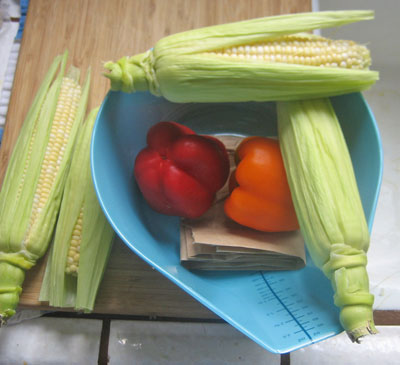 Here’s the corn and bell peppers ready to go. No prep needed, except cleaning up the corn.
 The hot grill is going — opened for the picture. Besides the corn and peppers I had half of a sweet onion and 1/3 of a red onion left from other things, as well as three Johnsonville Beef Brats and two Stadium Brats. In about 4 or 5 minutes, the Brats were browned; the vegetables went for about 8 minutes.
 I could do the grilling about five o’clock when it was really nice outside and let the food wait until dinnertime. The peppers are sweating in the paper bag.
 When dinnertime came around, the corn and peppers were sautéed in butter and the Brats put in a 200 ° toaster oven to warm. Cherry tomatoes and a bottle of Cline California Zinfandel completed the picture. Yum.
Category Archives: San Francisco
Material developed in San Francisco
Chickens in the Field
In April I took the opportunity to visit Marin Sun Farms. We saw lots of pasture, goats, cattle and sheep, but the interesting part for me, was the chicken operation. This time of year, they have both broilers and laying hens. These are the broilers, which run about 4 pounds. The pens are on wheels and are moved every day. The cylinders are for organic grain, the grass is the grass. You can see behind the pens, where the grass has been eaten, clawed and shat in. It takes about 8 days for the grass to get back to normal. We’ve eaten two of these guys. Oh my, they’re good. It was sunny, but we enjoyed a constant 30mph wind and temps in the low 50’s, that’s why everyone is bundled up. The farm is in the Point Reyes Preserve, owned by the National Park Service and leased to farmers as pastureland. You can see the Pacific Ocean in the background.
Continue reading
Waste Wise Farm Tour, Part One
Jepson Prairie Organics
This tour will take us to the Jepson Prairie Organics facility just outside of Dixon CA (southwest of Davis) where food waste from San Francisco and plant waste from Dixon and Vacaville is composted. Following that, we will visit Eatwell Farm, situated between Winters and Davis, one of the places Jepson Prairie Organics’ compost is used.
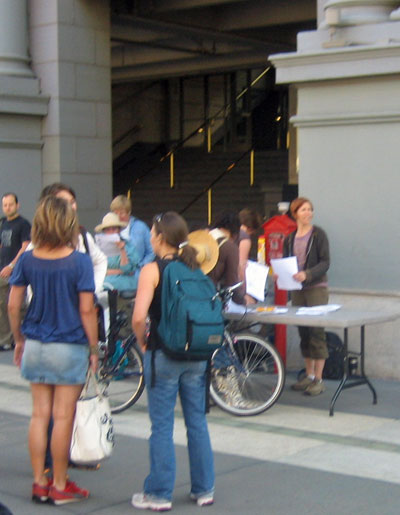
Friday June 13 at 8:30, step right up and sign in please. We met in front of the Ferry Building and were obliged to check in and sign an accident/injury waiver for the trip. Closed toed shoes were required; sun hats, sunglasses, sun screen and water were strongly advised, as we were anticipating a sunny day and nearly 100 degrees where we’re going.
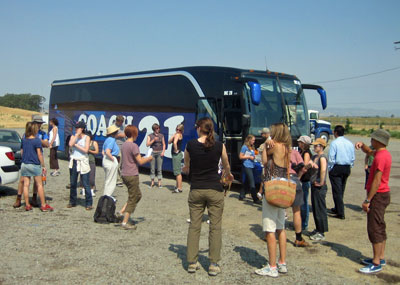
On the way to Jepson Prairie Organics, Julie Cummins, the Director of Education for CUESA explained the Waste Wise Initiative at the Ferry Plaza Farmers Market.
The program has been wildly successful since it’s start on Earth Day, in April. Having a captive audience, she also stressed the need for volunteers for that program, and acknowledged the sponsorship of, among others, Coach 21, the bus upon which we were riding.
Off the bus, we found a beautiful day, not totally hot and with a light breeze, but gnats. We were told that normal days are hot and very windy, but the wind keeps the gnats away.
Fiddlehead Fern
Continuing a celebration of Spring

photo from chow.com
I passed the mushroom stand at the market and there they were, gleaming green and beckoning to me, fiddlehead ferns. Oh boy.
Home and into the refrigerator and well, they slipped my mind for a couple of days. Carol is doing a Cornish hen for dinner and I’m making plane reservations. “Can I use these fiddleheads?” she said.
“Sure, I think we just sautéed them before, but I’ll check the Internet for recipes,” said I.
Well, I Googled “fiddlehead” and the descriptions, facts and recipes came forth as if a fiddlehead cornucopia (if you twist your mind a bit, a fiddlehead looks like a cornucopia.
I learned a lot. It’s especially fun to compare information from various sites, and in the case of fiddleheads, there are experts galore. Most are from the northeast — Maine, Vermont, Quebec — and take pride in the gathering and foraging as well as the cooking and eating. (Rule: Unusual foods have — self-proclaimed — experts, common foods don’t.)
Continue reading
Beans 'n' Tomatoes

When I come back from the Farmers Market on Saturday morning, Carol usually has cooking shows on the kitchen TV. As I was putting away the market fare, I heard Joanne Weir say, “I can swoon over an artless dish of braised big white beans in garlicky tomato sauce with a scattering of wild arugula.” I made a note of it.
Weeks or months later,*
I happened to have some cooked Rancho Gordo Runner Cannellini beans and some fresh heirloom tomatoes; it was lunchtime and I was hungry. I didn’t have any arugula, but I imagined it. I keep a jar of Mezzetta Express Deli-Sliced Tamed Jalapeno Peppers on hand because they give good jalapeno flavor without the heat (Carol screams bloody murder if there’s heat).
I went to work.
Continue reading
Fava Beans
(or, “Demystifying Fava Beans,” as Cook’s Illustrated would say)

Favas, a sure sign of Spring.
Favas, a process.
Favas, a great, over-the-top, green taste.
Favas, how much is enough?
It is true. One needs some time and patience to get to the great taste part of a Fava Bean. And it’s almost all in prep, because by the time you’ve liberated the beans, the cooking of them is simple and easy. Then it’s all about how to serve, and with what to pair them.
My recipe list includes soups, salads, stews and pasta dishes of one kind or another, most often as a side dish for a main course. They almost always include green garlic — it’s that season, too. In any dish, the fava beans should be the star, it doesn’t work in a supporting role.
Favas Soup — a simple green soup with favas and spring garlic and salt and pepper and water and whatever fresh herb is easily at hand
Fava Bean Orzo, a risotto made with orzo (orzotto?)
Umbrian Fava Bean Stew (Scafata) chopped onion, fennel, chard and tomatoes
Fava Bean Ragout (from Chez Panisse Vegetables by Alice Waters) w/olive oil, rosemary and garlic
Fava alla Romana — (from Classic Italian Coookbook by Marcella Hazan) This is quite wonderful. Not strictly a vegeteble dish, very meaty. Peppery too. w/pancetta
Our Favorite Fava Beans (from Mariquita Farm) sautéed with green garlic and oil
Julia’s Fava and Orzo Salad (from Mariquita Farm) with bits of carrot and radish
Rice Salad with Shrimp and Fava Beans
Fava Bean and Couscous Salad w/scallions and a honey vinaigrette
Fava Beans w/Tomato and sweet onion over tagliatelle
Garganelli Pasta with Fava Beans — (Chez Panisse Cafe Cookbook) Garganelli is a type of egg pasta characterized by a shape that resembles a small, ridged, rolled tube, similar to a quill.Fava and Fresh Ricotta Bruschetta
Time was when I was mystified by favas, what on earth do I do with these? No longer. Continue reading
Farmers Markets. ‘Tis the season.
Bean and Bacon Salad
I live in San Francisco and have my choice of about 20 farmers markets, but in 2008, farmers markets are pretty much everywhere. Besides the Ferry Plaza Farmers Market, I’ve shopped at Farmers Markets in San Rafael, Berkeley, Oakland, Sacramento, Healdsburg, Boston, Newton MA, Portland ME, Belfast ME, Columbus OH, and yes, even Lancaster OH. Look around on Saturday or Sunday, you can find one.
This is a farmers market meal. You could make it with stuff from the supermarket, but fresh, local stuff just tastes better.

Let’s go down the list.
WHITE BEANS. I used Marrow Beans from Rancho Gordo and cooked them the day before. I cook beans half-a-pound at a time. That yields about 4 cups of cooked beans. Well I work at home, so I can cook the beans anytime, you say. I say, put your beans to soak in the morning before you go to work. When you get home, pour your bowl of beans into a saucepan, water and all (you want to change the water, be my guest). Make sure the water covers by at least an inch. (I use a clay pot, which I think is better, but it’s an investment.) Now, bring that to a boil and let it boil for 4 or 5 minutes, cover and turn the heat as low as possible. That takes about 20 minutes. You want the beans to barely simmer. If you have a heat diffuser, that’s good. Set your timer for 45 minutes and do something else.
Continue reading
Film Food
It’s film festival time — late April, early May — and the 51st San Francisco International Film Festival (SFIFF51) is upon us. In doing menu planning for the Saturday Farmers Market, I noted that we had scheduled films for every dinnertime this week but one — and on that day we had tickets for the Giants v. Rockies baseball game. Time to think about alternative eats.

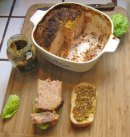

bean salad ham loaf sandwich macaroni salad
What is Film Food? It’s gotta be able to be made ahead. Can’t be messy. Must be able to be eaten cold — or at ambient temperature.
Film Society (SFFS) screenings during the year are usually at 7 or 7:30pm. While we reserve spots in advance, the seating is not reserved, so we line up outside up to an hour before the screening in order to secure our favorite seats. The line is part of the experience, part of the social gathering. It also affords a chance to eat a bite before the film is over at nine or later.

We see folks in line with pizza slices, Burger King boxes, containers of sushi or salad, all purchased nearby to eat while in line or even in the theater before the screening. What’s available at the concession stand is hardly healthy or good eats (I’m not a popcorn guy), and frightfully expensive, and the concession stand is not available until after line time.
The situation is similar for the Festival, only heightened by the frequency of the screenings throughout the day and night. My schedule Wednesday, for example shows Frozen at 3:30, out at 5:10, I Served the King of England at 6:00, out at 8:00. That’s five and a half hours, counting the line time. It’s possible to see another film at 9pm, and some folks will. Continue reading
CUESA at Macy's Cellar
Center for Urban Education about Sustainable Agriculture
Local chefs and farmers pair up at Macy’s ~ April 16
CUESA is partnering with Macy’s Cellar again for a series of three cooking demonstrations and farmer/chef interviews. At the first event, on Wednesday, April 16, farmer Brandon Ross of Ella Bella Farm and chef Charles Phan of The Slanted Door will talk about how they are both staying true to their values of sustainable agriculture, seasonal produce, and worker’s rights as they grow their companies. Seating is first-come, first-served starting at 6 pm in the Union Square Cellar Kitchen at Macy’s. A $10 donation to CUESA (tickets at the door) will get you a seat at the demonstration, a sample of the featured dish, a glass of wine from Benziger Family Winery, a canvas Ferry Plaza Farmers Market tote, and a sample of Origins’ new organic skin care line.

I went to the CUESA cooking demonstration and farmer/chef interview at Macy’s Cellar last evening. I had gone to two of their series of three last year and found them interesting and enlightening, enough so to forgo a film on Schindler’s Houses sponsored by the SF chapter of the American Institute of Architects the same evening.
This one featured farmer Brandon Ross of Ella Bella Farm and chef Charles Phan of The Slanted Door. Of course I knew Charles Phan as the master of the Slanted Door empire of Vietnamese restaurants, he is, after all, a celebrity chef in terms of his appearances on TV and in newspapers and magazines, but it turns out I knew little about the man and his values. Brandon Ross, I hadn’t heard of, although I pass by his Ella Bella stand at the Farmers Market every Saturday.
Lordy, I had a lot to learn and learned a LOT. These programs are more about education and sustainable agriculture — the ES and A of CUESA — than about cooking, although who would want to attend a program featuring Charles Phan and not have him whip up a little something — in this case, a broccoli decicco stir-fry. Continue reading
Turn the Other (Beef) Cheek
Braised Beef Cheek with Pappardelle
Beef Cheek Ravioli with Agretti

“Yeah, filet mignon is expensive,” David Evans said during our tour of Marin Sun Farms. “There’s only 15 pounds of it on a 750 pound dressed steer. You don’t want to spend so much, buy some of the lesser cuts.” I bought the Beef Cheek.
I was aware of beef cheek; Carol had Braised Beef Cheek at Absinthe just last week, and son Eric had Beef Cheek Ravioli at Babbo in New York about the same time. Here’s what he had to say about it,
“My beef cheek ravioli were arranged in a single layer on the plate, about eight handmade squares with a very light stock sauce coating. The menu promised a mix of goose liver with the cheek, but the liver provided more of a flavor than a richness, which the beef cheek had plenty of on its own. It was very very good and the others seemed to enjoy their taste of it, but I wouldn’t say it was mind altering. Perhaps too much hype had preceded it.”
I had never seen beef cheek for sale, until I saw it at Marin Sun Farms. I asked the guy, “What do I do with this, braise it?”
“Low and slow,” he said.
How could I resist, it was $7.99 a pound for a 1.2 pound cheek. Continue reading
 eats for one