
Bean Soup

Tuscan White Bean Soup for the slow cooker
Second Version

Cooking beans, for soup or on the plate, has been a subject with which I have struggled over the years. I wrote about this last September, but times have changed.

Having “discovered” the slow cooker for perfectly cooked beans, (thanks RG bean lady), I may have settled on the last, best, cooking method. Look at it this way, on top of the stove, you’re looking at six hours or more for beans (say 4-6 to soak, 1-2 to cook). Soaking is soaking, but during the cooking time, you have to pay attention once in a while, and chances are the beans won’t be perfect because you got impatient or the fire is too hot or not hot enough, whatever. With the slow cooker, throw in the beans and water and anything else   you want, turn it on, set the timer and go away. I am a believer.

Thus, I figured I could make perfectly good bean soup. With what I’d learned about the slow cooker, I adapted a Cook’s Illustrated recipe. I chose Tuscan White Bean Soup, the simplest possible bean soup (beans, water, seasonings) for my experiment. I adjusted the ingredients a bit and rewrote the instructions for the slow cooker.
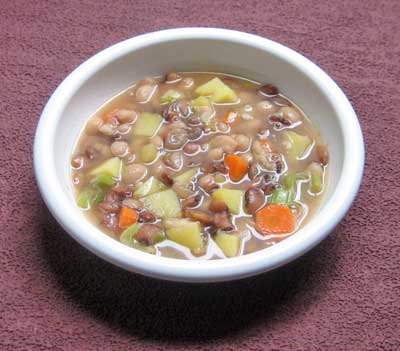
bean_soup.jpg

Continue reading

Soup's On

sb_knife.jpg
February is soup season in Maine; with all due respect to San Francisco in the summer, it can get pretty cold here. Our very favorite cold weather soup is an ancient recipe from Rome that includes bread, egg, cheese, and garlic in chicken stock. When it’s done right, it’s not even a soup really — it’s so thick that each spoonful will crown over the spoon edge. The garlic opens your often stuffy nasal passages, and the egg and bread fill you right up. There’s nothing better to be eaten in front of a roaring fire on a dark winter night. The recipe we normally use is from a 1993 SF Chronicle article by Carol Field who calls it “Pancotto.” However, there’s another good recipe in The Frugal Gourmet Cooks Three Ancient Cuisines where Jeff Smith traces a bit of the history of the soup, and then offers a version that makes “rags” out of semolina, eggs, and grated cheese that are cooked in the broth just before being served. Either way, you can’t go wrong when you’re looking for a quick filling way to warm up.

February is also Maine shrimp (Pandalus borealis) season, when this smallish species (averaging 30 to 60 pieces to a pound in the conventional shrimp meat measurement) of comes south for the winter from its summer home in the Arctic ocean. The nice thing about buying these shrimp in season is that you can often buy them directly from the fishermen, who sit in pick-up trucks just off Route 1 (the coastal State highway) propping up hand-lettered signs advertising their catch. And, believe it or not, these days the shrimp, often less than 24 hours out of the net, cost $1.00 or less a pound (the best I got this winter were $0.75 a pound)! That’s in the shell, but you can get more than a pound of tail meat from two pounds of shrimp, and that’s a very nice meal for two to four people. The remaining shells make this deal even better because the heads and shells contain lots of flavor of their own (and often the shells also include eggs stuck to the legs because the shrimp breed at this time, and the roe offer even more rich fat and flavor), and you can make some serious shrimp stock for poaching other fish, or as a base for sauces or soups.
Continue reading

Cincinnati Chili

Sally Redmond’s Cincinnati Chili
Cincinnati_Chili.JPG
Sally lived across the street from us in Newton, and though she isn’t from Cincinnati, her husband Jeff is. In any case, they would have a Kentucky Derby Party every spring, with Mint Juleps, their own Tote Board, and this chili, served in small bowls. It was generally accompanied by creamy Cole slaw, since this chili has some spice.

The party would start well before the five o’clock Derby, so we could get our bets down and our tote board correct, and last into the night. Money changed hands. As the evening became night, dancing ensued in the living room. I often wound up dancing with Sally to tunes from Jackson Browne’s Late for the Sky LP.
Continue reading

Soup With Cabbage

Chou

Just after Christmas 2005 I began reading one of my Christmas presents, The Perfectionist; Life and Death in Haute Cuisine by Rudolph Chelminski. It’s the story of Bernard Loiseau, a three-star French chef of a legendary restaurant called “La Côte d’Or” in Burgundy who killed himself when his restaurant was threatened with the loss of a star. But Chelminski was still “setting the stage” early in the book, describing Loiseau’s family and father, when I read this passage:

…soupe au chou: cabbage quarters simply boiled in water with potatoes, carrots, and onions and a large slab of smoked lard (a cut similar to unsliced bacon), chockablock with rich, cholesterol-laden fat. Cut thick slices of sourdough peasant bread to serve with it (not forgetting to first whip the knife back and forth over the loaf in a quick sign of the cross) and you have a dish that is the closest thing to the magic potion of Asterix and Obelix. Soupe au chou is a true French icon, a peasant curative and forifiant that can go head to head with the world’s champion of Jewish penicillins.”

It was cold and gray and snowy most of the week before the New Year, I had all the ingredients on hand (in fact had GROWN all the veg ingredients myself, and had KILLED and salted the meat myself) and could think of no better time to find out if Chelminski was right about this Gallic version of chicken soup. I’m also very partial to cabbage and all of it’s brothers and sisters in the Brassica oleracea clan, and we have an abundance of red cabbage in our root cellar from our 2005 garden. The idea that this is a “French icon” that I’d never heard of or tasted was also very appealing.
Continue reading