Grill it all

…sausages, beans, cabbage

What’s for dinner?

My question to myself each day.  Carol likes to cook, so she has taken over on days she doesn’t work. We reached agreement on that a few weeks ago. But the day was Wednesday and I was pondering, “What’s for dinner?”

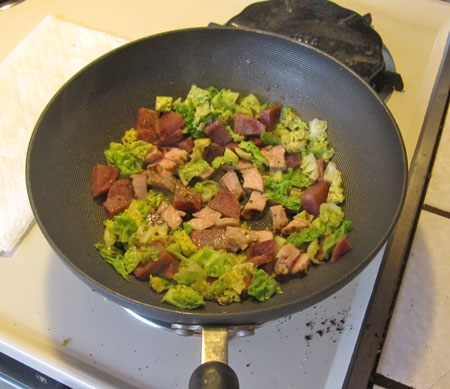
It was a beautiful day for grilling and I had some fennel sausages from Fatted Calf. That’s a good start. But do I light up the grill just for sausages? The fridge offered cooked Mariquita pinto beans… red beans and rice would be good, but Carol is not a lover of beans. Braised cabbage also had a place on the second shelf. A nice fennel sausage nestled in a bed of braised cabbage would please Carol. Beans, rice, cabbage — that’s stovetop work; I would be back and forth between the kitchen and the grill. Of course the beans, rice and cabbage will hold, but still.

g_ready_for_grill

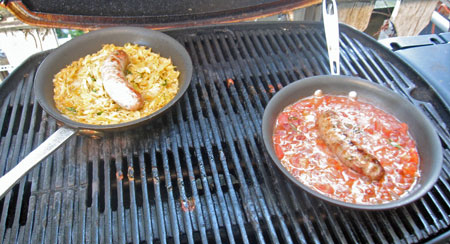
Why not do the beans and cabbage on the grill? They can sit over the gas flame – hardly different than being on the gas range – and I can turn off the center flame and grill the sausage there. Good idea.

g_sausage_grilling

g_sausage_in_pan

And I can cook the rice in lots of boiling water – like pasta – on the stove while the grill is heating up. That takes about 12 minutes and the grill takes 15 to warm up. That’s a plan!

“When I’m making rice salad, a huge pot is just right. Boiled like pasta in too much water, rice gives up its starch. Drained and cooled, it drifts apart into separate grains, no clumping.”

From Pete Wells in a New York Times column on boiling

We have a rice cooker, but once I tried the boiling method, that’s my method of choice. Once cooked, I drain the rice and put the strainer in the empty rice pot with the lid on to hold.

g_view

That gives me time to sit on the back porch and contemplate the Pacific Heights skyline while the grill is going. I love that. (OK, a bit of Pacific Heights and a lot of the Alhambra roof and my neighbor’s trees.)

g_served

So everything went just right. I loved my beans and sausage and Carol loved her cabbage and sausage. We slathered the sausage with Raye’s mustard, had a bit of the tarragon potato salad on the side and that made a simple, easy, beautiful dinner.

Spring Supper

Sausage in a sandwich of greens

Spring is in the air and the Market is fraught with the fresh and the new. A simple spring dinner is in the offing. I hung the spring garlic on the wall in my kitchen next to the bamboo bread bag.

s_spring_garlic

“You play the guitar on your MTV
That ain’t workin’ that’s the way you do it
Get your money for nothin’ get your chicks for free”

— Dire Straits Money For Nothing Lyrics

Shoppin’ at the Market, that’s the way you do it,
Money for red beets get your greens for free
Over there at Star Route, that’s the way you do it,
Money for turnips, get your greens for free

And so it goes.

s_red_beets_spring_onions

s_lil_caulif_turnip_beet_gr

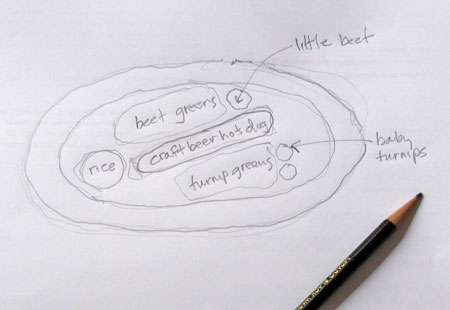
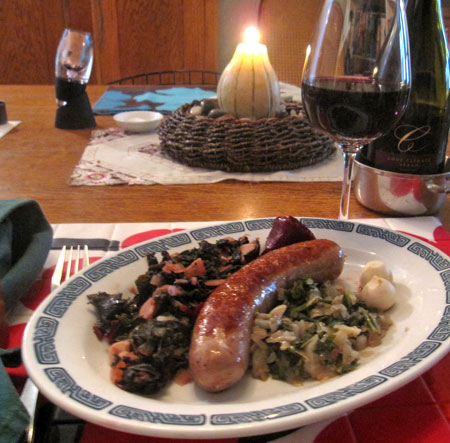
After lunch, I washed the beet greens and left them in a big bowl of water, the turnip greens in a plastic vegetable bag. I wanted to use them but didn’t know quite what to do, so I took a nap. Lying on the couch with my eyes closed, drifting, it came to me; I could cook them separately and arrange on a plate on each side of one of those Craft Beer Links I got at Fatted Calf. I could see the picture in my head, so I got up and drew it.

s_drawing

Craft Beer Links are described as “plump smoked pork links made this week with WTF from Lagunitas Brewing Co,” and the guy at the Fatted Calf stand was all over them with praise.

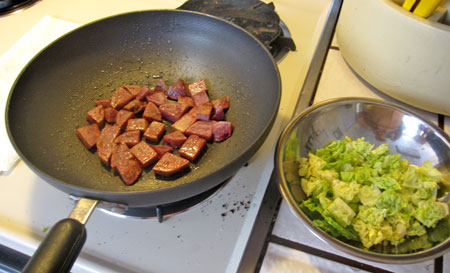
I set to work trimming the greens while roasting the beets. Sauté some chopped spring onions and sliced spring garlic, blanch the greens and brown the links. Drain the greens and add some of the garlic and onion to each. Pot intensive, but easy and quick.

s_saute_n_blanch

The only thing left to do is arrange the plates.s_serve_2

Bring assorted Raye’s mustards to the table and open a bottle of Cline Cool Climate Syrah. Enjoy.

A Fine Pork Chop

…revisited for lunch

The Globe Restaurant on Pacific at Battery is open late, frequented by off-duty cooks, so they say, and folks like us, hungry after a movie at the Embarcadero.

Globe

The room is a nice size with high ceilings; entry and bar at one end, partially open kitchen at the other. Feels good to be in this place bustling with diners. It was quite noisy until the group of nine near us were fed, happy and gone. It was quite dark, as well, so my pictures are pretty grainy – I won’t use a flash in such a place.

Globe_lil_gem

We started, sharing a lil gem salad from Mariquita Farm. Just right.

Globe_pork_chop

My pork chop with cabbage and potatoes was so good and I was so hungry, that I forgot to take its picture – even though artfully presented. Well, you’ll have to imagine what’s in my tummy. But this is about that pork chop revisited. No way I could eat all of it, so I took most of that part at the top – including the bone – home.

Next day at lunch I decided to recreate that dinner as best I could. I peeled and cut up a red potato – this variety happens to have red flesh, as well, a colorful paring with the cabbage – and set it to cooking slowly in duck fat. Duck fat and cabbage are long time lovers… I trust the potato can love a little, as well.

gr_potato_cabbage

I chopped half of a small Savoy cabbage to add to the skillet at just the right time.

gr_saute

Remains of the Globe pork chop, were diced and added to the skillet, along with a bit of white wine, salt, pepper and tarragon. After thoroughly warming and bubbling for a few minutes, lunch slid nicely onto my dish.

gr_served

Not exactly the atmosphere of the Globe, but the flavors and textures are there for a fine treat. Yum.

Just a Steak

Carol’s brother, Alan, called about 6:15. “Yo Alan, what’s up?”steak_to_grill

“You cookin’ dinner?”

“Yep.”

“What’s for dinner?”

“Drunken Steak. A beautiful boneless New York Strip.”

“What’s a Drunken Steak? You gonna grill it?”

“It’s marinated in a cup of light rum, half-cup of soy sauce, some brown sugar, chopped garlic, ginger, scallion… that’s about it… then dry it and grill it. It’s a beautiful evening for grilling.”

“Sounds good, I’ll have to try it sometime. Is the Mrs. home yet?”

“Just walked in the door. Heeeerrrrrre’s Carol.”

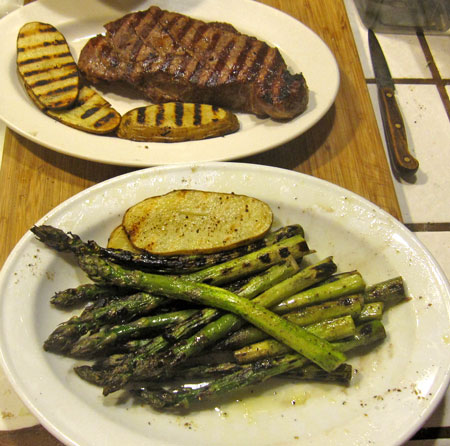
I went on to light the fire and get to grilling. I threw on a sliced potato, as well, tossed with olive oil, salt and pepper. When I returned, Carol had set the table, opened a nice bottle of 2006 Cline Ancient Vines Mourvedre and made a salad of sliced Cherokee Purple tomato and fresh mozzarella.

steak_grilled

“Why are you taking a picture of that? It’s just a steak.”

“Never know when I might need a picture of a steak.”

“Well, I’m hungry and you’re holding up dinner.”

“Besides, its not ‘just a steak.’ Its a grass fed, Marin Sun Farms boneless New York steak… and the first grilled steak of the year.”

“You grilled a flank steak when Tom was here.”

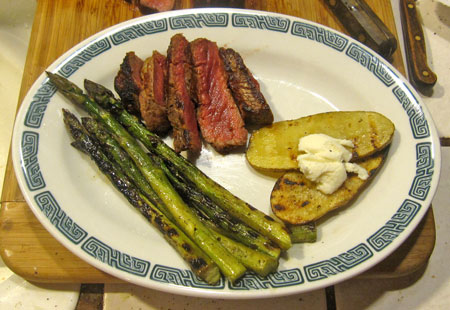
“OK, the first grilled steak of the Spring, in the twilight, not the dark… warm, not cold out. Besides I grilled this lovely asparagus, definitely the first grilled asparagus of the year.”

steak_served_2

Dinner was served. “This is really good steak,” said Carol.

Great Balls o’ Lamb

Greek-Style Braised Lamb Meatballs

balls_served

Brother Tom is in the food service industry so he gets all the trade publications. He sent me a bunch of meatball recipes from Restaurant and Institutions Magazine (what a melodious name!) and asked me to give this one a test drive as I had served goat meatballs when he last visited. Carol is a lamb lover, so this was very appropriate. I got the ground lamb from Marin Sun Farms at the Farmers Market. Lucky it’s almost spring; hothouse tomatoes and mint are available at the Market, as well.

Apropos of many restaurant recipes… this has lots of ingredients in small quantities. I guess a restaurant always has cooked rice, lamb broth, fresh mint and dill on hand. I had to break out the rice cooker and make a batch for the three tablespoons and buy a whole bunch of mint for two tablespoons. One tablespoon of dill? Fahgeddaboutit. I used one teaspoon dried dill. Lamb broth? Nope, I used demi-glace gold. Also — oops — I put all the olives in the balls instead of reserving some for garnish. No matter. The baking time seemed right… balls browned; gravy bubbly and thick. Yum.

The labor was worth it as the balls were very good and very rich. I served them in a bowl with the gravy, chopped tomato and garnish as noted. C thought I should serve over rice or noodles. Maybe, but they were good straight, accompanied by a fine, big salad and good bread.

All was not lost, as I mixed up the leftover rice, salad, and garnish to make a rice salad for lunch the next day.

balls_herbs_olives_rice

For this recipe – for all recipes as far as I’m concerned – it’s really important to get your mise en place together before starting. For the balls themselves, everything goes into one bowl and gets mixed up, but the sauce ingredients come into play one or two at a time. Here are breadcrumbs, herbs, spices in the big bowl. Lurking beneath them are the bread cubes and cream. Chopped olives and the famous three tablespoons of rice are in the smaller bowl.

balls_making

I’m starting to make the balls. Pinch off a batch of lamb mixture and roll between your palms. It helps to wet your hands from time to time between balls. Continue reading

French Grind

Rustic French Meatloaf using a hand grinder

Why would anyone want to hand-grind their own meat for a meatloaf? A fair question. For one thing, I have a hand-crank meat grinder — Silex No Clamp Chopper ca. 1959. When Carol’s grandmother died, it went to Carol’s mom’s basement where it lived until Carol claimed it. That was sometime in the seventies, but we gave it little use until recently when I rediscovered ham loaf.

I am an avid maker of meatloaf, meatballs and ham loaf. It’s common to buy ground beef or pork, turkey or chicken, even veal from your butcher, and that works fine for meatballs and meatloaf or most other ground meat preparations. For ham, it is a different matter. Ground ham is not readily available, so you ask your butcher to grind your ham, or grind it yourself. I learned that the ham I grind myself has a more coarse texture than that ground by the butcher. I like that much better. Why not try the hand-grinder for a meatloaf called “rustic” made with pork and veal? Why indeed; I got some pork and veal stew meat and went to work.

m_pork_veal_grinding

To demonstrate the swell meat grinder and some other handy kitchen tools, I selected a recipe from the April, 2009 Gourmet Magazine: Rustic French Meatloaf, using veal, pork, chicken livers and your usual meatloaf things. I alternated pieces of pork and veal… presto, instant mixing.

m_grinder

Here’s the grinder broken down. Pretty simple… the auger pushes the meat through the holes in the extruder and the meat is cut by the propeller shaped blade. I love the weight and the hefty feel of this grinder, and it is extremely easy to clean. Continue reading

Country Rope Sausage

A few years ago, Carol’s folks gave us a gift pack of ham and sausages from Burgers’ Smokehouse. Good stuff. We’ve ordered from them a few times… always ham – oddly, it’s hard to find good country ham in San Francisco – and something we haven’t tried. This time it was Country Rope Sausage.

b_sausage_n_oil

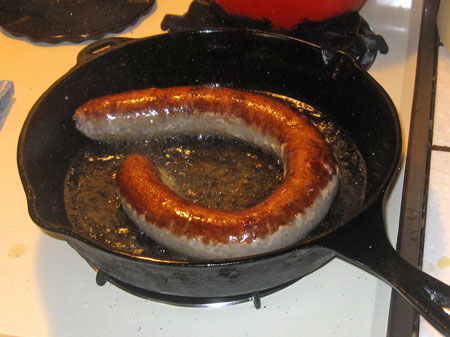
The rope sausage comes in three flavors, mild, medium and hot… I chose the mild to start with and followed the package directions to cook.

“Preheat skillet to 300 degrees. Add 1/4 cup oil and 1 lb. Burgers Rope Sausage. Cover and brown for approximately 8 minutes. Turn and brown an additional 8 minutes. Reduce heat to 250 degrees. Add 1 cup water. Cover and cook for approximately 8 minutes. Turn and cook for an additional 8 minutes or until done. Use meat drippings for milk gravy or fried eggs.”
b_rope_browns

I figured medium heat would be about 300 degrees for my cast iron skillet, and my oil of choice was olive oil since I would be using the drippings for a vegetable saute.

b_rope_steams

For my vegetable saute, I peeled and sliced one green pepper, one onion and half a large bulb of fennel. I added thyme to the mix and when the vegetables were almost tender, added some white wine to finish.

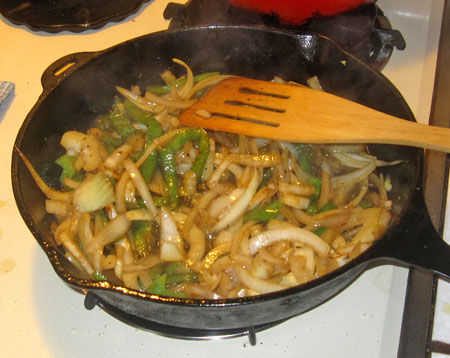
b_vegetablesb_veg_cook

The sausage is a medium fine grind and turned out perfectly browned, moist and tasty. The vegetable saute was a superb accompaniment.

b_rope_served

Damn fine brunch, but I got to thinking I ought to be feeling a twinge of guilt.

That morning, I attended a talk by Michael Pollan on his book Food Rules. I’m a big fan and have read most of his other books. One of the basic tenants of his philosophy is knowing where your food comes from. Well, this sausage came from Burgers’ Smokehouse in California, Missouri. But where do they get their meat? Their web site is all about their smokehouse and marketing… no mention of where and how their pork is raised.

They do say,

“By 1956 Mr. Burger was producing around 5,000 hams annually so he curtailed his farming activities to devote more time to the ham business. An expansion program was outlined. On July 23, 1956, the company became the first country cured meat company in the United States to receive Federal Inspection.

The family-owned corporation now comprises more than 305,545 square feet and is still located on the original site. Interestingly enough, that first little 1952 building remains a part of the existing plant complex. At the present time, the company produces 750,000 hams, bacon, sausage and a dozen other specialty meats.”

With trepidation, I sent them an email and asked the question.

Subject: a question about your products
From: Marcus Rector
Date: January 25, 2010 10:43:42 AM PST
To: service@smokehouse.com

A few years ago, we were given a gift pack of ham and sausage from Burgers’ Smokehouse. Good stuff. We’ve ordered from you two or three times a year since then. Oddly, it’s hard to find good smoked ham in San Francisco.

I buy nearly all my meat at the Ferry Plaza Farmers Market in San Francisco, so I know where it comes from and how it is raised. Where does the pork that you process in your smokehouse come from and how it is raised?

Sincerely,
Marcus Rector

From: service@smokehouse.com
Subject: Re: [Bulk] a question about your products
Date: January 25, 2010 1:38:57 PM PST
To: Marcus Rector

Our pork come from commercial producers in our state or from surrounding
states such as Iowa and Kansas.  All our meat products are USDA inspected
and first quality.
Thank you for the inquiry,
Edwena Shock
Customer Service for the Smokehouse

I have to reason that if their pork was free range, grass fed, heritage breed or any of that, they would say so. By buying from them I am indirectly supporting industrial feed lots. But their pork products are so good… they really know how to handle their spices and curing. Their ingredients are certainly straightforward: pork (including hams, loins and tenderloins), water, salt, seasoning (spices), sugar, monosodium glutamate.

So a nice brunch turns into a moral dilemma. I buy mostly local, and foods that are in season locally, but I’m not a fanatic. And is buying from Burgers’ Smokehouse any different than buying meat from Safeway?

Good sausages are certainly available at the Farmers Market, but not like these. And as I said, I haven’t found good country ham in San Francisco. So I will continue looking for that stuff at the market, continue to support the meat merchants at the market and rationalize my paltry one or two purchases a year from Burgers.

Chicken Liver Pate

Back in July, 2007, I posted a story called A Chicken’s Liver, about what to do with the liver you find inside your chicken — make a quick one-liver pate. I do that as a matter of course when I have the occasion to use a whole chicken.

And that’s good, but not plenty. Carol recently said, “You know what we haven’t had for a while? Chicken livers.” I listened.

From time to time, I make the traditional Chopped Chicken Liver — liver, onions and hard cooked eggs mixed together — most recently for my Super Bowl XLIII Party. Good, but it lacks finesse; and on that occasion it was overshadowed by my Bacon Explosion, wildly popular at the time.

I went in search of a real chicken liver pate — buttery and boozy and rich — and found the answer on the KQED blog in a recipe by Thy Tran, a food writer I had seen in the Chronicle from time to time.

Here’s what she thinks about a real chicken liver pate:

“For those trying to watch their cholesterol intake, you can stop reading right now. Ditto for the vegetarians and the hard-core dieters. Teetolers might also want to move along.

For those remaining — those of us who still manage to reward ourselves during the dark days of winter — it’s time to whip up some chicken liver paté.

As buttery treats go, liver is dense with protein, vitamins and minerals. A few crackers spread thinly with this paté will make the bitterest salad sweeter. Accompanied with a thinly sliced apple and a glass of wine, it becomes a very adult way to enjoy a movie at home. And little ramekins set out for guests never fails to impress.”

That’s my kind of food treat — I’m not much into sweets — so I set to work.

w_chix_liversFirst, marinate the livers in cognac and thyme to get all flavorful and joyful. OK, it doesn’t look all that good… yet. But chicken livers, cognac and thyme… there’s no bad in there. I did a half recipe, so that’s a half pound chicken livers, an ounce of cognac and one and a half tablespoons fresh thyme. Continue reading

Noodle Beef

w_nb_ingred_det

“Thorne has an accompanying recipe for Noodle Beef. The beef takes eight hours to poach, but based on the results with the chicken, I’m ready to embark on a beef adventure.”

So I said at the end of my Noodle Chicken story. Well, I have now cooked the beef. As a bonus, I cooked another batch of chicken during the first three hours of beef cooking. Both went in the fridge.

I used boneless beef short ribs from Golden Gate Meats. The meat poaches for eight hours at 170°F. I learned to control the water temperature by cracking the lid on the pot to a greater or lesser degree to keep the temperature in the acceptable range of 165 to 175. Although 8 hours is a long time, the cooking doesn’t require much attention. I checked every 30 to 45 minutes.

w_nb_somen

The poached beef was almost as tender and velvety as the chicken, but there was no mistaking the rich beef taste. Once cooled and shredded, the beef and its broth can be kept in a covered bowl in the refrigerator for a week or so.

The next day I made the Noodle Beef. The method is the same, but the ingredients vary to go with the meat — red bell pepper and Napa Cabbage to complement the chicken, carrots and bok choy for the beef — along with the common ingredients; scallions, garlic, ginger, chile paste and noodles.

When cooking the chicken version I found the recipe hard to follow. It’s written as though John Thorne made it up as he went along and prepped his vegetables while he was cooking. Maybe he did make it that way, but I’m not seasoned enough to cook like that. I have learned that if I get my mise en place together before starting to cook I don’t forget stuff. What one does with the carrot, for example, (2 medium to large carrots, peeled, cut into thirds and sliced vertically into wide thin strips.) I would note in the ingredients, rather than in the instructions. So I altered the recipe for the way I work. Continue reading

Lemon Chicken with Agretti

April 25.09

This dish is just so beautiful that I had to write about it. It comes from the stephencooks website, one of the quality food blogs out there. He has been a major source of inspiration for me since I became a lapsed architect.

Recently, Stephen was diagnosed with Type 2 Diabetes, so he took some time to get his life together and began anew with recipes to fit his new diet regimen. This is one of the first.

“Skinless boneless chicken breasts — or thighs, if well-trimmed of fat — always work very well for a healthy diet, whether you’re looking to control your blood glucose level or just trying to stay trim. They’re low fat, have zero carbs and are a good source of protein and so they frequently show up in diet regimens or recommendations.

The challenge with boneless breasts is, lets face it: how to make them interesting. The Chinese have a technique, however, called veleting which, with a little planning and a few simple ingredients, turns bland, dry chicken breast meat into a tender, juicy treat with a nice slippery feel in the mouth. I’ve learned this technique from years of cooking from Irene Kuo’s excellent The Key to Chinese Cooking.”

Low fat is not why I cook, but this looked intriguing, so I tried it. I used thighs – at least they have a modicum of flavor, and paired it with agretti, a green vegetable with a bright, lemony taste and succulent texture. Continue reading