Primo’s Saltimbocca

“Melissa’s grandfather Primo ate the Saltimbocca on a regular basis—his favorite dish, in fact— and the one dish Melissa never takes off the menu, for this reason.“Pork loin pounded thin, sautéed, served on a tall bed of garlic mashed potatoes with a sage Madeira shiitake sauce and a garnish of shaved Parma ham on top. The way Primo liked to eat it.”

Primo’s Saltimbocca as described in the story of Melissa Kelly’s Primo Restaurant in Rockland, Maine, in The Reach of a Chef by Michael Ruhlman.

Made me hungry, so I assembled the ingredients.

Here’s what I did:

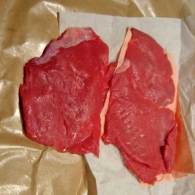
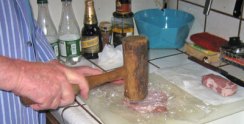
Pounded two boneless pork loin chops thin
pound_pork.jpg

pounded_pork.jpg Continue reading

Tale of Two Salads

Sometime in 2001

Before leaving for work, Carol said, “I’m going to be late coming home and you’re going to be late, so we’ve got all the stuff, there’s the leftover Flank Steak, and a bag of spinach, that avocado, cherry tomatoes and stuff in the vegetable drawer, so we’ll throw together a Steak Salad.”

“Great,” sez I.

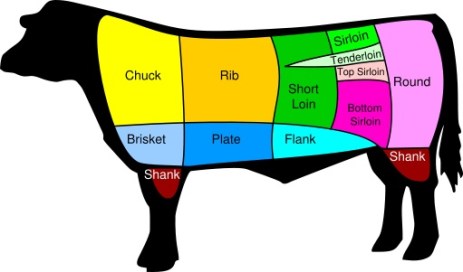
beef_cuts.jpg

I was tired coming home, after closing the store at nine. It was about quarter to ten and Carol was watching The West Wing, the recipient of many Emmy Awards, recently. She said she had been too hungry, and had eaten about 9 o’clock, and presented me with the big wooden salad bowl. In it was lots of spinach, some cherry tomatoes, bits of celery and scallion. Near the stove, she pointed to a plate with some steak and mushrooms that had been sauteed in butter. “Just heat these in the skillet, throw them warm on the greens, slice this half-avocado on top, throw on some Newman’s, and there you have it.” Continue reading

Hungry and Tired? Go for the Pasta

Kinda Sorta Pasta Primavera
Tuesday’s Dinner

I got home late from the Film Society, hungry. Carol is off at the toney Westerbeke Ranch on a “retreat” with her cohorts, no doubt dining on a gourmet dinner.

My weekly menu says leftover something. So I do what any guy would do, open the refrigerator. (Some guys might reach for the Chinese delivery menu, and I have done that on many occasions such as this.) Here’s what I found:

what_i_have.jpg

Some leftover spaghetti from last Thursday’s spaghetti with Tuscan meat sauce, A partial head of cauliflower and a partial head of broccoli from Saturday’s salmon dish. About a cup of my San Marzano tomato sauce, pretty much always on hand, stored in one of the handy POM Tea jars.

I can put together a kinda sorta pasta primavera, and add some ever-present Jimmy Dean hot sausage from the meat drawer.

This looks a lot my Saturday Brunch entry or Sunday Supper from a while back, but it just goes to show that eats for one has an enduring life, from the planned and precise to the thrown-together quickly, as long as I remember to take pictures. Continue reading

Dinner This Week

menu_book.jpg

A ways back, I wrote about my Food Book.

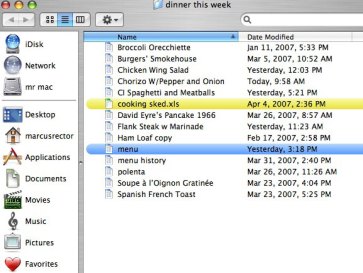
Well, the electronic age caught up with me. I now have a folder on the iMac that contains recipes for the meals I want to cook this week, a menu document and a menu history document. The menu history may seem a little narcissistic but sometimes I remember something for dinner a few weeks ago—what the hell was it—and I can page back and find it. Or, what did we have the last time whosis was here?

dinner_this_wk.jpgmenu_posted.jpg

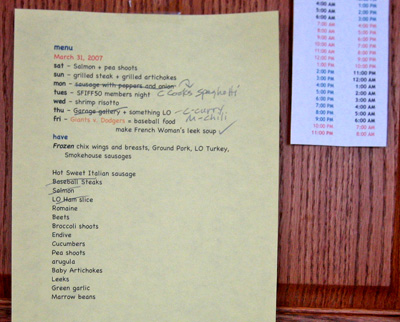
Menu posted.

(On the right, time of day in San Francisco and France.) Continue reading

Saturday Brunch

On Saturdays I have time to make whatever I want to eat after the Market. When putting away stuff in the refrigerator, old stuff has to be juggled or taken out so the new stuff fits. This taking out can be an opportunity for what to eat for brunch. (I do this alone, as C will already have eaten a big breakfast while I’m at the Market.) And there’s also the possibility of throwing stuff out, but I hate to do that.

So today, I threw out some leftover garlic mashed potatoes, about half a cup in a way too large container, taking up way too much space, which weren’t very good in the first place.

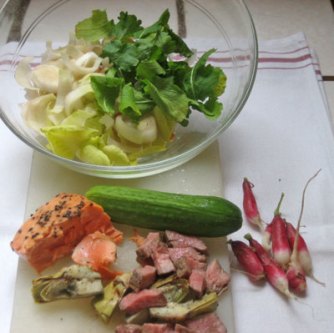
Oh, but look what I found:

sat_brunch_prep.jpg Continue reading

Chili: My Top Five

chilis.jpg

I am a chili lover.

Having “discovered” the slow cooker for perfectly cooked beans (thanks Joan), I spied a recipe for Rancho Gordo Chili Con Carne on the Rancho Gordo blog. It was Friday, so the next day, Market Day at the Ferry Plaza Farmers Market, I stopped by the Rancho Gordo stand and got the necessary Good Mother Stallard Beans and Mexican Oregano. I was able to find the Negra Modelo beer at Whole Food.

I slow cooked the beans and then assembled the chili in a conventional pot. Yum.

chilis.jpgchilis.jpgchilis.jpg

Over the years, I settled on my top four chili recipes, dating back to the 80’s and 90’s, but I’m always on the lookout for a new one. The Rancho Gordo just made the list for its simplicity and pure, rich chili taste. Now I have a Top Five. Here they are, listed alphabetically. I can’t rank them because though they are all built around chili powder, they are very different from one another. The recipes for each follow the discussion.
Continue reading

Bean Soup

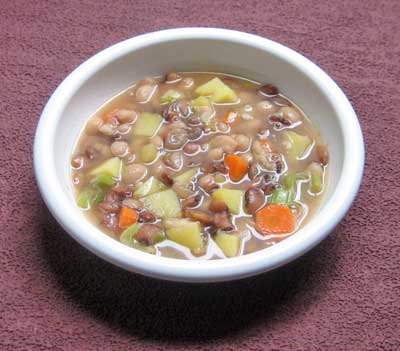
Tuscan White Bean Soup for the slow cooker
Second Version

Cooking beans, for soup or on the plate, has been a subject with which I have struggled over the years. I wrote about this last September, but times have changed.

Having “discovered” the slow cooker for perfectly cooked beans, (thanks RG bean lady), I may have settled on the last, best, cooking method. Look at it this way, on top of the stove, you’re looking at six hours or more for beans (say 4-6 to soak, 1-2 to cook). Soaking is soaking, but during the cooking time, you have to pay attention once in a while, and chances are the beans won’t be perfect because you got impatient or the fire is too hot or not hot enough, whatever. With the slow cooker, throw in the beans and water and anything else   you want, turn it on, set the timer and go away. I am a believer.

Thus, I figured I could make perfectly good bean soup. With what I’d learned about the slow cooker, I adapted a Cook’s Illustrated recipe. I chose Tuscan White Bean Soup, the simplest possible bean soup (beans, water, seasonings) for my experiment. I adjusted the ingredients a bit and rewrote the instructions for the slow cooker.

bean_soup.jpg

Continue reading

The Real Veal

Veal Parmigniana
Broccoli Pasta Fall Back

veal.jpg

I don’t seek out veal, but I was shopping at Golden Gate Meats and there were these marvelous looking veal scaloppini staring at me from under the glass, my mouth watered at the thought of Veal alla Parmigiana. There was something about them that just cried out, “Parmigiana!”

I’ve never cooked it, to my recollection, but on a first visit to any “red Italian” restaurant, that’s what I’ll order, reasoning that if they make a great Veal alla Parmigniana, their other dishes might be good. With this veal, how could I go wrong?

I’ve cooked veal chops, made Osso Buco and bought veal bones for stock. I know that veal is the subject of some controversy among the animal rights folks. I too espouse the humane treatment of animals raised for food. Since I live in place with many superb and convenient farmers markets, and where even in the supermarkets all food doesn’t come wrapped in packages, I can rely on my rule with regard to organic/sustainability/good food issues, “know from whom you are buying.”
Continue reading

Slow Cookery

How I learned to live with a slow cooker.

nebd_crock_box.jpg
Bean and Seafood Stew
Slow Cooker Pollo Pulquero
New England Boiled (NOT) Dinner
Is slow cooking, cooking?

Beans
I was standing at the Rancho Gordo stand at the Farmers Market taking in the array of, gosh, 15 or more bean varieties and I asked the bean lady, “What’s the bean of the day?”

“Runner Cellini are just in, I made the best seafood stew the other day, Put the beans and a can of clams with their juice in your slow cooker, and cook them for six hours on high. You don’t even have to soak the beans. With about an hour to go, throw in a pack of Trader Joe’s seafood mix. Devine.”

“Do you always do your beans in a slow cooker?” I asked.

“I do now, it’s so easy, six hours, no soak.”

Wow.

The next day, I went to Macy’s and got me a slow cooker, an actual Crock Pot, 5 quart. Ready to go.
Continue reading

Soup's On

sb_knife.jpg
February is soup season in Maine; with all due respect to San Francisco in the summer, it can get pretty cold here. Our very favorite cold weather soup is an ancient recipe from Rome that includes bread, egg, cheese, and garlic in chicken stock. When it’s done right, it’s not even a soup really — it’s so thick that each spoonful will crown over the spoon edge. The garlic opens your often stuffy nasal passages, and the egg and bread fill you right up. There’s nothing better to be eaten in front of a roaring fire on a dark winter night. The recipe we normally use is from a 1993 SF Chronicle article by Carol Field who calls it “Pancotto.” However, there’s another good recipe in The Frugal Gourmet Cooks Three Ancient Cuisines where Jeff Smith traces a bit of the history of the soup, and then offers a version that makes “rags” out of semolina, eggs, and grated cheese that are cooked in the broth just before being served. Either way, you can’t go wrong when you’re looking for a quick filling way to warm up.

February is also Maine shrimp (Pandalus borealis) season, when this smallish species (averaging 30 to 60 pieces to a pound in the conventional shrimp meat measurement) of comes south for the winter from its summer home in the Arctic ocean. The nice thing about buying these shrimp in season is that you can often buy them directly from the fishermen, who sit in pick-up trucks just off Route 1 (the coastal State highway) propping up hand-lettered signs advertising their catch. And, believe it or not, these days the shrimp, often less than 24 hours out of the net, cost $1.00 or less a pound (the best I got this winter were $0.75 a pound)! That’s in the shell, but you can get more than a pound of tail meat from two pounds of shrimp, and that’s a very nice meal for two to four people. The remaining shells make this deal even better because the heads and shells contain lots of flavor of their own (and often the shells also include eggs stuck to the legs because the shrimp breed at this time, and the roe offer even more rich fat and flavor), and you can make some serious shrimp stock for poaching other fish, or as a base for sauces or soups.
Continue reading