POST PIG

pig to eat and an actual recipe

DAY 8 TUESDAY 10.15
Funny. No pig to process. But Eric fried up some sausage for breakfast.
lovely morning

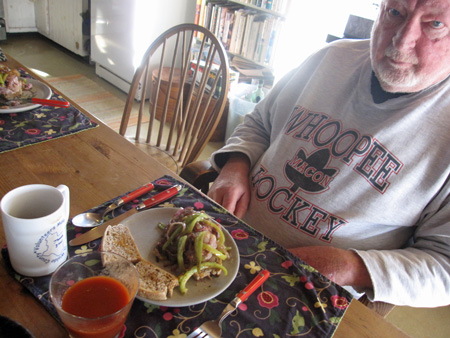
Of course, he doesn’t just fry up some sausage, he adds the trimmings, in this case, onions and peppers and bread toasted on the wood stove.

sausage and stuff, V8 and coffee

We got back to real life. Eric catching up on work while Carol and Alison did some laundry and I did some reading and journal writing.

laundry swinging in the breeze

We took a ride into Belfast to look around. Stop on the waterfront for a Growler of beer at the Marshall Wharf Brewing Company.
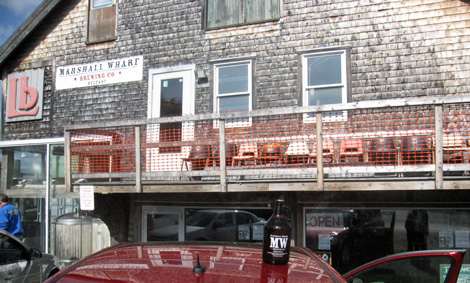
Marshall Wharf Brewing Co… growler on top of car.

Belfast has a new waterfront walk…

and a new industry, the Front Street Shipyard,  biggest on the coast of Maine (not including Bath Ironworks, of course, where the Navy’s newest destroyer was built). It’s a clean industry — as opposed to a chicken operation formerly on this site — and they can handle some pretty large boats.

a pretty large boat, I’d say…

last tomatillos of the season

While we were doing pig things, Alison picked all the tomatillos left standing in the garden. I was volunteered to make something with them, using as much pork loin as I could manage. Maybe a green chili. I recalled using tomatillos for the chili I made for the Sierra Canyon Chili Cookoff, so I looked that up on eats, and looked for ideas in Mark Bittman’s How to Cook Everything. There was one chili recipe, “Chili Non Carne.” I adapted it to use the pork and the tomatillos and used his spices and suggested cooking times.

Marc’s Tomatillo Chili con Carne

Cook 2 cups of dry beans with one onion by your usual method. Drain and reserve bean juice, just in case you need some. (Or open a can of beans.)

Select enough tomatillos to produce 2 cups and peel off their papery skins. Roast  at 400°F for one hour. Wrap 6 to 8 cloves garlic in foil and roast with the tomatillos.

Mash garlic and mix in with tomatillos. If you don’t have 2 cups, add some bean juice.

Add tomatillos mixture to beans and mix. Stir in 1 fresh or dried chopped chili or 1 Tbsp chili powder. (Eric chopped a dried ancho chili.) Add 1 tsp ground cumin, 1/2 tsp dried oregano.

Cut up 1 pound meat (our pork tenderloin). Brown with peanut oil, season with salt and pepper, and add to pot. Cook about 15 minutes more.

a nice bowl of green

DAT was good.

The Pig :: Day Three

“I love sausage, but don’t care to see how it’s made.”

Today, you’ll see how it’s made.

Although the recipes came from various sources, the ingredients are simple and similar:

  • ground pork
  • spices
  • herbs
  • often onions and garlic
  • liquid — usually wine

Breakfast sausage (sage and onions) from Better Than Store Bought by Helen Willyard and Elizabeth Coichie
Saucisson (black and white pepper sausage for dry curing) from La Technique by Jacques Pepin
Pork Liver Terrine Pate Campagnola from Cooking by Hand by Paul Bertolli
Boudin blanc (emulsified sausage) from Charcuterie by Michael Ruhlman and Brian Polcyn
Cotechino (classic Italian with Anise and boiled pork skin) from Cooking by Hand by Paul Bertolli
Crepinettes, each of the fresh sausage mixtures made into patties and wrapped in caul fat

The meat was all cut up yesterday and divided into portions for the various sausages.

prep for Pate Campagnole

Each team put together its recipe ingredients — this particular prep is for the Pate Campagnole — you can tell by the use of liver.

The meat is ground with a cast iron grinder attachment for the commercial mixer.

grinding

The ground meat, herbs, spices, etc. are mixed.

mixing

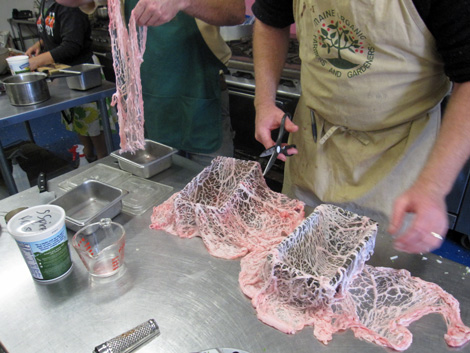
Here, we visit the terrine. Loaf pans are lined with caul fat and the ground meat mixture pressed into the pans.

pate underway

The pans are placed in a water bath and baked. Continue reading

The Pig :: Day Two

Breaking down the sides…

We are entering the middle day of our journey from two snorting and snuffling pigs to some hams, bacon, sausages and the like.

Today, we’ll smoke some bacon, make some headcheese, start some hams, render some leaf lard, and have a swell and somewhat unusual lunch, make big pieces into little pieces and sort them.

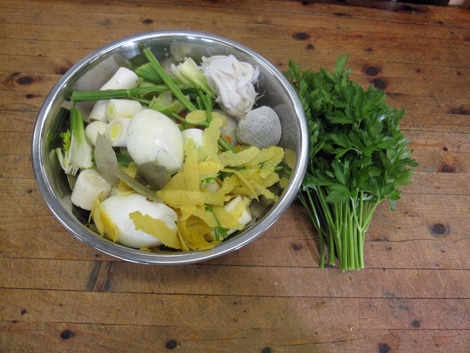
These are the vegetables for Head Cheese, or what Fergus Henderson in his book “Nose to Tail Eating” calls BRAWN. We’re looking at onions, carrots, leeks, celery, garlic, lemon zest, a splash of red wine vinegar, bundle of herbs and a small handful of black peppercorns. While I prepped the vegetables, the pig’s head in water was coming to a boil in a big pot. When it got to a simmer, I stuffed the vegetables into the pot.

vegetables for head cheese

After about 2 1/2 hours, everything comes out of the pot and the remaining liquor is reduced by half. The vegetables are discarded and all the good bits of meat are picked out of the head. A terrine will be lined with cling film, the bits of meat added, the reduced liquor poured over and refrigerated overnight to set. The bits leftover will be made into patties, breaded and fried. That’s for tomorrow’s lunch.

My other job-of-the-day was to cook up the pig lungs for lunch. When they were harvested yesterday and before going into their sterilized tray, one of the students picked it (them?) up and blew them full of air. Hey, they work.

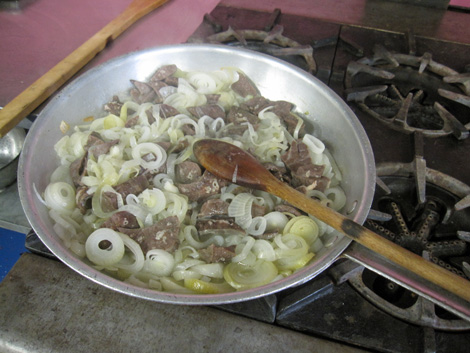
I trimmed the lungs of their gnarly parts, cut into small pieces and parboiled. Sliced a boatload of onions and got all that going over a very low flame. That would cook until lunchtime, almost three hours. Salt and pepper was the only seasoning.

lungs n onions saute very slowly

Meanwhile, the ribs were cut out, trimmed and roasted.

clockwise from bread: roasted potatoes, lungs n onions, roasted ribs, vegetable salad

This was a very nice lunch. When I went back for seconds on the ribs, the lungs were totally gone. Bummer. I was surprised that the lungs didn’t taste at all like organ meat. Probably because they are so fresh.

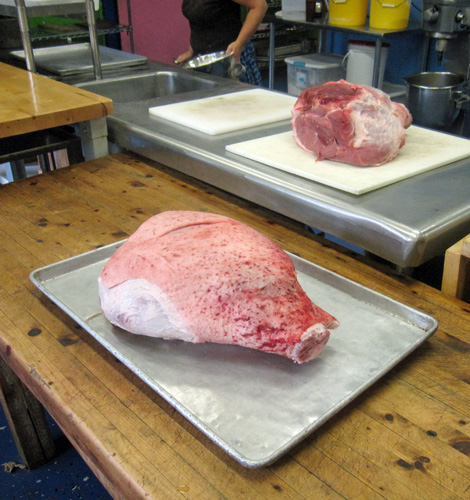
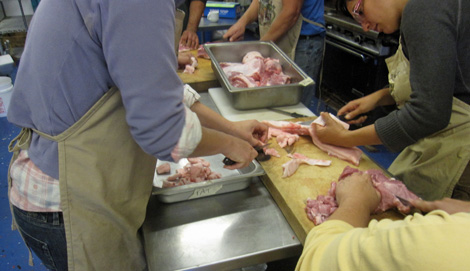
Meanwhile, the prime cuts; hams, loin, ribs, chops and roasts are cut and the balance of the meat is cut into bits for sausage. These bits are sorted by lean and fat so they can be mixed in proper proportion. The shoulder (Boston Butt) has perfect proportion by itself.

hams, cut two ways

some of the lean meat being cut

The cut meat is put in that yellow bucket, weighed and then sorted into hotel pans and labeled for its ultimate use. Tomorrow, we’re going to make 5 kinds of sausage and a pate.

These are the more fatty cuts.

The person top right is cutting the skin from the meat. The skin will be boiled until tender and go into sausage as fat.

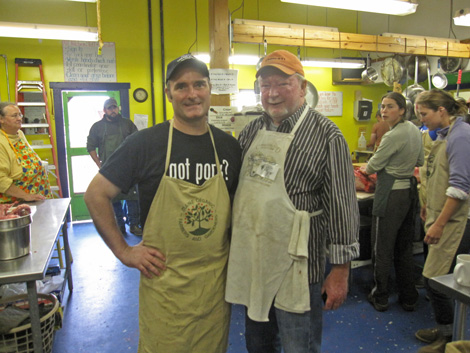
Alison requested this picture. It was hard to catch Eric standing still long enough to pose.

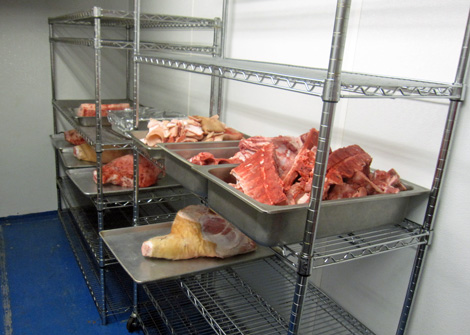
At the end of the day, what once had been carcasses, was transformed into hotel pans of various cuts of meat.

A cooler of pig.

another view showing meat sorted for sausages

The Pig

NEW ENGLAND, 14 DAYS IN OCTOBER, 2013

At age 30, we moved to Massachusetts. Our sons were five and three. At age 54 we moved to San Francisco. All but one year of that time, we lived at 48 Harrison Street, Newton Highlands MA 02138. 617-969-3359 It was the time when we embraced adulthood, raised our children and forged lasting friendships. A time like no other in our lives. This is about revisiting New England, not for reflection and nostalgia, but for activity and exploration.
Our visit was centered around the Maine Organic Farmers and Gardeners Association (MOFGA) annual Nose to Tail Pig Processing Workshop during Columbus Day weekend. Before, we made our way to the Belfast Maine environs, and after, we drove across the whole of New England to Cooperstown, New York, and from there to Newton Highlands.
The story has a beginning, middle and end. You recently read the beginning, “Getting to the Pig.” And here is the middle and the raison d’etre, “The Pig” where we will journey from two snorting and snuffling pigs to some hams, bacon, sausages and the like.

Pig One

We called this fella “Pig One” He’s been in this stall about two days to get used to his surroundings. He’s had his food withheld but given plenty of water. He’s met the farmers, Paul and Everett, so he knows them and is not afraid.

the big room with tables in a “U” shape

We met in this big, high room each morning for coffee and a muffin and to discuss what will be going on that day. Eric — at the corner table — says that today, Paul and Everett, our farmer instructors, will lead us through the process of killing and dressing two pigs.

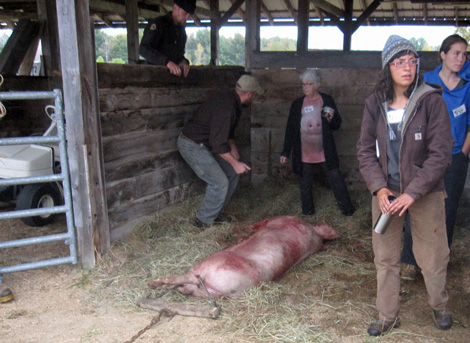
The day was cloudy and quite cool, perfect weather for our task at hand. We walked across the field to greet Pig One and be instructed how he will meet his demise. The killing must be quick and efficient and cause no trauma in the pig. In this case, Paul will shoot the pig with a .22 caliber pistol aimed at the center of a triangle formed by the pigs eyes and nose. — I was surprised at how calm the pig was, Paul walked into the stall and slowly up to the pig’s head and BANG. — The pig will writhe violently, so stand clear, a flailing leg could cause serious injury.

As soon as possible, the pig will be “stuck” by inserting a knife just above the breast bone and thrusting up. This will cut the main artery that runs above the breast bone and the pigs own heart will pump all of the blood out onto the straw of the pen. Very efficient. That whole process took about 30 seconds.

spreader attached to the pig

A spreader is attached to the pig’s hind feet and he will be picked up and hosed down to wash off mud, blood and straw.

We will process two pigs, the first will be scraped clean of his hair and dressed with his skin on. Often, for hams or bacon, the cut with skin on is preferred. Excess skin can be boiled and ground into sausage, as well. The other pig will be skinned.

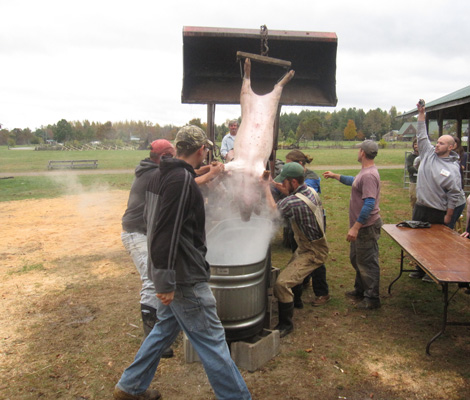
Very early, a trough was filled with water and a fire built under the trough. Now the water temperature is just under boiling and the pig will be lowered into the water and sloshed around. The hot water bath eases the scraping… just like shaving, guys.

the pig, being guided into very hot water

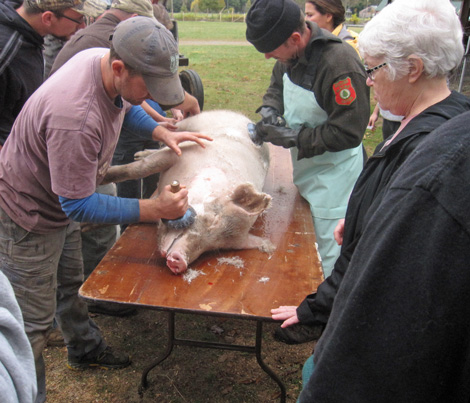
The table to the right has been washed and sanitized with a vinegar water solution. Out he comes, onto the table.

pig on the table

scraping starts at the head

For this pig, the head will be cut off whole, to be boiled and made into headcheese. Continue reading