
In April I took the opportunity to visit Marin Sun Farms. We saw lots of pasture, goats, cattle and sheep, but the interesting part for me, was the chicken operation. This time of year, they have both broilers and laying hens. These are the broilers, which run about 4 pounds. The pens are on wheels and are moved every day. The cylinders are for organic grain, the grass is the grass. You can see behind the pens, where the grass has been eaten, clawed and shat in. It takes about 8 days for the grass to get back to normal. We’ve eaten two of these guys. Oh my, they’re good. It was sunny, but we enjoyed a constant 30mph wind and temps in the low 50’s, that’s why everyone is bundled up. The farm is in the Point Reyes Preserve, owned by the National Park Service and leased to farmers as pastureland. You can see the Pacific Ocean in the background.
Continue reading
Monthly Archives: June 2008
Waste Wise Farm Tour, Part One
Jepson Prairie Organics
This tour will take us to the Jepson Prairie Organics facility just outside of Dixon CA (southwest of Davis) where food waste from San Francisco and plant waste from Dixon and Vacaville is composted. Following that, we will visit Eatwell Farm, situated between Winters and Davis, one of the places Jepson Prairie Organics’ compost is used.
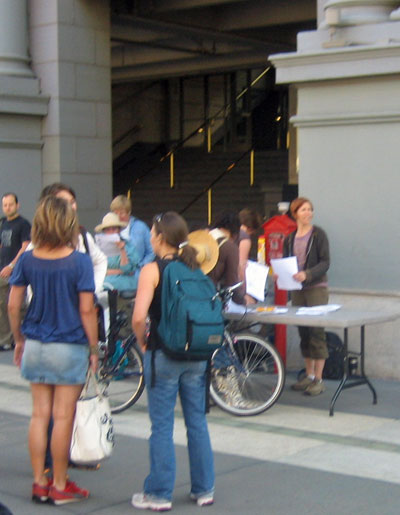
Friday June 13 at 8:30, step right up and sign in please. We met in front of the Ferry Building and were obliged to check in and sign an accident/injury waiver for the trip. Closed toed shoes were required; sun hats, sunglasses, sun screen and water were strongly advised, as we were anticipating a sunny day and nearly 100 degrees where we’re going.
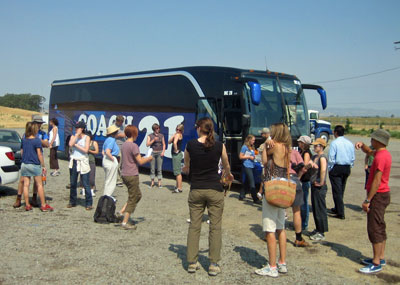
On the way to Jepson Prairie Organics, Julie Cummins, the Director of Education for CUESA explained the Waste Wise Initiative at the Ferry Plaza Farmers Market.
The program has been wildly successful since it’s start on Earth Day, in April. Having a captive audience, she also stressed the need for volunteers for that program, and acknowledged the sponsorship of, among others, Coach 21, the bus upon which we were riding.
Off the bus, we found a beautiful day, not totally hot and with a light breeze, but gnats. We were told that normal days are hot and very windy, but the wind keeps the gnats away.
Fiddlehead Fern
Continuing a celebration of Spring

photo from chow.com
I passed the mushroom stand at the market and there they were, gleaming green and beckoning to me, fiddlehead ferns. Oh boy.
Home and into the refrigerator and well, they slipped my mind for a couple of days. Carol is doing a Cornish hen for dinner and I’m making plane reservations. “Can I use these fiddleheads?” she said.
“Sure, I think we just sautéed them before, but I’ll check the Internet for recipes,” said I.
Well, I Googled “fiddlehead” and the descriptions, facts and recipes came forth as if a fiddlehead cornucopia (if you twist your mind a bit, a fiddlehead looks like a cornucopia.
I learned a lot. It’s especially fun to compare information from various sites, and in the case of fiddleheads, there are experts galore. Most are from the northeast — Maine, Vermont, Quebec — and take pride in the gathering and foraging as well as the cooking and eating. (Rule: Unusual foods have — self-proclaimed — experts, common foods don’t.)
Continue reading
Beans 'n' Tomatoes

When I come back from the Farmers Market on Saturday morning, Carol usually has cooking shows on the kitchen TV. As I was putting away the market fare, I heard Joanne Weir say, “I can swoon over an artless dish of braised big white beans in garlicky tomato sauce with a scattering of wild arugula.” I made a note of it.
Weeks or months later,*
I happened to have some cooked Rancho Gordo Runner Cannellini beans and some fresh heirloom tomatoes; it was lunchtime and I was hungry. I didn’t have any arugula, but I imagined it. I keep a jar of Mezzetta Express Deli-Sliced Tamed Jalapeno Peppers on hand because they give good jalapeno flavor without the heat (Carol screams bloody murder if there’s heat).
I went to work.
Continue reading
Fava Beans
(or, “Demystifying Fava Beans,” as Cook’s Illustrated would say)

Favas, a sure sign of Spring.
Favas, a process.
Favas, a great, over-the-top, green taste.
Favas, how much is enough?
It is true. One needs some time and patience to get to the great taste part of a Fava Bean. And it’s almost all in prep, because by the time you’ve liberated the beans, the cooking of them is simple and easy. Then it’s all about how to serve, and with what to pair them.
My recipe list includes soups, salads, stews and pasta dishes of one kind or another, most often as a side dish for a main course. They almost always include green garlic — it’s that season, too. In any dish, the fava beans should be the star, it doesn’t work in a supporting role.
Favas Soup — a simple green soup with favas and spring garlic and salt and pepper and water and whatever fresh herb is easily at hand
Fava Bean Orzo, a risotto made with orzo (orzotto?)
Umbrian Fava Bean Stew (Scafata) chopped onion, fennel, chard and tomatoes
Fava Bean Ragout (from Chez Panisse Vegetables by Alice Waters) w/olive oil, rosemary and garlic
Fava alla Romana — (from Classic Italian Coookbook by Marcella Hazan) This is quite wonderful. Not strictly a vegeteble dish, very meaty. Peppery too. w/pancetta
Our Favorite Fava Beans (from Mariquita Farm) sautéed with green garlic and oil
Julia’s Fava and Orzo Salad (from Mariquita Farm) with bits of carrot and radish
Rice Salad with Shrimp and Fava Beans
Fava Bean and Couscous Salad w/scallions and a honey vinaigrette
Fava Beans w/Tomato and sweet onion over tagliatelle
Garganelli Pasta with Fava Beans — (Chez Panisse Cafe Cookbook) Garganelli is a type of egg pasta characterized by a shape that resembles a small, ridged, rolled tube, similar to a quill.Fava and Fresh Ricotta Bruschetta
Time was when I was mystified by favas, what on earth do I do with these? No longer. Continue reading
 eats for one