
Greenhouse Farms Tour Part Two

Here we embark on the afternoon portion of our   tour, as described by the announcement in CUESA Newsletter.

Enjoy the bus ride through the scenic and fertile Capay Valley, home to numerous small family farms. A representative from Capay Valley Grown will narrate along the way and will tell us about how the farms in this valley work together to market their crops.Our final destination will be Orangewood Farm in Rumsey. Mother-and-daughter team Jackie and Bonny Scott run this nursery that utilizes a greenhouse to grow organic plant starts for home gardeners, including 67 varieties of tomatoes. The Scotts also have citrus and pecan trees, and are working to restore the hills on their property by planting native grasses. Each participant will receive a nursery plant to take home.

Upon leaving the Bruins’ farm, we turned north onto Route 16 and picked up Paul Muller of Full Belly Farm to narrate our trip through the Capay Valley. (Pronounced Kay-Pay) This small, very fertile valley, fed by Cache Creek, does not lend itself to huge industrial agriculture that you’ll find in the Central Valley, and so has attracted small farms, ranging from 20 to 150 acres. In addition to his work at Full Belly, Paul Muller is one of the leaders of a movement to create a Capay Valley Grown brand.

img_4139_bus_view.jpg
Our destination is Orangewood Farm, where Jackie Scott cultivates oranges and grapefruits and her daughter Bonny has a plant nursery growing over 100 kinds of plant starts. They harvest pecans that grow wild on their property, as well. Continue reading
Greenhouse Farms Tour Part One

Announcement in CUESA Newsletter:
Sun April 20, Greenhouse Grown Farm Tour, 9 am – 6 pm
Spend a day visiting two farms that rely on greenhouses to help grow their crops.We will first visit Bruins Farms in Winters, CA where greenhouses allow Paul, Eva and Bart Bruins to bring their heirloom and hybrid tomatoes to market well before the local field-grown fruits are available. See the tomatoes at several different stages, and learn how the Bruins family produces such perfect-looking tomatoes without using pesticides. CUESA will provide a delicious lunch made from farmers’ market foods.Then enjoy the bus ride through the scenic and fertile Capay Valley, home to numerous small family farms. A representative from Capay Valley Grown will narrate along the way and will tell us about how the farms in this valley work together to market their crops.Our final destination will be Orangewood Farm in Rumsey. Mother-and-daughter team Jackie and Bonny Scott run this nursery that utilizes a greenhouse to grow organic plant starts for home gardeners, including 67 varieties of tomatoes. The Scotts also have citrus and pecan trees, and are working to restore the hills on their property by planting native grasses. Each participant will receive a nursery plant to take home.

The tour is $25 and includes lunch made with farmers’ market ingredients.

81_bus.jpg

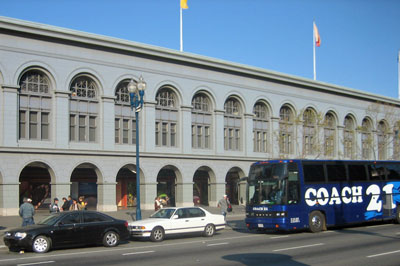
It was chilly and windy in front of the Ferry Building as we waited to board the big Coach 21 bus. The weather report said that that the weather in Winters was about the same as SF. Lucky for us, the weather turned fine in Winters and beyond, so we could wear shirtsleeves in the warm breeze. Continue reading

CUESA at Macy's Cellar

Center for Urban Education about Sustainable Agriculture

Local chefs and farmers pair up at Macy’s ~ April 16
CUESA is partnering with Macy’s Cellar again for a series of three cooking demonstrations and farmer/chef interviews. At the first event, on Wednesday, April 16, farmer Brandon Ross of Ella Bella Farm and chef Charles Phan of The Slanted Door will talk about how they are both staying true to their values of sustainable agriculture, seasonal produce, and worker’s rights as they grow their companies. Seating is first-come, first-served starting at 6 pm in the Union Square Cellar Kitchen at Macy’s. A $10 donation to CUESA (tickets at the door) will get you a seat at the demonstration, a sample of the featured dish, a glass of wine from Benziger Family Winery, a canvas Ferry Plaza Farmers Market tote, and a sample of Origins’ new organic skin care line.

ferry_bag.jpg
I went to the CUESA cooking demonstration and farmer/chef interview at Macy’s Cellar last evening. I had gone to two of their series of three last year and found them interesting and enlightening, enough so to forgo a film on Schindler’s Houses sponsored by the SF chapter of the American Institute of Architects the same evening.

This one featured farmer Brandon Ross of Ella Bella Farm and chef Charles Phan of The Slanted Door. Of course I knew Charles Phan as the master of the Slanted Door empire of Vietnamese restaurants, he is, after all, a celebrity chef in terms of his appearances on TV and in newspapers and magazines, but it turns out I knew little about the man and his values. Brandon Ross, I hadn’t heard of, although I pass by his Ella Bella stand at the Farmers Market every Saturday.

Lordy, I had a lot to learn and learned a LOT. These programs are more about education and sustainable agriculture — the ES and A of CUESA — than about cooking, although who would want to attend a program featuring Charles Phan and not have him whip up a little something — in this case, a broccoli decicco stir-fry. Continue reading

Turn the Other (Beef) Cheek

Braised Beef Cheek with Pappardelle

Beef Cheek Ravioli with Agretti

beef_w_cheek.jpg

“Yeah, filet mignon is expensive,” David Evans said during our tour of Marin Sun Farms. “There’s only 15 pounds of it on a 750 pound dressed steer. You don’t want to spend so much, buy some of the lesser cuts.” I bought the Beef Cheek.

I was aware of beef cheek; Carol had Braised Beef Cheek at Absinthe just last week, and son Eric had Beef Cheek Ravioli at Babbo in New York about the same time. Here’s what he had to say about it,

“My beef cheek ravioli were arranged in a single layer on the plate, about eight handmade squares with a very light stock sauce coating. The menu promised a mix of goose liver with the cheek, but the liver provided more of a flavor than a richness, which the beef cheek had plenty of on its own. It was very very good and the others seemed to enjoy their taste of it, but I wouldn’t say it was mind altering. Perhaps too much hype had preceded it.”

I had never seen beef cheek for sale, until I saw it at Marin Sun Farms. I asked the guy, “What do I do with this, braise it?”

“Low and slow,” he said.beef_cheek.jpg

How could I resist, it was $7.99 a pound for a 1.2 pound cheek. Continue reading